According to Gopi Prasad Koirala, head of the Public Debt Management Office, an additional burden of Rs 115.75 billion has been added to Nepal's outstanding public debt as of mid-April.
We use Google Cloud Translation Services. Google requires we provide the following disclaimer relating to use of this service:
This service may contain translations powered by Google. Google disclaims all warranties related to the translations, expressed or implied, including any warranties of accuracy, reliability, and any implied warranties of merchantability, fitness for a particular purpose, and noninfringement.
As the exchange rate of the Nepalese currency continues to decline against foreign currencies, including the US dollar, Nepal's outstanding public debt has been facing an additional burden. The debt that Nepal has taken has to be repaid in foreign currency.
Regardless of the exchange rate of the foreign currency when taking a loan, it has to be repaid at the current rate. The exchange rate of foreign currencies, including the US dollar, has been continuously increasing in recent months. That is why Nepal's outstanding public debt is being added to every month, said Gopi Prasad Koirala, head of the Public Debt Management Office. According to him, as of mid-April, Nepal's outstanding public debt has been added to an additional burden of Rs 115.75 billion.
The debt that Nepal has taken has to be repaid in foreign currency (mainly in US dollars). In the past, the exchange rate of foreign currencies was low when borrowing. Koirala said that the increase in the exchange rate of foreign currencies, including the US dollar, has added an additional burden to the public debt to be repaid. 'We usually calculate the foreign currencies of all countries by converting them into US dollars.' Even if the exchange rate of foreign currencies other than the dollar increases, we should pay more accordingly,' he said, 'When the exchange rate of foreign currencies decreases, Nepal benefits.'
Nepal benefits when the exchange rate of the dollar decreases, while it loses when it increases. Due to the change in the exchange rate, there has been a loss in 4 of the last 7 fiscal years, while in profit in the remaining years. This year too, Nepal has had to bear losses in most months.
The Nepali rupee has depreciated by 7.1 percent against the US dollar by last Falgun compared to Asad 2082. The Nepali rupee had depreciated by 4.2 percent during the same period last year. In mid-Falgun 2082, the buying exchange rate of one US dollar reached 147.64 rupees. In mid-Asad 2082, the exchange rate was 137 rupees.
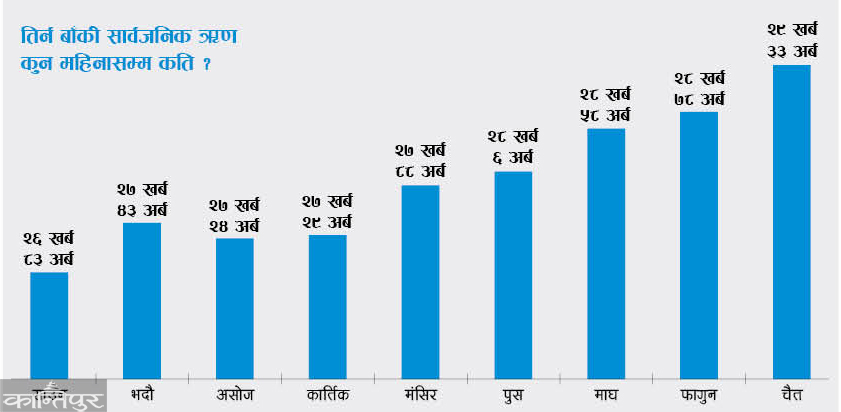
In the nine months of the current fiscal year (from Shrawan to Chait), more than 2.5 trillion rupees of public debt has been added. According to the Public Debt Management Office, public debt in Nepal reached 2933.79 billion rupees as of last Chaitra. This is 259.74 billion rupees more than the public debt outstanding in last Ashar. The government debt outstanding in last Ashar was 2674.04 billion rupees. The total government debt outstanding by the government as of Chaitra is equivalent to 48.04 percent of the gross domestic product (GDP). The National Statistics Office has projected that GDP will reach 6107 billion rupees in the current fiscal year. The total public debt includes 47.31 percent domestic or 1388 billion rupees and 52.69 percent foreign or 1545 billion rupees. As the Nepalese rupee continues to weaken, additional burden is being added to public debt every month. - Gopi Prasad Koirala, Chief, Public Debt Management Office
Economists say that the continuously increasing public debt poses risks. In the fiscal year 2080/81 and the previous fiscal year, the allocation under the heading of financial management exceeded the size of capital expenditure. However, this is not the case in the current fiscal year. However, experts say that this situation is the result of continuous growth in internal and external debt.
Similarly, in the last 9 months, the government has collected public debt of Rs 348.15 billion. This is 58.45 percent of the annual target. In this, the share of internal and external debt collection is 78.36 and 27.60 percent respectively. This year, the government had targeted to mobilize public debt of Rs 595 billion. With the increasing debt repayment obligation, the gap between the level of capital expenditure and the budget allocated for financial management is widening, which risks shrinking the government's ability to invest in the future. Economists say that there is also a risk of fiscal imbalance.
Similarly, till last Chaitra, the government has spent Rs 258.44 billion for principal and interest payments on the debt. This is 62.88 percent of the annual target. The total debt service expenditure as of Falgun is 4.23 percent of the gross domestic product. This year, the government has allocated Rs 411.1 billion for debt principal and interest payments. Of the total amount paid by the government until Falgun, Rs 244.16 billion has been spent on principal and the remaining Rs 54.27 billion on interest.
The amount used for interest payments on public debt is included in current expenditure. Therefore, Rs 244.16 billion spent on principal payments is deducted from the Rs 348.15 billion raised during the period. The additional burden of Rs 259.74 billion due to changes in foreign exchange rates is added to the amount received in this way. In this way, more than Rs 2.5 trillion has been added to public debt in the last nine months.

