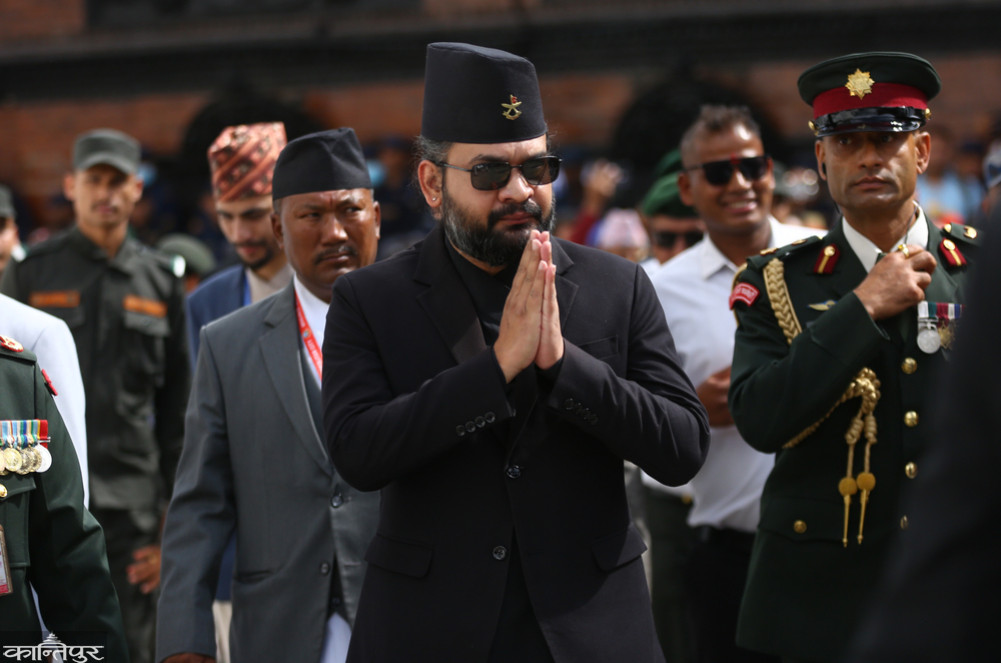
The draft National Commitment Letter mainly covers the reform of the overall economy, including agriculture, tourism, infrastructure, energy, minerals, cooperatives, and microfinance.
We use Google Cloud Translation Services. Google requires we provide the following disclaimer relating to use of this service:
This service may contain translations powered by Google. Google disclaims all warranties related to the translations, expressed or implied, including any warranties of accuracy, reliability, and any implied warranties of merchantability, fitness for a particular purpose, and noninfringement.
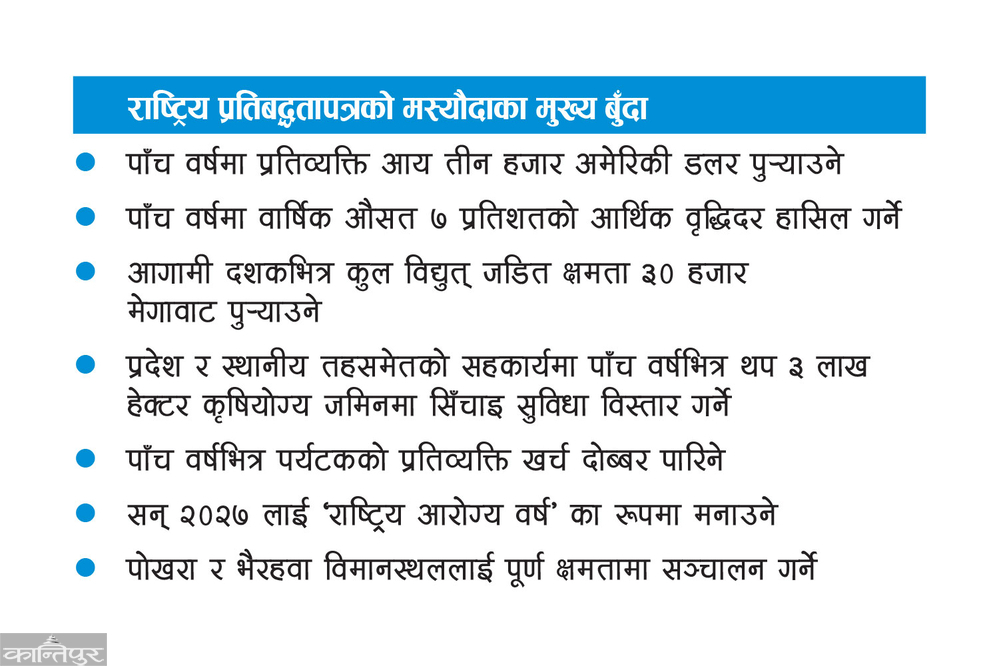
The government has made public a draft of a commitment letter with an ambitious goal of creating 1.5 million new jobs within five years and taking the country's economy to $1 trillion. The draft, made public on Monday, also aims to achieve an average economic growth rate of 7 percent in the next five years and increase the per capita income of Nepalis to $3,000. This will also qualify Nepal as a middle-income country, the draft said.
The draft mainly covers the reform of the overall economy, including agriculture, tourism, infrastructure, energy, minerals, cooperatives and microfinance. The draft also states that an industry-friendly business environment will be created by ending 'rent-seeking', policy exploitation, cartelization, unhealthy competition and artificial scarcity in the market and encouraging innovation, entrepreneurship and healthy competition. The draft says that business protection, a fearless environment for investment will be created to mobilize the private sector as the main driver of national prosperity, innovation based on public-private partnership, and inclusive economic policies will be adopted.
 The draft commitment states that the country will be upgraded to a middle-income economy by utilizing Nepal's youth-centric demographic dividend as an economic transformation towards stability and reform in the economic sector. It is stated that the foundation for overall development will be prepared by balancing equitable redistribution of national income through rescue economic policies, public education, health, transportation, housing and social security to promote private sector dynamism, innovation and creativity. Similarly, the draft commitment also includes the formulation of national and sectoral policies for national capital formation, job creation, export growth and macroeconomic stability by establishing a national consensus among major political parties on the economic agenda for a certain period of time for economic transformation.
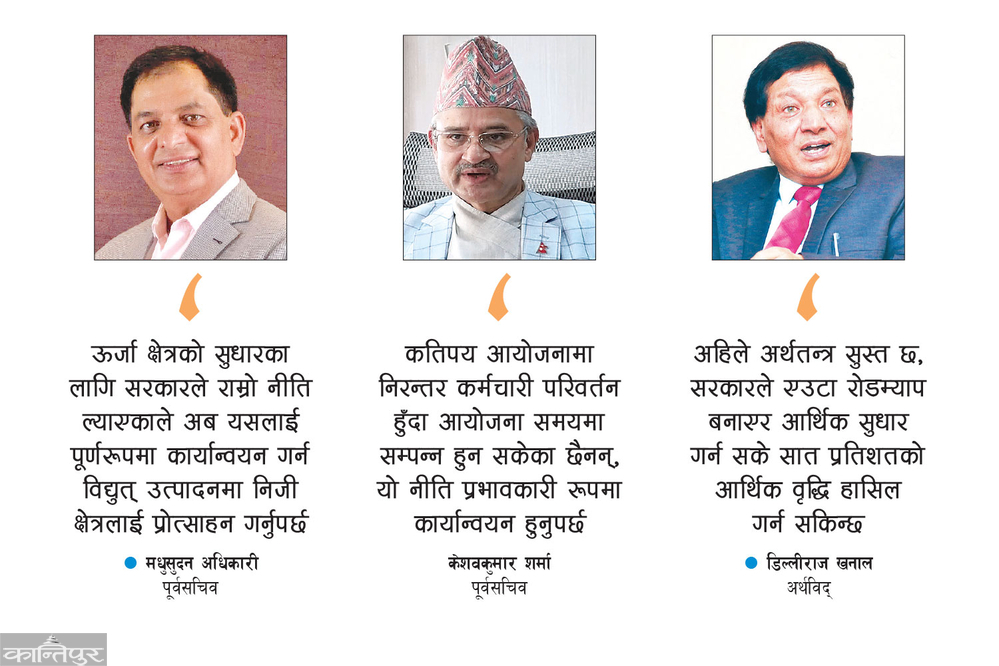
Economists and former secretaries say that although the economic goals included in the draft commitment are good to hear and read, they are challenging to achieve. They also say that if implemented, many problems in the economy will be solved and economic activities will become dynamic.
Economist Dilliraj Khanal argues that the economic targets set by the government with a new mandate should be taken positively. ‘The good things included in the manifestos and pledges of other political parties have been included in the national commitment letter by the Rashtriya Swayamsevak Sangh (RSS) by making commitments,’ he said, ‘This is the beginning of a positive and new culture.’ Khanal said that this step by a strong government with a close to two-thirds majority has further ensured accountability when no government has addressed the manifestos of other political parties in the past. ‘When there is transparency in everything, responsibility and accountability increase in implementing it,’ he said, ‘It is necessary to first reconsider what is in the current system in terms of taxes.’
Similarly, the draft commitment letter states that the digital economy will be developed as a key area for economic growth, high productivity, and quality employment creation. The government is committed to providing legal guarantees with stability so that tax rates and terms remain stable for ten years. ‘A simplified digital system will be implemented to make all processes from industry registration to renewal paperless and hassle-free,’ the draft states, ‘Economic and social inequality will be reduced to 10 percent in five years through a balanced and complementary development model between the private, cooperative and public sectors.’
The draft also mentions that financial transparency, money laundering control, regulatory reforms in line with international standards and effective implementation will be implemented to free Nepal from the FATF’s ‘grey list.’ The government is preparing to formulate a time-bound action plan to remove the country from the ‘grey list’ within the specified time. The government is committed to increasing the attraction of small, domestic and foreign institutional investors in the capital market.
‘The economy is currently sluggish, if the government can move forward by creating a roadmap, an economic growth of seven percent can be achieved,’ Khanal said, ‘Even with an economic growth of seven percent, per capita income cannot reach $3,000 in five years. To do this, a growth rate of 11/12 percent is required, which is challenging.’
The government has also made public a plan to open a chemical fertilizer factory in collaboration with the private sector. The government has stated that it will arrange for electricity supply by opening a fertilizer factory. Similarly, the commitment is also mentioned in the commitment to ensure quality agricultural products and markets by providing advanced indigenous and nutritious seeds, including local varieties. Similarly, the government has also stated that it will update the data on chemical fertilizer requirements and create a procurement calendar on that basis to improve the chaos in purchase, sale and distribution.
The government has also expressed a commitment to provide Kisan Credit Cards, insurance and concessional loans to make it respectable and secure by developing the psychology that agriculture is the main profession and work. Similarly, the government has stated that it will provide subsidies, loans, service facilities and social security only to genuine farmers based on the contribution-based farmer pension and farmer identity card.
The commitment is that irrigation projects of national pride will be completed on time to expand irrigation facilities to an additional 300,000 hectares of arable land within five years in collaboration with the provincial and local levels. Similarly, the government has stated that the number of tourists entering Nepal and the average stay will be increased, and per capita expenditure will be doubled within five years, creating the basis for quality tourism. For this, a new 'ecosystem' will be created by connecting nature, culture and community to diversify tourism. It is stated that health tourism will be developed by celebrating 2027 as the 'National Health Year' with various programs in collaboration with the provincial government, local levels, private sector and community.
The government has included in its plan to operate hotels, resorts, adventure services and eco-tourism in public-private partnerships. The Civil Aviation Authority of Nepal will be developed into two autonomous bodies, namely a service provider and a regulator, and air safety will be strengthened. It is stated that Pokhara and Bhairahawa airports will be operated at full capacity and direct flights will be operated from major cities of the world.
Similarly, the government has set a target of increasing the total installed capacity of electricity to 30,000 MW within the next decade. To achieve this goal, the government is also committed to amending laws and policy reforms, including land, forest and environment. ‘The government will provide viability gap funding to the construction of large reservoir and semi-reservoir projects such as Budhi Gandaki and Dudhkoshi,’ the commitment states. ‘Along with power generation, private sector-friendly policy and legal arrangements will be made to encourage private sector participation in storage, transmission and distribution systems.’
It is stated that the government itself will make arrangements to increase electricity consumption and expand transmission lines to industries. Energy trade will be conducted with neighboring countries India and Bangladesh by strengthening bilateral and regional cooperation through energy diplomacy. The government has stated that the state will increase investment in clean energy production, transmission and distribution systems to develop Nepal as a hub for clean energy exports in South Asia.
Former Secretary Madhusudan Adhikari said that positive results would be achieved if the concept made public by the government on energy reform is implemented. ‘It is necessary to encourage the private sector in power generation, for this, private sector investment should be increased,’ he said, ‘the government should play a facilitating and regulatory role in this.’
Similarly, a plan has been put forward to develop an investment model based on public-private partnership by formulating investment-friendly mining policies and laws through the draft commitment letter. In addition, the commitment letter mentions that a Mining and Minerals Authority will be established for the overall regulation and effectiveness monitoring of construction-oriented material excavation, production, supply and use.
 It is also stated that inter-agency coordination will be made mandatory in project classification and project implementation towards infrastructure. ‘In order to ensure quality work on time, arrangements will be made not to transfer project heads and employees until the project is completed. "A result-oriented, time-bound action plan will be prepared and implemented for projects of national pride," the draft states, "The trend of allocating budgets for development projects based on accessibility rather than study, need, priority and resource management will be ended, and only priority-based, result-oriented and national development-oriented projects will be implemented." The commitment letter states that infrastructure such as highways, waterways, airports, etc. will be developed as an integrated multimodal transport system by linking them. The commitment letter also states that the 'Mahendra' highway will be upgraded to international highway standards within three years.
Former Secretary Keshav Kumar Sharma said that although the plans made public by the government are good in themselves, they depend on implementation. "The plan not to transfer employees until the project is completed is absolutely right. In some projects, employees are transferred without understanding about it. When there is a problem in the project, employees tend to request transfer themselves. It is good to end such problems," he said. "That is why employees were not transferred until the project is completed." He said that there is a tendency to place road plans even in areas with low vehicle traffic, so it is necessary to discourage this.
To ensure that people can work for foreign companies, agencies or employers while staying in Nepal, legal and policy amendments will be made to promote remote work, digital employment and cross-border service exports. The government is committed to creating more employment opportunities by making policy reforms in priority sectors (information technology, construction, tourism, commercial, agriculture, etc.).
Technical human resources in the fields of doctors, nurses, engineers, agriculture, forestry, information technology, etc. will be motivated to stay in the country and do employment and business. A labor skill development program will be launched by researching and documenting the needs and availability of labor through the local level. The government has stated that 1.5 million jobs will be created in five years by making employment a permanent basis, not a temporary relief.
The government has stated that compulsory labor will be made possible by connecting everyone with labor culture. Along with the rural employment program, a job fair will be organized to create employment for the private sector. The draft also mentions implementing a comprehensive labor market reform program to end fraud, wage arrears, and labor exploitation to make the labor market safe, dignified, and just. The government has stated that the skills, knowledge, and experience of Nepalis living abroad will be used as 'brain gain'. The government is committed to providing engineering consulting and technical assistance to convert remittances received from foreign employment into safe investments.