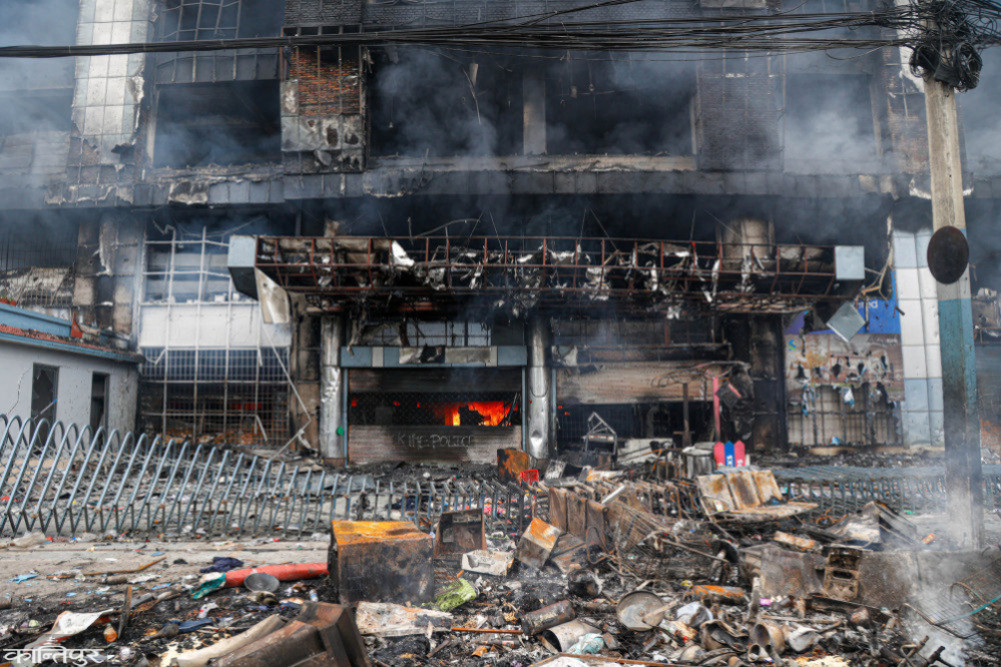
Sufficient liquidity for investment, record foreign exchange reserves, a healthy balance of payments and current account, low interest rates, and increased remittances have created opportunities for the new government.
We use Google Cloud Translation Services. Google requires we provide the following disclaimer relating to use of this service:
This service may contain translations powered by Google. Google disclaims all warranties related to the translations, expressed or implied, including any warranties of accuracy, reliability, and any implied warranties of merchantability, fitness for a particular purpose, and noninfringement.
Last year was not a happy one for the Nepali economy. On 10 Falgun 2081, the international organization Financial Action Task Force (FATF) put Nepal on the 'Grey List' for the second time. The loanable amount accumulated in banks since three years ago did not decrease this year either, but increased significantly.
Although there were signs of improvement in the economy since the beginning of the current fiscal year, the protests of 23 Bhadau and 24 Bhadau posed a major obstacle. Despite years of political changes, federal restructuring, and repeated assurances, there was no improvement in issues related to good governance, forcing the youth to take to the streets.
Looking at the events of 24 Bhadau, there is government data showing damage caused by the protests in 262 municipalities in 54 districts of all seven provinces. According to this, 20 people died on 23 Bhadau, 37 on 24, and an additional 20 in the following days. The protests caused damage to physical infrastructure worth about 84.45 billion rupees.
The movement has caused damage to private sector businesses and private household buildings, including physical property. According to government data, a total of 33.5487 billion rupees have been damaged, including 27.49 billion rupees in private businesses and 6.584 billion rupees in private households. Of this, 45.5 percent (15.287 billion rupees) were damaged in buildings and houses, 5.5 percent (1.851 billion rupees) in vehicles, and the rest was damage to other property.
The lack of employment-based education, the inability of marginalized people in society to get jobs according to their qualifications despite higher education, the inability of marginalized people in society to be integrated into the mainstream of development, and the appointment of only relatives and close associates of the leadership in political appointments have disrupted good governance in the country. Rising unemployment, the compulsion to go abroad for employment, low income, low wages even in areas where there is employment, economic instability, and the lack of inclusive development systems are also reasons for the movement. However, sufficient liquidity for investment, the highest ever foreign exchange reserves, balance of payments and current account surplus, low interest rates and increased remittances are opportunities for the new government.
Limited entrepreneurship opportunities and increasing economic inequality have also increased dissatisfaction among the youth. The interim government after the Gen-G movement, the election on 21 Falgun and the new government with the franchise of the Rashtriya Swayamsevak Sangh (RSS) in the elections have been formed. An attempt has been made to analyze the state of the economy last year.
The time given by FATF to Nepal to escape from the 'Grey List' is now about one year away. On Falgun 9 (February 2025), when Nepal was placed on the 'Grey List', the FATF had prepared an action plan. Nepal can easily get out of the list if it can do the specified work within the specified time. Nepal has been given two years to get out of the 'Grey List'. Although an action plan has been prepared for that, the implementation has not been effective, according to the FATF. However, since the main reason for the Gen-G movement is a campaign against corruption, a positive message has been sent internationally with the formation of the new government.
The study report titled ‘Understanding the Gen-G Movement: Root Cause, Reality and Roadmap for a Strong Nepal’ conducted by the Central Department of Economics of Tribhuvan University has shown that the movement was against corruption, misgovernance, lack of economic opportunities, social injustice and institutional failure. The study concludes that the movement is not a momentary anger of the youth but a collective and structural reaction against corruption, misgovernance, lack of economic opportunities, social injustice and institutional failure. Even if it works according to the action plan for about a year, Nepal is likely to be removed from the grey list on time.
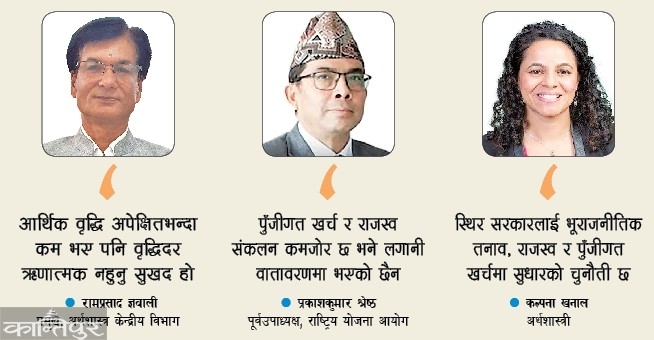
Former Vice Chairman of the National Planning Commission Prakash Kumar Shrestha said that the economy has seen a mixed trend in the past one year. ‘Compared to Chaitra 2081, the economy has neither deteriorated much nor has there been the expected improvement. In terms of economic growth, it has shrunk even more,’ he said, ‘Under normal circumstances, there was a possibility of economic growth of more than five percent. That too has shrunk. The Asian Development Bank and the World Bank have projected a contraction in economic growth. Our estimate is also only three and a half to four percent.'
He also said that no new jobs have been created in a year. 'Capital expenditure and revenue collection seem to be the weakest,' Shrestha said, 'There is more liquidity in banks and financial institutions, so there is a challenge to increase investment and expand credit.' However, he said that there is more potential in sectors such as hydropower, tourism, mining, agriculture, information technology, etc.
Ram Prasad Gyawali, head of the Central Department of Economics at Tribhuvan University, argues that it is good that even though the economic growth rate has shrunk, it has remained positive and not negative. 'Economic growth is expected to be lower than expected, but the growth rate is not negative,' he said, 'There is a two-thirds government, now the economic policy will be stable. Investor confidence will increase.'
Remittances at a high level
From last Shrawan to Falgun, Nepal received remittances worth Rs 1449 billion. Compared to the eight months of the last fiscal year, remittance inflows have increased by 37.7 percent during the same period of this year. Till Falgun 2081, Rs 1052 billion had been received. Till Chait 2081, Rs 1191 billion 311 crore had been received.
Foreign exchange reserves exceed Rs 34 trillion
As of last Falgun, foreign exchange reserves have increased by 27.5 percent to Rs 3413 billion 770 million. Compared to last Ashar, it was Rs 2677 billion 680 million. Until Chait 2081, such reserves were Rs 2426 billion 840 million.
It seems that about Rs 1000 billion of foreign exchange reserves have been added in a period of one year. Based on imports up to eight months of the fiscal year 2082/83, the foreign exchange reserves of the banking sector are sufficient to cover 21.4 months of goods imports and 18.5 months of goods and services imports, the National Bank claims. The National Bank has set a target of maintaining foreign exchange reserves sufficient to cover at least six months of imports this year.
Balance of payments surplus 658 billion
As of last Falgun, the balance of payments position is in surplus by 658 billion.35 crore. In the same period last year, the balance of payments position was in surplus by 310 billion.37 crore. However, as of 2081 Chaitra, the balance of payments position was in surplus by 346 billion.23 crore. In one year, the balance of payments surplus has increased by about 3 trillion. As of last Falgun, the current account is in surplus by 552 billion.85 crore. As of 2081 Chaitra, it was in surplus by 210 billion.22 crore. In the last eight months, 10 billion.84 billion foreign direct investment (equity only) has entered Nepal. As of Chaitra last year, there was only Rs 8.46 billion in direct foreign investment (equity only).
Although we are proud of the continuously increasing remittance inflow, the conflict in West Asia has the potential to drastically reduce it, Gyawali said. ‘What if remittances stop coming from the Gulf and a large number of Nepalis return?’ He countered, ‘Petroleum products will have to be gradually replaced by electricity. Investment will have to be expanded by increasing the confidence of the private sector. The investment ratio in GDP is the weakest ever, how can we increase capital expenditure?’ The confidence of the private sector is at its weakest point in history. However, the private sector has not allowed its confidence to waver. It is starting to get worse.
Foreign exchange reserves are at their highest point in history. Until a month ago, remittance inflows were also very good, the balance of payments position and current account were also in surplus, so external indicators are strong. However, revenue collection has not increased as expected, and the impact of the conflict in West Asia has already reached the Nepali market.
1.22 trillion rupees more liquidity in banks
The accumulation of money in banks has continued this year as well. Accordingly, 1.22 trillion rupees (excess liquidity) have been accumulated in banks and financial institutions as of last week. Liquidity has been accumulating in banks for about three years. The increase in remittances in recent days has accelerated the accumulation of money in banks. There was excess liquidity of about 10 trillion rupees in Chaitra 2081. This year, deposits have increased by 6.6 percent and loans by 4.4 percent. Until Chaitra 2081, deposits had increased by 5.7 percent and loans by 7.1 percent.
Stock market
The NEPSE index, which was at 2,662.08 points in mid-Chaitra 2081, reached 2,833.60 in Chaitra 2082. There have been many policy reforms in the stock market in one year. Along with stock investors, not only investments in demat accounts and IPOs, but also the number of active investors in the secondary market has increased. The size of the stock market, which was Rs 4.425 trillion in Chaitra 2081, has reached Rs 4.832 trillion by mid-Chaitra this year.
Unprecedented price increase
The consumer price inflation rate (inflation) in Falgun 2082 is 3.62 percent. During that period, the inflation rate in the food and beverage group is 3.60 percent, while the inflation rate in the non-food and service group is 3.63 percent.
In Chaitra 2081, such inflation was 3.39 percent. During that period, the inflation rate in the food and beverage group is 2.45 percent and the inflation rate in the non-food and service group is 3.90 percent. ‘Especially due to the war in West Asia, the life of Nepalis is in a state of chaos due to the shortage of petroleum products. "Fee in the transport sector has increased by 16 to 24 percent. The contribution of the transport sector to the consumer price index is about 6 percent," said Gyawali, head of the Central Department of Economics at Tribhuvan University. "More than one percent of inflation is expected to come from the transport sector. Along with this, transportation costs have also increased in agriculture, exports and other sectors."
Government Finance
As of 30 Chaitra 2082, the government has spent Rs 93.13 billion 5.6 million on capital expenditure. This is 22.83 percent of the annual target. As of mid-Chaitra 2081, the government had spent Rs 100.14 billion 95 million or 28.8 percent of capital expenditure. Till Chaitra this year, the government has collected Rs 867.47 billion in revenue, or 58.61 percent of the annual target. While Rs 821.67 billion or 57.89 percent of revenue was collected till Chaitra 2081. As of Chaitra 2082, the government has received Rs 14.72 billion 3.2 million in grants. A grant of Rs 14.268 billion was received by Chaitra 2081.
Challenges and prospects
It has been analyzed that remittances coming to Nepal are also at risk after the war in West Asia disrupted the economy there. However, experts say that the impact of the war has not been seen on the remittance inflow up to Falgun.
It is estimated that almost half of the total remittances coming to Nepal will be affected after the Israel-Iran war affected many countries in West Asia. The war began in this region on February 28, 2026. It has been analyzed that the war disrupted the economy there and remittances coming to Nepal are also at risk. However, experts say that the impact of the war has not been seen on the remittance inflow up to Falgun.
If the ongoing tension in West Asia continues, more Nepalis will not be able to go abroad and even after those who have gone, there may be a double problem in the Nepalese economy. Currently, about 40 to 45 percent of the remittances coming to Nepal come from West Asia. Even if we assume that the average monthly remittance is Rs 1.5 trillion, it is estimated that around Rs 60/65 billion in remittances may be affected.
Economist Kalpana Khanal said that despite the challenges, there are ample opportunities in the economy due to the changing political environment. ‘There are signs of political stability in the country. This means that policies and regulations can be changed and implemented in a timely manner,’ she said. ‘Even if there is a stable government, the leadership of government bodies, institutions, and regulatory bodies seems to be stable. This makes implementation much easier.’ She said that the challenges facing the economy are increased liquidity, geopolitical situation, revenue collection, and increasing capital expenditure.
Currently, there are around 1.9 million Nepali workers in the Gulf region. Out of the 700,000 Nepalis who go abroad for employment every year, around 65 percent, or 450,000, go to the Gulf countries alone. After the US and Israel attacked Iran, Iran has been retaliating repeatedly, targeting US military camps in the Gulf countries.
In the fiscal year 2081/82, 17 trillion 2 billion remittances were received. Of this, the share of the Gulf countries was 6 trillion 73 billion. In the last Falgun, remittances in US dollars increased by 31 percent to 10 billion 150 million. In the fiscal year 2081/82, 17 trillion 2 billion remittances were received. Of this, the share of the Gulf countries was 6 trillion 73 billion.
Balendra Shah became the 40th Prime Minister of Nepal on Friday after the Rashtriya Swayamsevak Sangh (RSS) party received close to two-thirds of the votes. The Finance Minister in this majority government is economist Swarnim Wagle. The RSSP has set a target in its manifesto of an average economic growth of 7 percent (at constant prices) in five years, per capita income of more than 3 thousand US dollars, and the size of the economy close to 100 trillion. The role of the Ministry of Finance is important in achieving these goals. The implementation of the manifesto, such as reducing the burden of all taxes, not imposing ghost taxes, and setting the income tax limit based on family burden, is not easy.
However, Finance Minister Wagle has said that a policy will be adopted to solve the problems seen in the economy as a whole, not piecemeal, and that systemic reforms will be carried out by removing discretionary powers, implementing the recommendations of the Public Expenditure Review Commission, increasing domestic production, creating jobs, and preparing a transformative budget will be prioritized.
Although some indicators, including foreign exchange reserves and the balance of payments, are strong, Wagle has become the Finance Minister at a time when the situation of revenue collection, capital expenditure, and foreign grants is critical. Experts argue that the challenge before him is to bring the economy back on track by increasing revenue collection and capital expenditure and controlling current expenditure at a time when policy corruption, financial mismanagement, revenue leakage, and procrastination are rampant.