While neighboring countries India and China have rolled out 5G nationwide and many countries around the world are moving forward with the commercial use of 5G technology, this technology is still in the testing phase in Nepal.
We use Google Cloud Translation Services. Google requires we provide the following disclaimer relating to use of this service:
This service may contain translations powered by Google. Google disclaims all warranties related to the translations, expressed or implied, including any warranties of accuracy, reliability, and any implied warranties of merchantability, fitness for a particular purpose, and noninfringement.
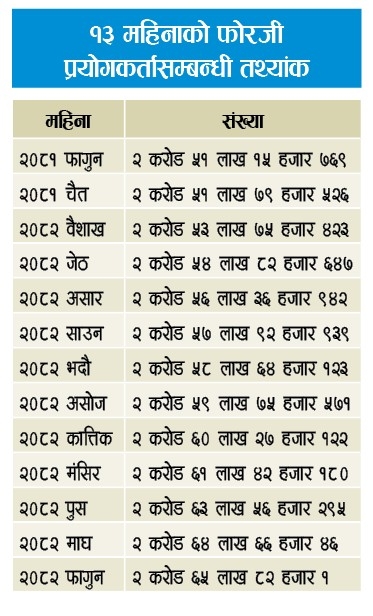
The number of 4G users as the main means of internet service in Nepal is continuously increasing. The number of 4G internet users on mobile is increasing by an average of 122,186 per month. According to the data of the Nepal Telecommunication Authority, the total number of broadband subscribers in Nepal has reached 38.28615, and about 86.24 percent use 4G. When 3G is also added, mobile broadband users account for 93.84 percent of the total population.
In 2081 Falgun, the number of 4G users in Nepal was 25.115769. In a span of one year, i.e. by 2082 Falgun, this number has increased to 26.58211. During this period, about 1.466 million new customers have been added to 4G service. After 4G, fiber internet (FTTH) is the second largest internet medium. But its share in the total broadband is only 11.12 percent. By 2082 Falgun, the number of customers using fiber internet has reached 3.427 million 497.
A total of 376 thousand 809 new customers have been added to fiber internet service in one year. In 2081 Falgun, private sector internet service providers had 2.728 million 98 customers, while in 2082 Falgun, this number reached 3.077 million 484. In one year, the private sector added 349 thousand 386 new customers. The number of fiber internet service users of government-owned Nepal Telecom has reached 350 thousand 13 by 2082 Falgun. The company has added 27 thousand 423 new customers in one year.
The share of 3G service under mobile broadband is shrinking. Both Nepal Telecom and Ncell have announced that they will discontinue 3G. Its share in total broadband users is about 2.55 percent. As of mid-Falgun, the number of 3G users is 786 thousand 292. The share of wireless fixed internet is very low, at only 0.11 percent. Its number of subscribers is 32,528. Nepal Telecom's ADSL/cable technology based on copper wires is almost on the verge of being replaced. There are currently 297 ADSL customers left across the country.
While neighboring countries India and China have made 5G nationwide and many countries around the world are moving forward with the commercial use of 5G technology, this technology is still in a testing and stalled state in Nepal. Although the government gave permission to Nepal Telecom to test 5G four years ago and it is said that it even tested it for some time, the company has not made its report public.
The new government has prioritized the expansion of 4G and its quality. The 10-point reform plan made public by the Ministry of Communications and Information Technology mentions that policy arrangements will be made to provide additional frequencies to improve the quality of 4G services within 30 days. While both service providers, Nepal Telecom and Ncell, are claiming to have reached 4G in most districts of the country, the government has once again talked about its expansion and frequency.
The regulatory Telecommunication Authority has not made any new announcements on frequency distribution for the past 6 years. In such a situation, consumers are not confident that this priority of the government will improve services. Even though 4G has reached the area, questions have been raised about its speed and quality. Even though 4G has been expanded in many places, consumers complain that the data speed is slow. ‘Since Ncell is not available in our village, I have been buying NTC packages for the village,’ says Nissan Tamang of Jyangdin-9, Solududhkund Municipality in Solukhumbu. ‘When I went to the village last Dashain and Mangsir, my Ncell pack was wasted, Ncell is not available in the village. I have taken two SIMs because Ncell does not work somewhere, NTC does not work somewhere, I have to use whatever works.'
Nissan's experience is one of the various reasons why mobile phone penetration in Nepal is higher than the population. According to the 2078 BS census, the population of Nepal is 29.164 million, while the number of mobile SIM card subscribers has reached more than 39.66 million, according to the NEA's own data. The density of mobile services has reached 103.19 percent.
Experts point out that this number is higher due to the tendency of a single person to use two or more SIMs. In terms of market share, Nepal Telecom is in the lead with 53.33 percent, while Ncell's share is 46.66 percent. In mobile internet, Nepal Telecom's share is 55.66 percent, while Ncell's is 44.34 percent.
2082 BS was the year of 4G and fiber internet for Nepal's digital infrastructure. As 3G services are gradually becoming obsolete, the future belongs to 4G and 5G. It seems necessary for the government and service providers to focus not only on expanding access but also on the quality of service. If 5G is not prioritized and the quality of 4G is not improved, Nepal risks falling behind in technology.

