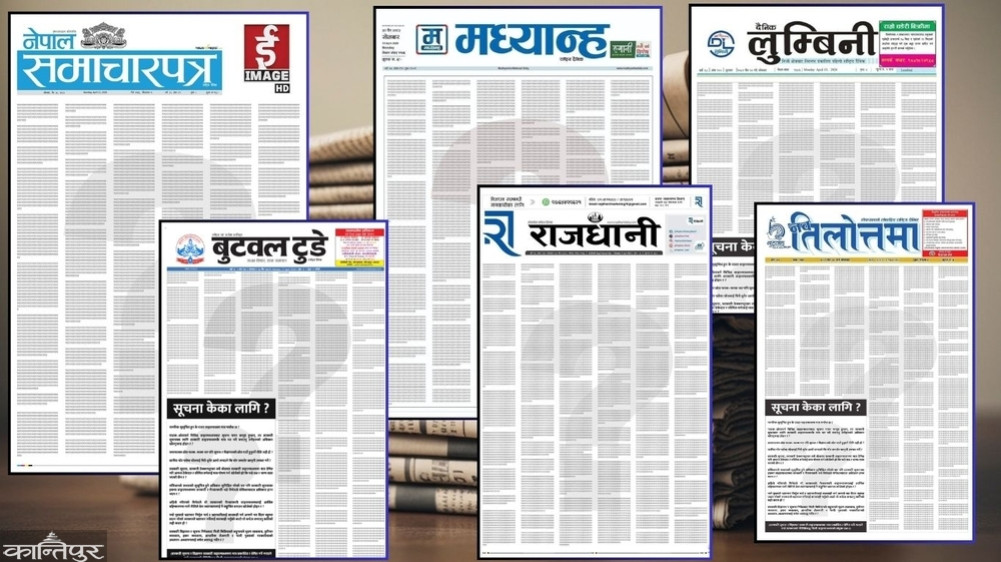
After the government directed that its information and advertisements be placed only in government media, non-government newspapers across the country have expressed symbolic protest by placing a large question mark on the front page of Chaitra 30.
We use Google Cloud Translation Services. Google requires we provide the following disclaimer relating to use of this service:
This service may contain translations powered by Google. Google disclaims all warranties related to the translations, expressed or implied, including any warranties of accuracy, reliability, and any implied warranties of merchantability, fitness for a particular purpose, and noninfringement.
Dozens of non-governmental print media outlets on Monday staged a symbolic protest nationwide against the government's decision to publish/broadcast government advertisements and information only on government-owned media outlets. Dozens of national and regional dailies published on Chaitra 30 expressed their dissatisfaction with the government's move by placing a large question mark on their front pages. They have symbolically protested by putting question marks instead of letters in all paragraphs on the front pages.
Dozens of newspapers across the country, including Nepal Samacharpatra, Rajdhani, Madhyahan, Dainik Lumbini, Butwal Today, Dainik Patra, Mechikali Sandesh, and Nav Kshitij, have expressed such symbolic protest in today's issue. Nepal Samacharpatra has published an open letter addressing the Prime Minister.
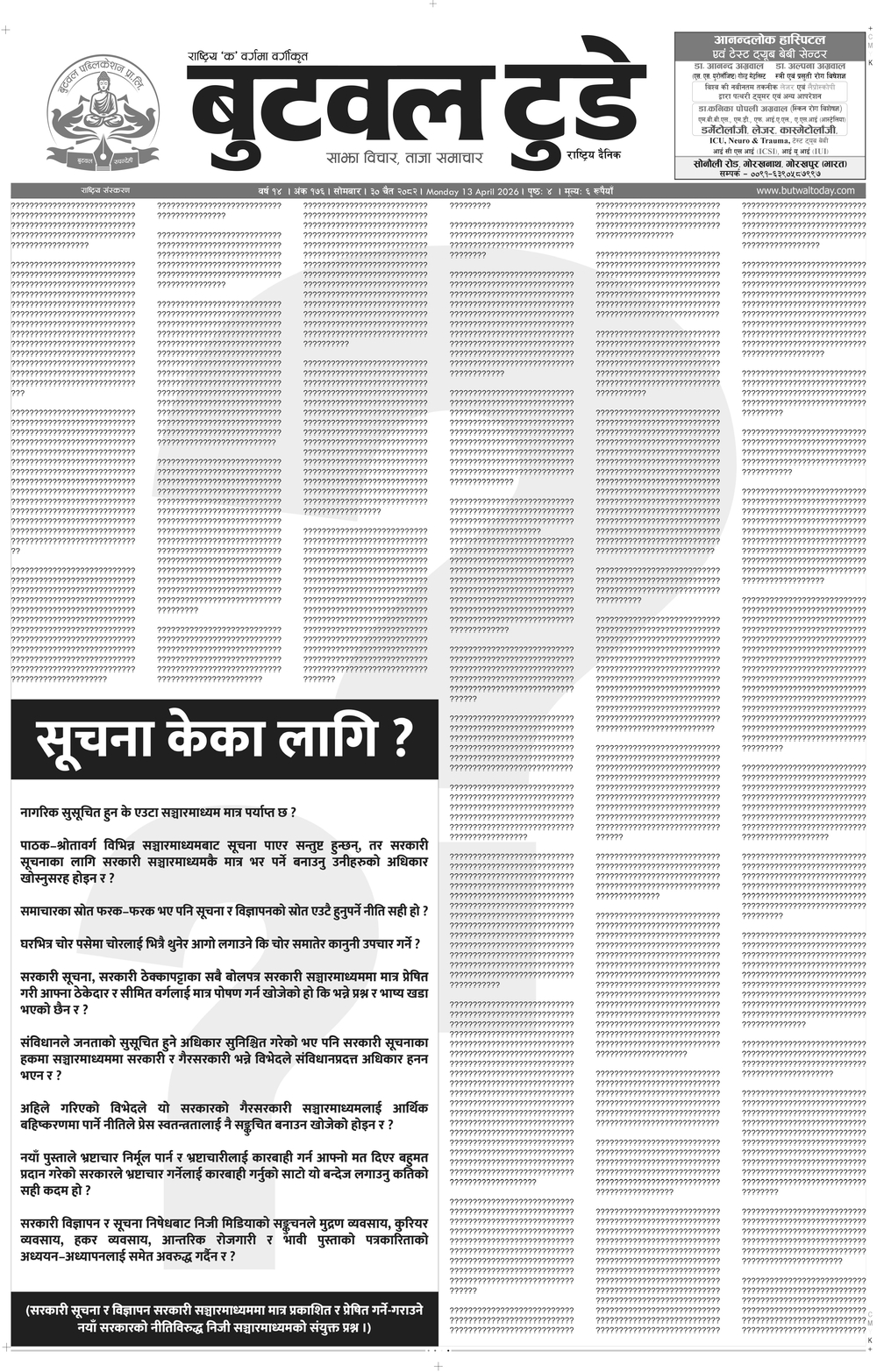
The Office of the Prime Minister and Council of Ministers issued a circular on Chaitra 18, directing that public body information be provided only to Gorkhapatra, Radio Nepal and Nepal Television. The circular states that the government has taken this decision to maintain economy in government expenditure, bring uniformity and transparency in the publication/broadcast of advertisements and information, and promote government-owned media. However, private sector media have called it an attack on press freedom and the right of citizens to be informed. The newspapers that have come out in protest have asked, ‘What is information for?’ They have asked, ‘Is only one media outlet sufficient for citizens to be informed?’ At a time when readers and listeners are satisfied with receiving information from various media outlets, relying solely on government media outlets for government information is tantamount to taking away their rights, according to non-governmental media outlets. Newspapers have criticized the government's policy of having different sources of news but the same source of information and advertising.
Small and medium media outlets hit by government advertising cuts

The print media outlets that have come out in protest have expressed doubts about the government's intentions. They wrote, "Hasn't the question and commentary arisen that by sending all government information and bids for government contracts only to government media outlets, it is an attempt to feed only its contractors and a limited group?"
They claim that discriminating between government and non-government sources in the case of government information is a violation of constitutional rights when the constitution ensures the right of the people to be informed. Concerns have been expressed that this decision will financially boycott non-government media outlets and curtail press freedom.
‘Will the contraction of private media from the government advertising and information sector not hinder the printing business, courier business, hawker business, internal employment and even the study and teaching of journalism for the future generation?’ They have asked, ‘If a thief enters a house, should we lock the thief inside and set him on fire or catch the thief and take legal action? Is it the right step for the government, which has given the majority vote to eradicate corruption and take action against the corrupt, to impose this restriction instead of taking action against the corrupt?’
According to the data of the regulatory Nepal Advertisement Board, the size of government advertising is 10.39 billion 16 million. After the media gives exemptions from it, the size of advertising is 4.84 billion 43 million. According to the board, advertisements worth 1 billion rupees used to go directly to Gorkhapatra. Although advertisements worth about 3.84 billion rupees were published in other media, non-governmental media outlets were earning only 50 to 60 million rupees annually.
The remaining approximately
3.25 billion will be 'lost in the middle' or corruption, according to media operators. Although they have been demanding an end to this distortion, dissatisfaction is being expressed saying that the government has adopted a policy of banning advertising.