The ADB has stated that economic growth will slow in 2026, job creation will be challenging, and remittances and exports may decline.
We use Google Cloud Translation Services. Google requires we provide the following disclaimer relating to use of this service:
This service may contain translations powered by Google. Google disclaims all warranties related to the translations, expressed or implied, including any warranties of accuracy, reliability, and any implied warranties of merchantability, fitness for a particular purpose, and noninfringement.
The Asian Development Bank (ADB) has projected Nepal's economic growth rate to shrink to 2.7 percent in 2026. The bank had estimated economic growth of 4.6 percent in the previous fiscal year 2025. The ADB believes that the economy will slow down this year due to the Gen-G uprising last Bhadra and the conflict in West Asia.
On Friday, the ADB, releasing its economic publication 'Asian Development Outlook', estimated that the inflation rate in 2026 will be around 3.7 percent, the growth rate of remittance inflows and exports will decrease, and the current account balance will be limited to 5.3 percent of the gross domestic product (GDP).
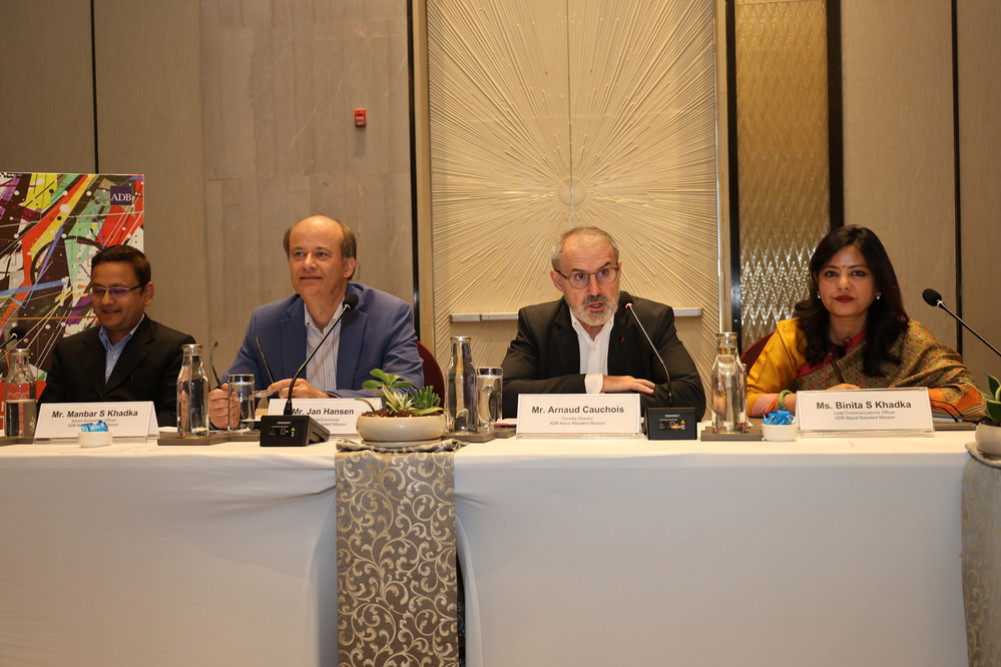
According to ADB economist Manbar Khadka, the overall economic growth is expected to fall to 2.7 percent this year due to the slowdown in the growth rate of the agriculture, industry and services sectors. “The agricultural sector is expected to grow at 2.7 percent due to the floods and decline in rice production in October,” he said. The ADB report states that the increase in fuel and transportation costs in Nepal has increased due to the tensions in West Asia caused by the US/Israel-Iran war, which has led to a rise in oil prices. The ADB believes that the war has also increased risks to Nepal’s remittance and tourism sectors. Even though the ceasefire has been declared for two weeks, if the conflict is prolonged, it is believed that the economies of the Gulf countries will weaken, reducing the demand for Nepali workers and reducing the growth rate of remittances. Nearly 40 percent of Nepal’s total remittances come from countries affiliated to the Gulf Coordination Council (GCC).
Fiscal Year 2025
| Fiscal Year 2026 | Fiscal Year 2027 | Nepal | 4.6% |
| 2.7% | 5.0% | Asia and the Pacific | 2% to 4.5% |
| 5.1% | 5.1% | ADB's projection. | Arno Koshwa, ADB's country director for Nepal, commented that Nepal's current economic structure based on remittances is not conducive to sustainable economic development. 'The private sector should be encouraged by changing the structure of the economy to create jobs for the approximately 500,000 youth who enter the labor market every day,' he said. 'It could be an opportunity for Nepal to use the skills and capital of skilled manpower returning from abroad to develop the country.' |
If political stability remains and the conflict in West Asia subsides, the ADB expects the economic growth rate to reach 5 percent again in the coming fiscal year 2027. The ADB has noted that if the 100-point reform program put forward by the government is implemented effectively, the morale of the private sector will increase. However, the ADB has pointed out that the weak capital expenditure situation and the risks of climate change remain challenges for Nepal's economic outlook.
ADB Country Director for Nepal, Koshwa, expressed confidence that political stability will support economic reform programs and increase investor and private sector confidence in the economy.
ADB Chief Economist Jan Hansen analyzed that Nepal is relatively well-positioned to weather the crisis due to low inflation, prudent monetary policy, and low public debt risks. He suggested that Nepal increase revenue collection, improve capital expenditure implementation, and facilitate foreign direct investment.