Based on government information, some businessmen have converted diesel and petrol-powered vehicles to electric ones, but are forced to keep them in workshops due to lack of approval.
We use Google Cloud Translation Services. Google requires we provide the following disclaimer relating to use of this service:
This service may contain translations powered by Google. Google disclaims all warranties related to the translations, expressed or implied, including any warranties of accuracy, reliability, and any implied warranties of merchantability, fitness for a particular purpose, and noninfringement.
The issue of converting diesel and petrol vehicles to electric vehicles has once again come under discussion. The Cabinet meeting chaired by Prime Minister Balendra Shah on Sunday decided to make the necessary legal provisions to convert diesel and petrol vehicles to electric vehicles.
It is not that there is no legal provision to convert vehicles from fuel to electricity. It is that this issue has not been implemented due to the lack of standards and procedures. On 15 Mangsir 2082, the Ministry of Physical Infrastructure and Transport issued a notification in the Gazette stating that a three-year exemption will be granted to vehicles whose fuel system is modified to be environmentally friendly or energy efficient. The government has issued a notification stating that it has decided to ‘grant exemption to vehicles whose fuel system is modified to be environmentally friendly or energy efficient’ by exercising the authority granted by Section 176 of the Vehicle and Transport Management Act, 2049, and that the restrictive clause of Section 39, Sub-section (2) of the same Act will not be applicable for three years.
Earlier, on 14 Chaitra 2078, the government had taken a policy to convert petroleum vehicles to electric ones by publishing a notice in the gazette. In the policy and program for the fiscal year 2080/81, the government had also announced that it would provide incentives for the trend of converting gas, diesel and petrol-powered vehicles to electric ones.
Even though some entrepreneurs have converted based on these government notices and announcements, they have had to park their vehicles in the workshop as they did not receive approval. The entrepreneurs had initiated the process of obtaining approval from the Department of Transport Management or the concerned Transport Management Office for the conversion as per the notice issued by the government. However, the transport offices have not been able to give approval as per the government's policy of converting petroleum vehicles to electric ones.
The offices say that they have not been able to give approval as the government has not set standards covering the blue book of converted vehicles, vehicle registration and numbering, etc. Sub-section 1 of Section 39 of the Vehicle and Transport Management Act, 2049, prohibits modifications to vehicles in such a way as to change the color, number of seats, appearance, engine or chassis of the vehicle. But in the same Sub-section 2, it is mentioned that if a change is required under Sub-section (1), the authorized officer may request approval and, if he deems it appropriate to make such a change, grant approval after conducting the necessary investigation.
 The government has also brought a policy to convert petroleum vehicles into electric ones by exercising the authority of Section 176 of the Act. Section 176 of the Act states that notwithstanding anything else written elsewhere, the Government of Nepal may grant exemptions so that no provision of this Act shall be applicable to any vehicle for a specified period.
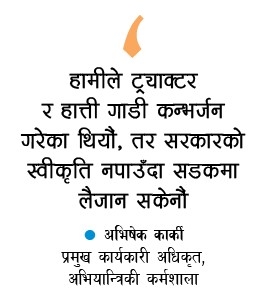
Founder and Chief Executive Officer of the Engineering Workshop, Abhishek Karki, said that the conversion procedure and standards have not been formulated and it has not been implemented. ‘Earlier, a notice had been published in the Gazette allowing conversion, but since other standards could not be formulated, it remained limited to the notice,’ he said, ‘We had also converted tractors and elephant vehicles. But we could not take it to the road without the government's approval.'
Karki said that although standards should be brought to include issues such as registration of the conversion company, permission for the company bringing the conversion goods, and what to do in the blue book after the conversion, they have not been brought yet. He said that only after the converted vehicles are allowed to run on the road can we know whether they are successful or unsuccessful. He said that the government should bring standards for conversion that are technically and financially feasible, and the next government can implement them.
Biraj Singh Thapa, an associate professor at Kathmandu University, said that hydrogen vehicles and Maruti 800 vehicles have also been successfully tested. He said that students studying at the university developed the design and converted it into an EV.
'The technology and process required for conversion are all original to the university,' he said, 'We have done the entire conversion process within the university's lab. It has been tested in all places, including uphill and downhill.'
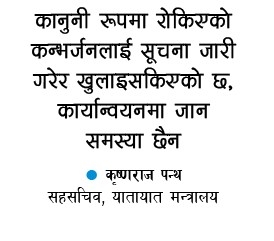 The legally blocked conversion has been opened by issuing a notice, said Krishnaraj Pantha, Joint Secretary of the Ministry of Transport. “The government had blocked the conversion legally, so we have opened it using the power of the Act,” Pantha said. He says there is no problem in implementing the decision taken by the Council of Ministers on Sunday.
He says that since the legal arrangements have been made, now the implementation can be started after discussing with the businessmen. “We are now discussing with the businessmen to come up with procedures or standards, so we will move towards implementation soon,” he said.
Vehicle conversion has also been given legal recognition in India. The Central Motor Vehicles Rules 1989 have been amended to allow the installation of electric kits in old petrol/diesel vehicles. The Government of India has made arrangements that only government-approved conversion kits can be used. It is said that after converting to electric, it must be registered again with the Regional Transport Office (RTO).
In the UK, after a vehicle is converted, it must pass an ‘Individual Vehicle Approval’ test, which is monitored by the Driver and Vehicle Licensing Agency. The European country of France also has legal provisions for conversion.

