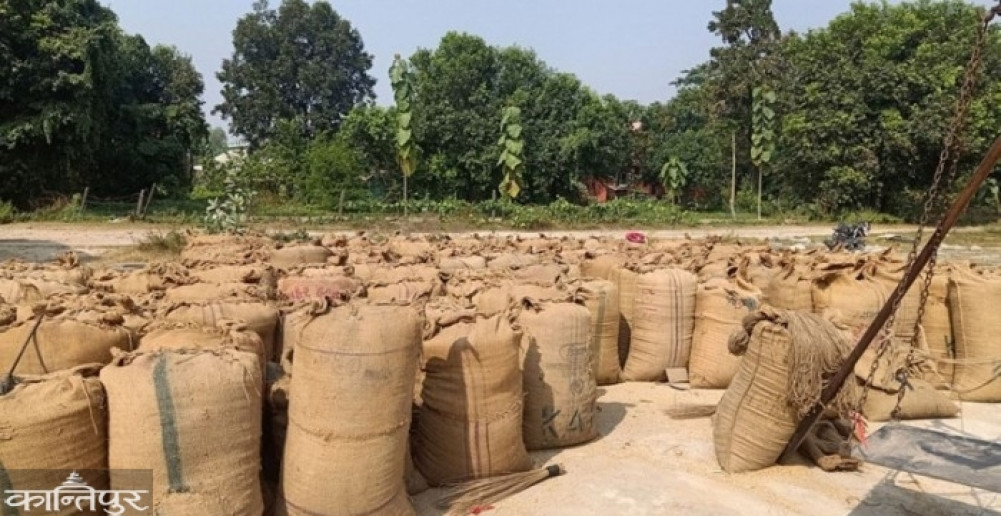
Insufficient rainfall during the main planting season (Asar-Shrawan), prolonged drought, and disruptions in the process of planting rice with fertilizers have had an impact on rice production.
We use Google Cloud Translation Services. Google requires we provide the following disclaimer relating to use of this service:
This service may contain translations powered by Google. Google disclaims all warranties related to the translations, expressed or implied, including any warranties of accuracy, reliability, and any implied warranties of merchantability, fitness for a particular purpose, and noninfringement.
Paddy production has declined this year in Madhesh, known as the granary. This year, production has declined in 8 districts of Madhesh, which accounts for 25 to 30 percent of Nepal's total paddy production. Insufficient rainfall during the main planting season (Asar-Shrawan), prolonged drought, and fertilizer use hindering the paddy planting process have affected paddy production.
66 percent of Madhesh farmers are engaged in agriculture, where paddy, wheat, and corn are produced in large quantities. However, problems have been seen in paddy production in some districts of Madhesh due to disease and insect infestation. Due to inconvenience of irrigation and high electricity tariffs for underground irrigation, farmers are forced to rely on rainwater. Farmers complain that productivity has decreased due to lack of timely fertilizer. Due to problems in seed quality, in some places, the problem of only tall rice plants but no ears has been observed, according to the Agricultural Knowledge Center Rautahat.
Production has declined in 8 districts of Madhesh, which account for 25 to 30 percent of Nepal’s total rice production. Chandrakishore, an expert on Madhesh affairs, says that the direct impact of the decline in rice production in Madhesh will definitely be on the national economy. ‘When the grain reserves of Madhesh are weak, it will affect not only Madhesh but also other parts of the country. Production in Madhesh was favorable even during the Corona period. But this time, rice production has decreased due to irrigation and weather changes,’ he said. ‘The irrigation system is weak and the weather changes every year, so farmers’ stoves are cold.’
Rice imports from India are expected to increase after domestic production decreases. Farmer Rajkishore Sah says that production has been affected due to lack of timely provision of fertilizers and improved seeds for winter crops (wheat, corn). Production is declining due to insufficient rainfall during rice planting and recent unseasonal floods and landslides that have damaged ripe rice. Surendra Prasad Kurmi, acting chief of the Agricultural Knowledge Center, Rautahat, said that farmers are not getting chemical fertilizers (urea, DAP) on time during the main farming season.
The floods after the incessant rains from 17 Asoj to 19 affected the rice crop in Rautahat. Compared to last year, the production of rice in Rautahat has decreased by 21,578 tons. Last year, the district produced 116,708 tons of rice and this year, 95,130 tons have been produced, said Kurmi, acting chief of the Agricultural Knowledge Center. This year, rice was cultivated on an area of 31,500 hectares.
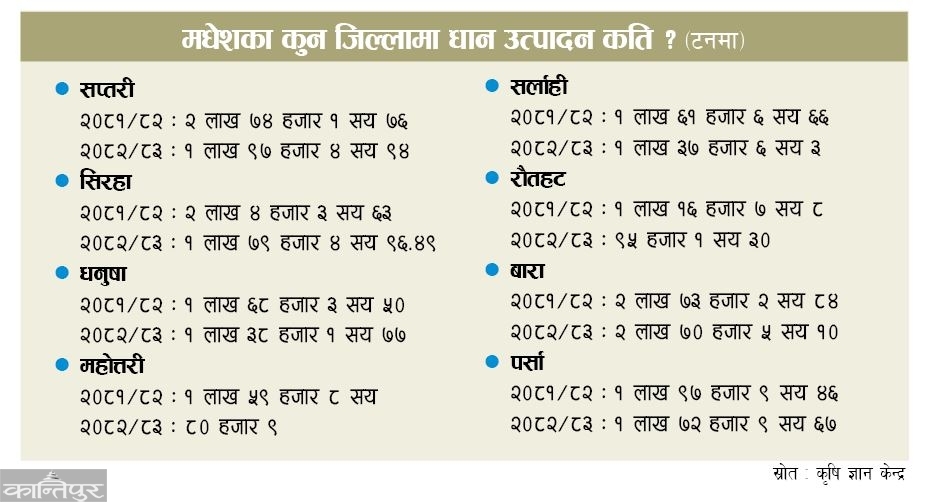
Last year, rice was cultivated on an area of 35,08 hectares. The floods that occurred last Asoj damaged the rice crop planted on 17,638 hectares of fields. According to the Agricultural Knowledge Center, Parsa, this year's rice production in Parsa has decreased by 24,997 tons compared to the previous year. This year, paddy was planted in an area of 47,130 hectares across the district. The office has stated that 172,967 tons of paddy were produced at the rate of 3.67 tons per hectare.
Ramjivan Thakur, head of the Agricultural Knowledge Center Parsa, said that production has decreased by 12.16 percent this year. According to the data provided by the Agricultural Knowledge Centers of 8 districts of Madhesh, Saptari produced 274,176 tons of paddy last year. This year, 197,494 tons have been produced. Siraha produced 24,363 tons of paddy last year. This year, 179,496 tons of paddy have been produced.
Dhanusha produced 168,350 tons last year. This year, 138,177 tons of paddy have been produced. Sarlahi produced 161,666 tons of paddy last year. This year, the office has stated that 137,603 tons of paddy were produced. Last year, 159,800 tons of paddy were produced in Mahottari. This year, only 80,000 tons have been produced.
Last year, 273,284 tons of paddy were produced in Bara. This year, 270,510 tons have been produced. According to the agricultural knowledge centers, the crops did not get the necessary nutrients due to the shortage of DAP and urea fertilizers during paddy cultivation and sowing, which has affected the production.
Insufficient rainfall during the main planting season (Asar-Shrawan), prolonged drought, and fertilizer use hindering the paddy planting process have had an impact on rice production. Even though the government has invested crores of rupees in the irrigation sector for the farmers of Madhesh, the farmers and the state have not been able to get the return due to zero monitoring, said Madhesh economist Bhogendra Jha. ‘We talk about the economy. We say that Madhesh is a storehouse of grain. But the state has invested so much in underground irrigation in Madhesh,’ Jha said, ‘Where is the monitoring? Did the water come or not, are the installed borings in good condition? Nothing has been monitored. The state of Madhesh's grain reserves is also deteriorating due to drought.'
Every year, the countrywide planting season starts from mid-Asar and ends by 15th Shrawan. Last monsoon, Madhesh farmers faced the problem of drought during planting. Due to lack of rain during monsoon, it was not possible to plant rice in dry fields on time. In Madhesh, which is considered a grain reserve, only those who had small and large deep borings around their fields planted. Those who did not have access to borings were forced to rely on rainwater. There are 9,000 small and large deep borings installed at government expense in Madhesh. Of these, about 1,500 are not operational. Due to lack of budget, everything has deteriorated and stalled.
Climate change has pushed back the rainy season every year and planting is being delayed by relying solely on underground water resources, said Yubaraj Bhattarai, a Madhesh MP and former minister. ‘Nepal has a monsoon-based farming system. There was not enough monsoon this year,’ he said, ‘The shallow and deep borings installed for irrigation did not work. Even those that did have deteriorated. Due to the lack of timely irrigation facilities, paddy planting was delayed and production decreased.’
Even though Madhesh is the country’s food bank, it has been suffering from drought for the last two to three years, said Sachin Kumar Mishra, a senior scientist at the Nepal Agricultural Research Council (NARC) and head of the Agricultural Equipment Research Center, Birgunj. "The impact of climate change is increasing. Earlier, rice could be planted with uniform rainfall at the same time every year. Recently, it has become difficult to plant rice in the rainy season," he said. "The agricultural sector has been affected the most. Last year, it was more. There is no rain at all. Now the weather does not seem favorable." According to the Center for Crop Development and Agricultural Biodiversity Conservation, the total area under rain-fed rice in Madhesh is 372,645 hectares.