The approximately three and a half kilometer road area from Khare Chowk to Shahid Chowk in Lakeside will be transformed into a festival. This time, the main attraction of the festival will be an exhibition of original and traditional food at the provincial level.
We use Google Cloud Translation Services. Google requires we provide the following disclaimer relating to use of this service:
This service may contain translations powered by Google. Google disclaims all warranties related to the translations, expressed or implied, including any warranties of accuracy, reliability, and any implied warranties of merchantability, fitness for a particular purpose, and noninfringement.
The shores of Fewa Lake, where the shadow of Machhapuchhre smiles. The warm air of Chait and the enthusiasm of the New Year. Pokhara is currently preparing for its own old rhythm and celebration. The Hotel Association Pokhara has intensified preparations for the 21st Fewa New Year Festival.
The festival to be held at the lakeside from 29 Chait to 1 Baisakh is also a continuation of the two-decade-long proud journey of Pokhara's tourism. In the early 2060s, when the country was in the grip of conflict and political instability, Pokhara's tourism had slowed down. At that time, this street festival, which was started with the aim of attracting tourists by bringing tourism, culture and food together in one place, has created a strong history by reaching its 21st edition.
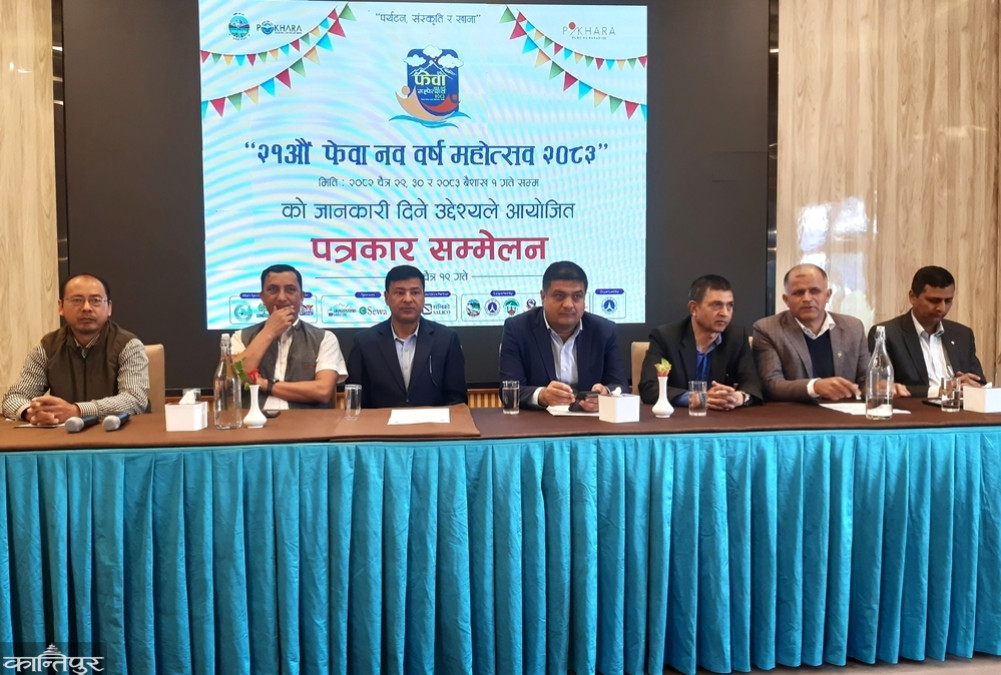
At a press conference organized in Pokhara on Thursday, Hotel Association Pokhara President and Festival Coordinator Laxman Subedi shared encouraging statistics. ‘This year, we have estimated that three lakh domestic and foreign tourists will enter Pokhara during the festival,’ he said, ‘We believe that the occupancy of hotels will reach above 90 percent.’
To revive Pokhara’s tourism, the association has reached out to cities in eastern Nepal and Lumbini province with the ‘Jaaun Hai Pokhara’ campaign and has distributed invitations. To make the festival more attractive, the association has announced special packages for tourists. Hotels affiliated to the association will offer up to 25 percent discount on the published rates. 10 percent cashback has been arranged when booking hotels through e-service.
The approximately three and a half kilometer road area from Khare Chowk to Shahid Chowk in Lakeside will be transformed into a festive area. This time, the main attraction of the festival will be an exhibition of original and traditional food at the provincial level. ‘We want to preserve our originality and history along with modernity,’ adds Chairman Subedi, ‘that is why we have given priority to the Panchaibaja competition and original tableaux.’ Before the official start of the festival, a tableau of various ethnic groups, brought out from Khare, will reach Ambot and take the form of an opening ceremony. The organizers believe that folk songs, pop concerts and tourist running competitions will make the streets of Lakeside more vibrant.
This festival, which started in the narrow streets of Lakeside in the early years, laid the foundation for making Pokhara a hub for ‘event tourism.’ At a time when the influence of foreign culture is increasing, its historic achievement is to establish the tradition of celebrating the original Nepali New Year as a festival on the streets.
Maniraj Lamichhane, head of the Tourism Board Gandaki, said that the festival will provide another opportunity to introduce Pokhara to the world as a safe and vibrant destination. According to Bikal Tulachan, former president of the Hotel Association of Pokhara, this festival will revive the sluggish economic activity.
‘When tourists step onto the streets of Pokhara in the last week of Chait, they will not only experience music and food, but will also feel the warmth of Pokhara hospitality,’ he said, ‘which has made this city the capital of tourism for years.’