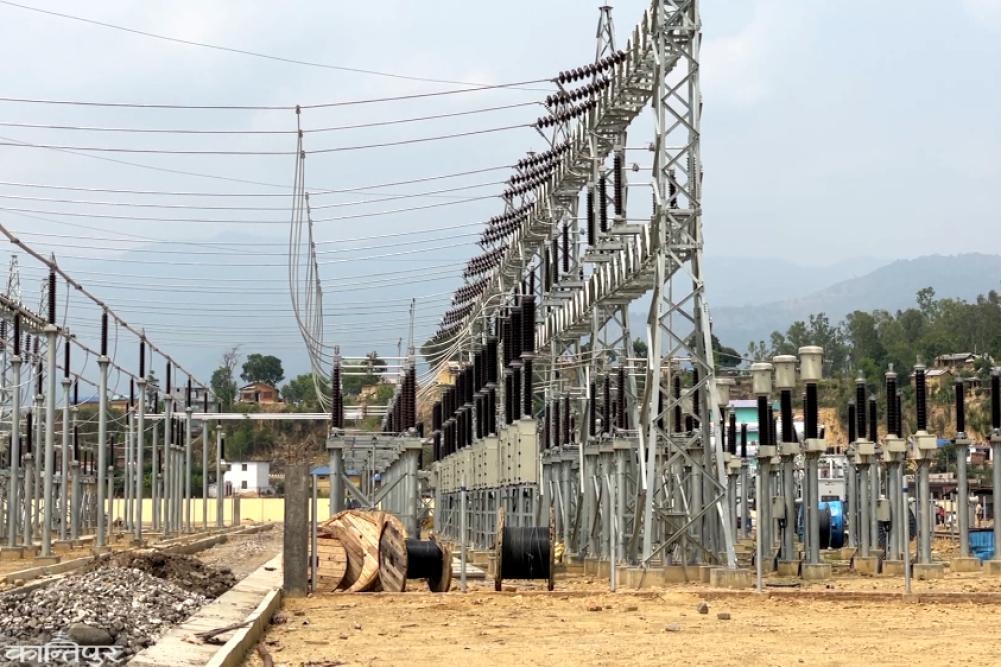
The NEA has been importing an average of 400 megawatts of electricity.
We use Google Cloud Translation Services. Google requires we provide the following disclaimer relating to use of this service:
This service may contain translations powered by Google. Google disclaims all warranties related to the translations, expressed or implied, including any warranties of accuracy, reliability, and any implied warranties of merchantability, fitness for a particular purpose, and noninfringement.
India has renewed its permission to import electricity from April to August. India has renewed it to provide electricity for 24 hours from 18 Chaitra to 2 Baisakh, 16 hours from 3 Baisakh to 16 Asar, and 24 hours from 17 Asar to 15 Bhadra. However, Nepal will start exporting to India and Bangladesh from the last week of Jestha.
In 2081 Chaitra, India had repeatedly renewed its permission to import electricity for 12 and 16 hours, but it had been providing electricity for 24 hours until Tuesday. From Wednesday, the Nepal Electricity Authority will be allowed to import electricity for only 16 hours a day.
India has renewed its permission to import 654 megawatts of electricity to Nepal at the competitive rate of the Indian Energy Exchange (IX) until next August. India had to renew its permission again to purchase electricity through IX from Wednesday. Hitendra Dev Shakya, Executive Director of the Nepal Electricity Authority, said that the permission has been renewed to allow India to import electricity for 16 hours a day.
Nepal has been importing electricity from India every year to meet its domestic demand due to the decrease in water flow in rivers and streams during winter. The Authority has been allowed to import 600 MW of electricity at a competitive rate through the 400 kV Dhalkebar-Muzaffarpur transmission line and 54 MW from Tanakpur-Mahendranagar.
India has renewed the permission to import electricity for 16 hours in April and May and in the following months in the 24-hour (RTC) mode. The Authority says that electricity can be imported from 2 am to 6 pm in April and from 4 am to 8 pm in May.
The Authority has stated that since India has renewed the permission, there will be no problem in importing electricity. In Mangsir 2081, when India allowed the import of electricity during winter, it allowed only 20 hours a day until Chaitra 2 and only solar hours (6 am to 6 pm) from Chaitra 3 to Ashar 16, 2082. Since Chaitra 3, 2081, the NEA had been importing electricity for 12 hours a day, but on Chaitra 15, it allowed the import of electricity for 16 hours a day. After that, electricity was imported from 6 am to 5 pm and from 11 pm to 4 am.
Although India renewed the permission, in Baisakh, when electricity was not received from India as per demand, it partially cut off electricity to the industry. At that time, the NEA itself had said that electricity could not be received from the 132 kV line connected to Bihar even after maximum efforts because the demand was high in India due to various reasons including the Indian Premier League (IPL), rising temperatures, and Nepal was unable to buy as much electricity as it wanted. The NEA had issued a statement saying that the power cut was due to the industrial sector being cut off due to the high demand in India. This time too, IPL has started in India from Saturday. Therefore, experts say that there is a doubt whether electricity will be available or not as per the demand this time too.
The Authority has been importing an average of 400 MW of electricity. The Authority has stated that the demand for electricity in the country is also increasing due to the increase in the use of electrical appliances in Nepal since the beginning of summer. Experts say that the government has no option but to move forward with reservoir-based and semi-reservoir-based hydropower projects, saying that energy security is a challenge during the dry season. The Authority has been purchasing electricity through competition in the IX day-ahead and real-time markets. Accordingly, the day before the purchase, there is a 'bidding' with price and quantity. The Authority had signed an agreement with India's Power Trading Company (PTC India) through a bilateral agreement to purchase 180 MW of electricity at Rs 6.95 per unit. This was for the period from January 2026 to May 31. Under this agreement, 100 MW of electricity can be imported from Dhalkebar-Muzaffarpur and 80 MW from Bihar's 132 kV transmission line. Despite the controversial agreement, the NEA has been importing electricity.
The NEA has said that 220 MW can be imported from the 132 kV Kataiya (India)-Kushwa (Nepal), Raxaul-Parwanipur and Gandak (Nepal)-Ramnagar (India) transmission lines and 50 MW from the 132 kV Mainhiya (Nepal)-Sampatiya (New Nautanwa, India) transmission line. India has allowed imports in RTC mode for 16 hours till April 15 and thereafter.
The NEA has fixed the rate of electricity purchased through the 132 kV transmission line at 8.22 rupees (13 rupees 15 paise) per unit, 8.91 rupees (11 rupees 58 paise) per unit at 33 kV.
and 11 kV level has been fixed at 9.55 rupees (15 rupees 28 paisa) per unit. Nepal will be able to import 350 megawatts of electricity through PEC. The Authority expects to further strengthen Nepal's electricity supply management during the dry season in the months of Chaitra-Baisakh.
The Authority had issued two notices to import electricity at open competitive rates keeping in mind this dry season. On January 19, the Authority had invited proposals to purchase 100 megawatts of electricity from India for this dry season. The Authority had invited proposals not exceeding 6.60 rupees per unit from February to March and 6.90 rupees per unit for April and May. Although the notice was issued asking for applications by January 28, no proposals were received at that time.
The Authority has been importing electricity as per the system requirements during the dry season. Therefore, the Authority had invited proposals on February 13 to purchase 100 megawatts of electricity for the months of April and May. At that time, the Authority had said that the proposals should be submitted by February 22. But the NEA amended the notice on February 21 and set a deadline of February 27. Although the NEA had set the per-unit rate of electricity purchased from April 1 to May 31 not to exceed Rs 6.90, no proposal was received.
The NEA board meeting held on December 15, chaired by the then Energy Minister Kulman Ghising, had decided to seek sealed quotation proposals from Category 1 Indian traders (commercial companies) through public notice, giving a period of 10 days to purchase 100 MW of electricity during the dry season through open competition. The NEA had sought proposals in accordance with the same decision.