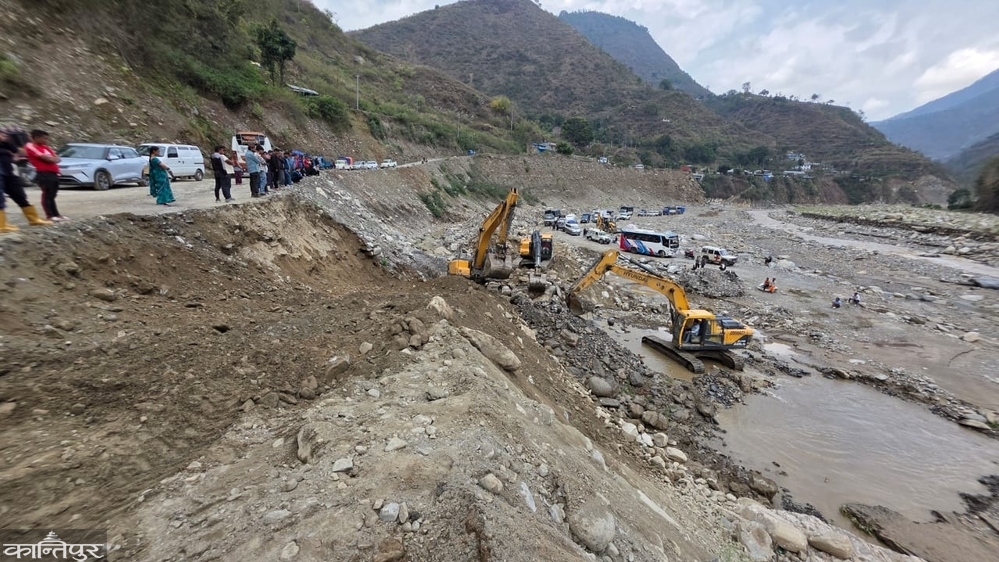
Although government agencies claim to have built sustainable road infrastructure targeting monsoon rains, landslides occur every year, blocking roads and causing loss of life and property. This is what happened on the BP Highway on Friday evening.
We use Google Cloud Translation Services. Google requires we provide the following disclaimer relating to use of this service:
This service may contain translations powered by Google. Google disclaims all warranties related to the translations, expressed or implied, including any warranties of accuracy, reliability, and any implied warranties of merchantability, fitness for a particular purpose, and noninfringement.
The highways are becoming blocked even during heavy rains, which has added to the confusion among the general public about what will happen during the monsoon. They have only one question - are the highways safe for the monsoon? Although the government bodies claim to have built sustainable road infrastructure targeting the monsoon, every year landslides block the roads, causing loss of life and property. This is what happened on the BP Highway on Friday evening.
The BP Highway, which was blocked from 7 pm on Friday, was reopened from 3 pm on Saturday. The traffic came to a standstill after the flood in the Roshi River washed away the temporary diversion of the highway. Since the highway is under permanent construction, a temporary diversion has been made in the river and vehicles are operating. Suman Yogesh, Chief of the Road Division Office, Bhaktapur, said that the flood washed away 5.5 kilometers of the temporary diversion. ‘The flood has caused damage from Chowkidanda to Barkhe Khola,’ he said, ‘The biggest problem is in Katunjebensi, Charsay Besi, Narke, Chiuribas, Boksikuna, Kaldhunga, and Piple sections.’
Yogesh said that work is being done to ply vehicles on a permanent road built above the river during the upcoming monsoon season. ‘A similar thing happened in 2082 Baisakh. The road was closed for a day after the Roshi Khola flooded due to sudden rain,’ he said, ‘This time, the problem arose when it rained in Chaitra and flooded. We will ply vehicles on a permanent road until Baisakh.’ He claims that arrangements will be made to ply vehicles from those places before the monsoon season, wherever road vehicles can be plyed above the river.
He said that vehicles will be plyed on the river by making diversions in some places before the monsoon season. ‘We will not let this be a problem during the monsoon season, we will drive vehicles on the permanently constructed road,’ said Yogesh, ‘Even if the road is not completely worked on, we will make it navigable throughout the monsoon season.’ The flood of Asoj 2081 caused more damage to the 30.5 km area along this highway, from Bhakundebensi to Nepalthok. Apart from the 3.2 km of the damaged highway, work is underway on a 27.3 km section.
The work has been progressed by making three packages, three towards Kavre and one towards Sindhuli. The contract for the 11 km section of the highway, from Bhakundebensi to Charsaybensi, which is being built in two lanes, has been won by Lama-Nawakantipur JV for Rs 1.14 billion. The contract for the 9 km stretch from Charsaybensi to Dalabesi has been won by Khani-Kamaljit-Awan JV for Rs 1.22 billion excluding VAT. The contract for both contracts was signed in Ashar.
The contract for the 2.3 km section from Piple to Dalabesi was signed with Uma & Company-Bhandari-Amarjyoti JV last October. The contract amount for this section is Rs 688 million. JICA will construct a 3.2 km road from Piple to Barkhekhola. The road is being constructed on this section with a grant of Rs 2.63 billion from the Japanese government.
The 5 km section from Barkhekhola to Nepalthok is in Sindhuli. The contract for this section has been taken by Kharidhunga-Ghising-Kshitij JV. Its contract amount is Rs 550 million excluding VAT. The Road Department has stated that the work on all sections should be completed within two years from the date of the agreement. Although there is a road on the highway, the construction of the bridge has not yet been carried out. The most traffic jams occur on the bridge in this section. More than 4,000 vehicles travel on this road daily. Due to the Sanghura and single-lane bridges, vehicles have to queue to cross. The floods in Asoj 2081 caused landslides at more than a dozen places on the Kanti Highway connecting Hetauda-Kathmandu, blocking traffic. Contract work is underway on a 29-kilometer stretch from Tikabhaiwar in Lalitpur to Baguwa.
The Road Department has said that contract work is also underway on a 50-kilometer stretch from Baguwa to Buddha Chowk in Hetauda. This road is becoming suitable for vehicles going to the eastern Terai. Tankers carrying dairy products, chickens and vegetables also enter the capital via this route. It is a two-lane road. The two-kilometer stretch, including the section where the mountain cannot be cut, is still a single lane.
Tankers carrying dairy products, chickens and vegetables also enter the capital via this route. This is a two-lane road. The two-kilometer section of the road, including the section where the hill cutting could not be done, is still a single lane. This highway connects the federal capital Kathmandu and the Bagmati Province capital Hetauda. The bridge construction work that has been started in Baguwa is not yet complete. Although work is underway on various sections of this highway, there is still a risk of landslides blocking the road during monsoon, according to a Road Department source. Another road that faces the most problems during monsoon is the Daunne section of the Narayangadh-Butwal section of the East-West Highway. Traffic on this section comes to a standstill with normal rainfall. Vehicles often skid after it rains.
Seven years after the work on the expansion of the road began, the work has not been completed. Even though work has been completed elsewhere, the 14-kilometer section of Daunne, which continues to face the most problems, has not been resolved. After the problems started increasing during monsoon, the road is being constructed using cement on 11 km of this section. Although the initial design mentioned blacktop, the slope work was taken forward after it was found that the blacktop would not be durable due to the soil in the area, said Chudaraj Dhakal, Project Chief of the Project Directorate (ADB).
‘Work is underway on the slope,’ said Dhakal, ‘the work at this place will be completed by the coming monsoon, and passengers and drivers will not have to face the problems like in previous years this time.’ Dhakal said that since the area is prone to waterlogging and swampy soil, there is a risk of the blacktop road collapsing and deteriorating when braking, so slope work was done for the durability of the road.
In addition, 99 km of the road has been built with four lanes in rural and forest areas and eight lanes with service lanes on both sides in market areas. Dhakal said that finishing work including painting is currently underway.
It was expanded with the help of a loan from the Asian Development Bank (ADB). Another major problem is the Nagdhunga-Muglin road. Areas at risk of landslides along the Nagdhunga-Muglin road include Furke Khola, Jhyaple Khola, 13 km, Charkil, Nagdhunga Tunnel entrance, Ratmate, near Sheetal Bazaar, Malinga, near Vishal Bazaar, Jyamireghat, Jawang Khola, Mauba Khola and Ghoptebhir.
The work on the Nagdhunga-Muglin road, which was upgraded with a concessional loan from the World Bank, has not yet been completed. It has been divided into three sections and contracted. The second-level blacktop work has been completed on the Nagdhunga-Naubise road section. Only the final phase of blacktop work remains on the 12.26 km section where the upgrade was started. On 13 Asoj 2081, 35 people died when a landslide occurred in the Jhyaple Khola on this section, which covered a microbus and a passenger bus. The risk of landslides remains in this area.
The second section is Naubise-Malekhu. The distance of this section is 43.54 km. The first layer of blacktop was done on 15 km of the road before Asar. In this section, 21.5 km of the first layer of blacktop has been completed on both sides. In the second layer, 15 km of the road has been blacktopped. Out of the 13 bridges in this section, 10 have been completed. The construction of the Salyang, Phedi Khola and Khahare Khola bridges is pending. The speed of work has not been increased due to the failure to remove the electricity poles in this section on time. The distance from Nagdhunga to Muglin is 94.66 km. More than 12,000 vehicles ply this road daily. Landslide prevention work has been carried out in areas considered to be at risk, said Keshav Prasad Ojha, Planning Chief of the Nagdhunga-Muglin Road Plan, Eastern Section.
‘Landslide control work has been carried out in the identified areas. But we cannot say this because landslides occur in new places more than expected,' Ojha said, 'We are working to ensure that there are no problems during the coming monsoon.' The progress of the Malekhu-Muglin section is minimal. The total distance of this section is 38.86 km, of which 11 km of the four-lane road has been blacktopped for the first layer. 6 km of the old blacktop road is being demolished and replaced in the Bishaltar and Majhimtar areas. Landslides occur every year in various sections of the Mechi Highway, causing problems.
Road Department Director General Vijay Jaisi said that work is being done to prevent any highway and road from becoming a problem during the monsoon. 'There are problems on the BP Highway as soon as it rains, there are arrangements to drive vehicles on the road even before the monsoon starts. Work is being done accordingly,' he said, 'There are problems because it rains at unexpected times.'

