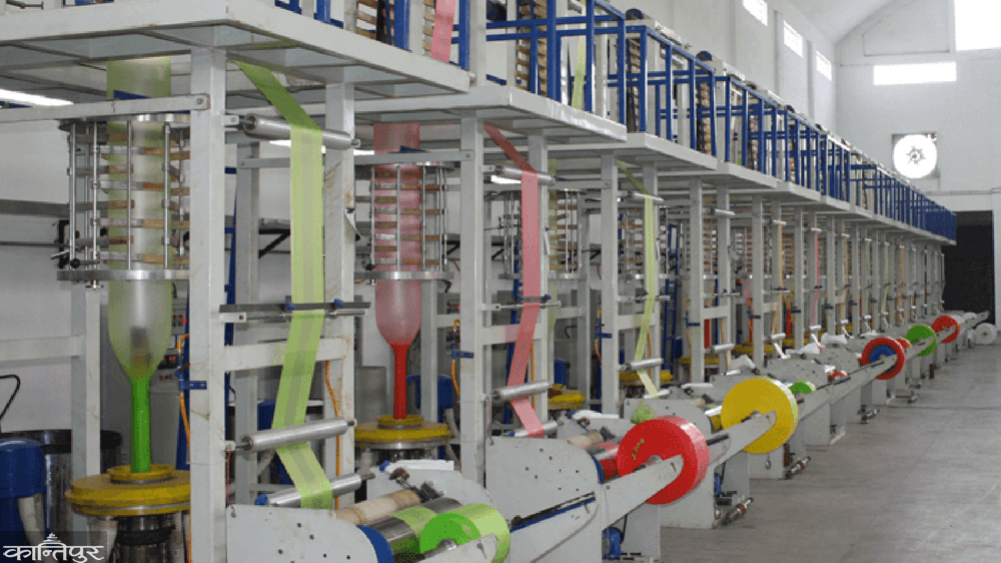
Industrialists are worried that the price of imported raw materials has increased by up to 40 percent, suggesting a possible shortage.
We use Google Cloud Translation Services. Google requires we provide the following disclaimer relating to use of this service:
This service may contain translations powered by Google. Google disclaims all warranties related to the translations, expressed or implied, including any warranties of accuracy, reliability, and any implied warranties of merchantability, fitness for a particular purpose, and noninfringement.
As the war between Israel and the US with Iran intensifies in West Asia, its effects are starting to be seen in Nepal's industries. The plastic industry is on the verge of shutting down due to lack of raw materials. The operating plastic industries have also cut production by 30 percent.
Swagatraj Pyakurel, the owner of MM Polymers, said that there is a problem in importing raw materials, which has led to a huge cut in production. The company has been producing bottles of Coca-Cola, Fanta and other beverages in the Hetauda industrial area.
Pyakurel said that there is a shortage of petrochemicals and polymers, which are essential industrial raw materials for the plastic industry. India has been importing crude oil from other countries, refining it and exporting petrochemicals to Nepal and other countries. At present, India is facing a problem of crude oil and if the war is prolonged, other industries will also be closed, said Bharatraj Acharya, treasurer of the Federation of Nepalese Chambers of Commerce and Industry. The plastic industry has been cutting production due to the shortage of raw materials, said Sangita Kunwar, head of Hetauda Industrial Area Management Limited.
There has been a shortage of plastic 'grains' used in the plastic industry. The import of raw materials for soybean and sunflower oil, which reach Nepali kitchens via India, has also been affected. According to the industrialists concerned, the shortage of raw materials is causing industries operating in the Butwal Industrial Area and Bhairahawa-Parasi Industrial Corridor to close.
Butwal Industrial Area Industry Association President Upendra Agrawal said that the plastic industry is in trouble in the first phase. 'The price of plastic raw materials has increased by up to 40 percent,' he said. 'If this situation continues, it has been said that raw materials may not be available even at the increased price. This has created more confusion and inconvenience.'
The crisis in the plastic and packaging industry has deepened due to the lack of plastic grains. Industrialists complain that the production of water bottles, bottle caps, pipes used in drinking water and building construction, motorcycle helmets, plastic chairs, packaging plastics, cartons and other materials is being directly affected.
Currently, the supply of stock goods is being done and the industry also has some goods in stock, so the industry is running for the time being. But if raw materials cannot be imported within a week, most of these industries will close, says Ejaz Alam, former president of the Rupandehi Industry Association and operator of United Plastic Industries. Industrialists said that Indian suppliers have stopped taking orders from Nepali industries.
Alam said that companies transporting raw materials from India and third countries to Nepal are sending a message that they will no longer be able to send them. ‘Industrialists are in trouble as the price of plastic ‘grains’ has increased by 40 percent,’ he said. ‘The price of petroleum by-products has increased significantly. The price of goods that cost 900 dollars has reached 1,500.’
Nepali industrialists purchase plastic pellets from India's Reliance and Indian Oil Corporation (IOC). In Rupandehi alone, there are more than 500 industries that purchase and process such plastic pellets and produce plastic products. At least 20,000 workers are employed in them. Those industries import goods by opening LCs every 15 days. But now, since they are unable to import goods even after opening LCs, the stock does not last even for 10 days. Industrialist Baburam Bohara said that there is no option but to close the industry.
Rupandehi has been producing everything from rice industries to cement and rods. Raw materials for all materials come from India. However, in the last two weeks, there has been a slight decrease in the number of goods coming through the Belahiya border crossing, said Santosh Neupane, an officer at the Belahiya Customs Office.
'Now, Indian suppliers have stopped taking orders. The impact of this can be seen from next week,' said Neupane, 'Although there has already been a slight decrease in the number of loaded vehicles, the exact figure for the decrease in imports has not been prepared.' He said that there may have been a decline in general imports of 15 to 20 percent. The office has stated that there will not be a significant decline immediately as many goods coming from the Belhiya border crossing come through Indian suppliers. Many goods coming from third countries are imported from Birgunj.
Kamal Karki, associate member of the Nepalgunj Chamber of Commerce and Industry and managing director of Star Polypipe, said that serious problems have arisen in the industrial sector after the import of raw materials stopped due to the war. 'Our production is decreasing due to the non-incoming raw materials. It has been one and a half months since the raw materials were stopped due to the war,' he said.
He said that production has decreased with the stoppage of raw materials. The decrease in production has caused problems in the operation of the industry. Raw materials related to petrochemicals are imported from third countries via India. However, now that India has tightened its export restrictions to avoid shortages in its own market, Nepalgunj Chamber of Commerce and Industry Senior Vice President Chiranjivi Oli said that the local industries are in crisis. He said that the shortage of raw materials related to petrochemicals is now affecting not only plastic products but also the production of daily consumer goods.
Akshay Golyan, Managing Director of Reliance Spinning Mills, said that there is no immediate impact as the raw materials are in stock. ‘The war has increased the price of crude oil. The raw materials of every manufacturing industry are linked to crude oil,’ he said. ‘The longer the war lasts, the more it will affect it.’
The production of more than a hundred plastic industries in the Sunsari-Morang Industrial Corridor has been badly affected due to the shortage of raw materials. Nandakishore Rathi, founder of Bagmati Plastic Industries, said that raw materials imported from Saudi Arabia, Qatar and other Gulf countries have not arrived since the war began.
‘Gulf exporters have not been able to send raw materials, industries used to import raw materials from India as an alternative to the Gulf,’ he said, ‘After India stopped exports, there has been a shortage of raw materials in industries.’
The High Density Polythene Pipe Manufacturers Association of Nepal has issued a press release stating that the new price of raw materials has increased by about 62 percent. ‘The raw materials used in the HDP industry (HDP granules) are produced by processing crude oil. Due to the ongoing tensions in West Asia, the transportation of raw materials imported from India and third countries has been disrupted for the past few weeks,’ the association said. The association stated that some industries have closed due to zero raw material stock and some industries are on the verge of closing.
This has started to have a direct impact, especially on plastic industries ranging from footwear to cables and wires. The cost of goods coming from China has also increased, said customs agent Suresh Bohra. The supply chain of chemical fertilizers from Russia and food from Ukraine has also been affected. The increase in transportation costs due to the increase in fuel prices has put pressure on the prices of every consumer good. It used to take 40 to 45 days for goods from Ukraine to arrive, and the current disruption has created further confusion, businessmen say.
The impact of the war is also seen in the textile industry. It has been mentioned in the international media that the cost of production will increase by 10 to 15 percent globally. Synthetic fibers are produced from petrochemicals and other materials. When oil prices increase, the cost of petrochemical products automatically increases.
On the other hand, the cost of transportation automatically increases when the price of petroleum products increases. This will also affect the supply chain, increasing the production cost of yarn, cloth, and everything else. It is said that this will affect fiber producers and textile mills, clothing manufacturers to retailers.
The cost of production in the country will increase by up to 20 percent, said Pashupati Dev Pandey, President of the Nepal Ready-Made Garment Industry Association. "Raw materials such as fabrics, threads, zippers, buttons, etc. come from India, China, Japan, Korea, and Bangladesh," he said. "The supply chain has been disrupted. Transportation costs have increased. The impact of this is already visible." He said that the cost of production will automatically increase as transportation costs and raw material prices increase.
The shoe manufacturing sector has also been affected by the war. Rudra Prasad Neupane, president of the Shoe Manufacturers Association, said that there is a shortage of raw materials such as soles and adhesives. He said that prices are increasing and shortages are also being seen as they are co-products of petroleum. He said that 70 percent of the raw materials required for shoe manufacturing are being imported from outside.
Ravi Singh, president of the Nepal Construction Entrepreneurs Federation, said that bitumen imports have been affected due to the co-production of petroleum products. ‘There is a problem in bitumen import, on the other hand, the price of cement and slag has increased,’ he said, ‘The price of slag has increased by Rs 20 per kg and that of bitumen by Rs 135.’
If the war does not stop, the import of chemical fertilizers into the country will also be affected. Nepal is dependent on imports for chemical fertilizers. Countries including Saudi Arabia, Qatar, Oman, and the UAE in West Asia are major suppliers of urea, sulfur, and ammonia. Iran is the third largest producer of ammonia, which is considered important for soil nutrients. As prices are increasing in the world market, it is seen that its impact will be felt in Nepal.
With the increasing price increase in the international market, suppliers are hesitant to deliver due to the fear of losses due to the instability between the price at the time of bidding and the market price at the time of supply, an official from the Ministry of Agriculture said. He said that the ministry has discussed alternative measures to be taken in such a situation as the problems seen in West Asia may cause some inconvenience in fertilizer supply. The Ministry of Agriculture and Livestock Development says that there is enough fertilizer stock until the upcoming month of Jestha. It is said that the ‘Strait of Hormuz’ is the means of importing chemical fertilizers and helium.
The impact of the conflict is also seen on the country's pharmaceutical manufacturing industry. Since the raw materials for medicines produced in Nepal are imported, the shortage of them is seen to cause problems in the industry. If the war is prolonged, it will be difficult to produce medicines in Nepal, says Biplav Adhikari, chairman of the Nepal Pharmaceutical Manufacturers Association. ‘Due to the war, the price of raw materials required for pharmaceutical production has increased by 30 percent,’ he said. ‘Especially, it may be difficult to obtain petroleum-based products.’ He said that there will be problems in the supply of plastic and other raw materials used to make saline bottles.
The government has fixed the prices of some essential medicines. The official said that the government should pay special attention to pharmaceutical production as it is linked to people's lives. ‘If we are instructed to store medicines, we can make preparations, otherwise we will not be able to buy raw materials at high prices and provide them at low prices,’ he said.
Kiran Sundar Bajracharya of the Department of Drug Management said that there is no immediate problem for medicines in the country. ‘We are conducting a detailed investigation into what medicines and raw materials are coming from which country,’ he said. ‘If the war continues for a long time, it may have an impact. However, right now, its impact has not been seen in Nepal immediately.’
With the disruption in the supply chain, the country’s exports and production costs are likely to be more affected. The cost of all transportation, including cargo, has increased, said Rajendra Sangraula, president of the Nepal Freight Forwarders Association. He estimates that the increase in import-export transportation will increase production costs by up to 50 percent. ‘How will we import and export goods if cargo does not come from West Asia? It was not possible to compete with other countries, now it will be even more difficult,’ he said.
- Also present are Aarti Poudel (Kathmandu), Pratap Bista (Hetauda), Ghanshyam Gautam (Butwal), Rupa Gahatraj (Nepalgunj), Parbat Portel (Biratnagar) and Shankar Acharya (Parsa)