Transactions through e-Sewa, Khalti and other wallets increased by about 22 percent, QR transactions by 76 percent, mobile banking by 40 percent, internet banking by 25 percent, and Connect IPS by 23 percent.
We use Google Cloud Translation Services. Google requires we provide the following disclaimer relating to use of this service:
This service may contain translations powered by Google. Google disclaims all warranties related to the translations, expressed or implied, including any warranties of accuracy, reliability, and any implied warranties of merchantability, fitness for a particular purpose, and noninfringement.
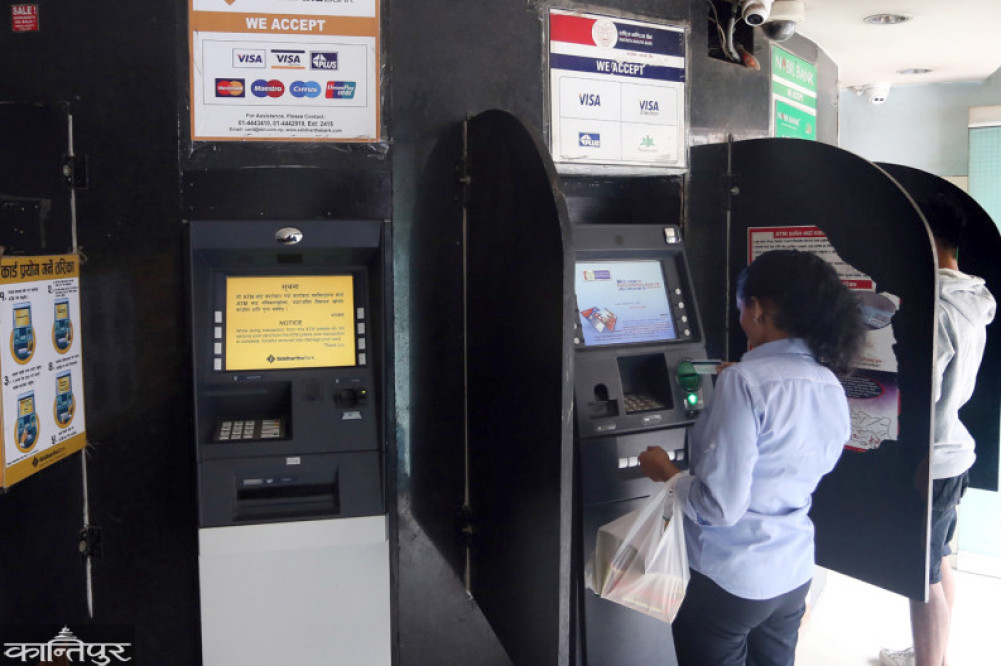
As banks and financial institutions promote digital banking, ATM withdrawals and card payments are decreasing. With the increase in the use of QR and mobile banking, the general public has reduced transactions through ATMs and electronic cards.
In the last month, citizens withdrew 73 billion rupees from ATM cards. Compared to the same period of the previous year, the amount withdrawn from ATMs has decreased by about 15.5 percent. In the same period of the previous year, citizens withdrew 86.47 billion rupees from ATMs. According to the data of the Nepal Rastra Bank, transactions through ATMs and debit cards have decreased in the last year due to the increase in transactions including QR, mobile banking, internet banking, etc.
In the last month, customers withdrew money from ATMs 92 lakh 89 thousand 149 times. While in the previous month, 12 lakh 50 thousand 604 such transactions were made. The use of ATMs has decreased due to the increase in digital banking, and the amount of transactions through them has also decreased, according to a Rastra Bank official.
‘As citizens have become attracted to digital banking, payments and cash transactions through ATMs and cards have decreased,’ said Satyendra Timilsina, Head of the Rastra Bank Payments Department. ‘It is seen that citizens’ interest in digital banking has increased as it is simpler and safer than cash transactions.’ He said that the Rastra Bank is also encouraging digital banking, and its impact on financial transactions is visible.
Banks and financial institutions have started reducing the number of counters (tellers) in their branches as cash transactions have decreased in the market, according to a banker. ‘In branches that previously required 3/4 counters, now only a single counter is working. In branches that used to handle more than 400 transactions daily, only 60/70 cash transactions are currently being done,’ said Santosh Koirala, President of the Nepal Bankers Association. ‘ATM transactions have also decreased. Because digital banking has increased widely.’
As ATM transactions have started to decline, banks have also started closing ATM machines based on customer demand and needs. ‘There is no need to seek permission from the National Bank to close ATMs, only to provide information. Therefore, the bank itself decides how many ATMs are needed, whether to add or reduce them. The permission of the National Bank is not required,’ Koirala added, ‘I am not aware of any ATM machine closures due to low transactions so far, but it is not possible to say that day will not come in the future.’
Compared to a year ago, transactions through e-services, Khalti and other wallets have increased by about 22 percent, QR transactions by 76 percent, mobile banking by 40 percent, internet banking by 25 percent, and Connect IPS by 23 percent. According to the National Bank, transactions through ATMs, debit cards, and branchless banking transactions have decreased during this period.
Koirala said that banks are adjusting/consolidating their branches in urban areas (metropolitan cities) due to the decline in cash transactions. In the last week of last Mangsir, in the context of increasing electronic payment transactions and significant branches of financial institutions, the Rastra Bank had made arrangements for banks and financial institutions to adjust/merge their branches in metropolitan cities. After that arrangement, banks are rapidly adjusting branches. ‘We have requested the Rastra Bank to allow branch mergers in municipal areas as well,’ said Chairman Koirala. ‘Looking at the pace at which digital banking is growing, it seems that even if there are not many branches in urban areas, it will be enough.’
Since last Magh, the arrangement has been implemented that prohibits the general public from making cash transactions of five or more. In a circular issued by the Rastra Bank in the name of banks and financial institutions and microfinance, it has directed them to implement a limit of cash transactions of up to 5 lakh rupees in the purchase and sale of goods. ‘When banks and financial institutions make payments of Rs 5 lakh or more, it is mandatory to make the payment only to the account of the account payee or the account of the person concerned,’ the directive issued last week states, ‘Payments of checks drawn in the name of a firm, company, organization or office must also be made to the account payee.’
However, if a depositor or saver shows a specific reason and the content and reason for the application for cash payment are found to be reasonable, such a depositor or saver may make cash payments exceeding the specified limit (banks and financial institutions will have to update the monthly statement of cash payments made in accordance with this provision), the Rastra Bank has stated.
In particular, to help prevent money laundering, discourage cash transactions and encourage digital payment transactions, the government had decided not to allow cash transactions of Rs 5 lakh or more from 1st Magh. The government published the decision of the Council of Ministers in the Gazette on 24th Poush. After that, the Rastra Bank has issued instructions to implement the provision.
There was no limit on cash transactions before 1 Shrawan 2074. The general public could conduct any transaction in cash. On 10 Chaitra 2073, the government had issued a notification in the Gazette and set the limit on cash transactions at Rs 1 million for the first time. That provision came into effect from 1 Shrawan 2074. The Rastra Bank has revised that provision and set the limit on cash transactions at Rs 5 million from Magh.
Even now, the general public is allowed to withdraw deposits exceeding the limit from financial institutions, make savings or exchanges, and make transactions to repay loans taken from financial institutions and their principal and interest. If a depositor or saver shows a specific reason and the content and reason of the application for cash payment are found to be reasonable, the financial institution in which such depositor or saver has an account can also make cash payments exceeding the specified limit to the depositor or saver.
According to Section 44 (c) of the Prevention of Money Laundering Act, 2064, the government has been given the authority to set limits on cash transactions. Sub-section (1) of Section 44(c) empowers the government to specify limits on cash transactions for certain goods, services or other transactions by publishing a notification in the Gazette. This authority can be used to make rules requiring transactions above a certain amount to be made through banks and financial institutions instead of cash. In accordance with the same provision, the government has currently set a limit of five lakh rupees or more for cash transactions.