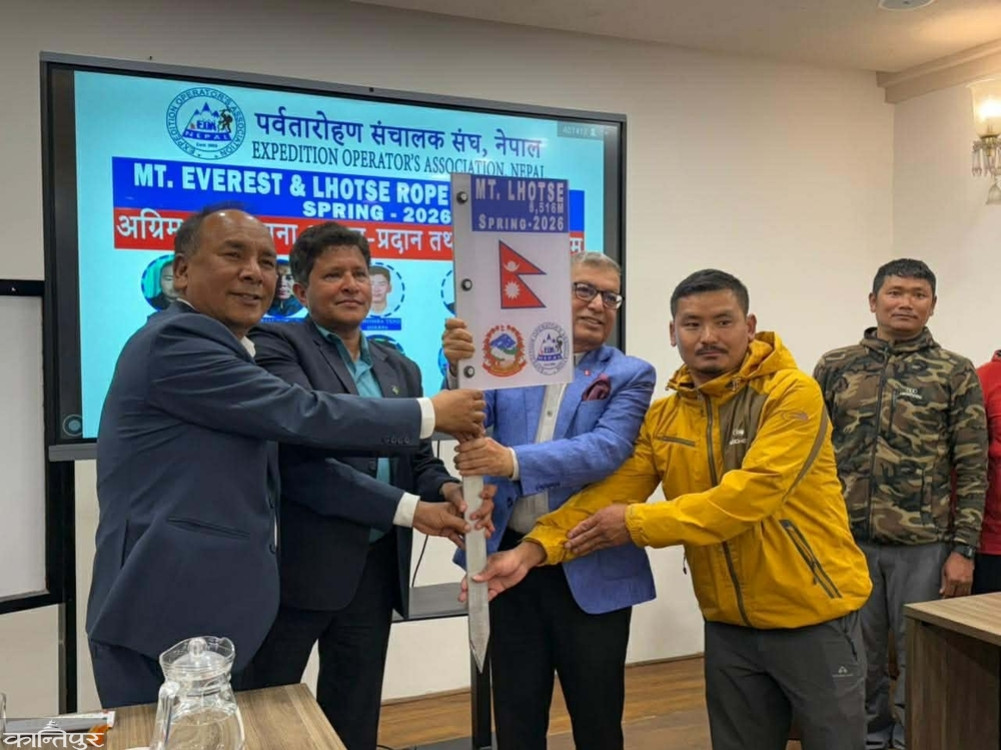
The Expedition Operators Association of Nepal, an organization of mountaineering professionals, bid farewell to a team of 10 Sherpa climbers who paved the way for both mountains and were skilled in installing ropes on the mountains, with a special ceremony in Kathmandu on Tuesday.
We use Google Cloud Translation Services. Google requires we provide the following disclaimer relating to use of this service:
This service may contain translations powered by Google. Google disclaims all warranties related to the translations, expressed or implied, including any warranties of accuracy, reliability, and any implied warranties of merchantability, fitness for a particular purpose, and noninfringement.
Ten Nepali Sherpas who built ropes on the world's highest peak, Everest (8,848.86 meters) and the fourth highest mountain, Lhotse (8,516 meters), were bid farewell on Tuesday for this year's Spring Mountaineering 2026 expedition.
The Expedition Operators Association of Nepal, an organization of mountaineering professionals, bid farewell to the 10-member Sherpa team who opened the route for both mountains and were skilled in installing ropes on the mountains, by organizing a special ceremony in Kathmandu on Tuesday.
According to Rishi Bhandari, general secretary of the Expedition Operators, this time the association bid farewell to Mingma Tenji Sherpa (team leader), Pam Dorje Sherpa, Chhomba Tenji Sherpa, Pasang Tashi Sherpa, Mingma Nurbu Sherpa, Lopsang Bhote, Furtenzing Sherpa, Guru Bhote, Mingma Dorchi Sherpa and Pasang Tenzing Sherpa in Kathmandu on Tuesday for preparing ropes for climbers on Everest and Lhotse.
Pam Dorje and Lopsang Bhote from Solukhumbu are from Taplejung, while the remaining 8 are from Sankhuwasabha. All these Sherpas have at least 18 years of experience guiding in high mountains, said team leader Mingma Tenji. According to him, they are going to Surke in Solukhumbu via road on Wednesday. The team is planning to walk from there to the Everest base camp in a week. The team will stay on Everest for at least 2 months.
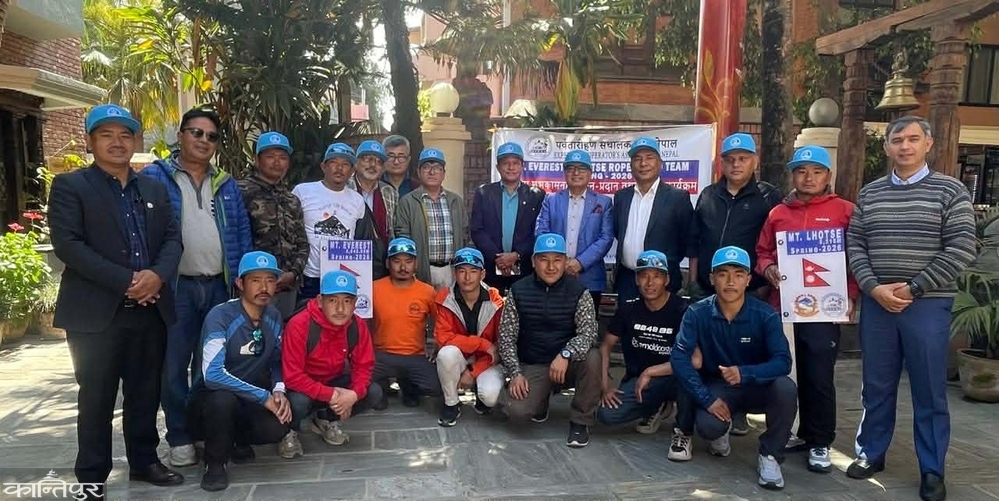
The Everest Pollution Control Committee (SPCC) will build a road from the Everest base camp at an altitude of 5,200 meters to the second camp at an altitude of 6,500 meters. The road from the second camp to the peak of Everest and Lhotse will be built by a team of 10 Sherpas deployed by the expedition operators.
The expedition operators used to assign the Sherpas associated with various climbing teams to build the road in previous years. But this time, General Secretary Bhandari told Kantipur that these 10 Sherpas have been given the responsibility of building roads by pulling ropes on Everest and Lhotse for this season, and removing old ropes. According to him, the association has stated that they will be paid 8 to 1.2 million rupees each for this work alone. Apart from this remuneration, the association will have to bear the expenses of transportation, food, accommodation, insurance, and gears. According to the association, gear along with ropes weighing 1,500 kilograms is being sent to both the mountains.
For effective coordination between the Everest base camp and Kathmandu, Babu Sherpa, a member of the association, has been appointed as the base camp coordinator and contact person. In addition, Base Camp Manager of Seven Summit Treks and Expeditions and Sirdar Dorje Ongdak Sherpa has been appointed as an additional coordinator.
The team has been provided with necessary gear including down suits and climbing boots by Chang Dawa Sherpa, the director of Seven Summit Treks. The entrepreneurs have said that the goal is to build a rope-assisted route to the peaks of both mountains by the last week of April.
The association estimates that 400 foreign climbers will reach Everest and 100 will reach Lhotse.