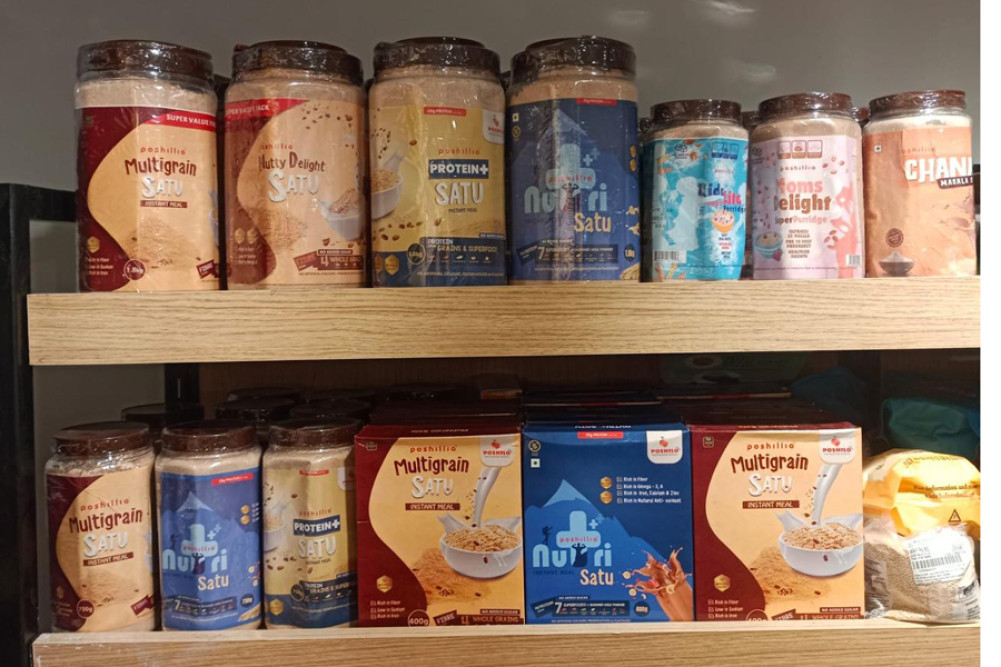
'Posilo' Satu, started by young entrepreneur Prithvi Kalyan Parajuli from Pokhara, is now not limited to Nepali kitchens but also reaches stores in America and India.
We use Google Cloud Translation Services. Google requires we provide the following disclaimer relating to use of this service:
This service may contain translations powered by Google. Google disclaims all warranties related to the translations, expressed or implied, including any warranties of accuracy, reliability, and any implied warranties of merchantability, fitness for a particular purpose, and noninfringement.
After the first phase of the Covid pandemic, Prithvikalyan Parajuli, who was trekking in the Annapurna region, saw corn and soybeans being ground in a mill. He took a small amount of satu in his hand and tasted it. He remembered the taste he had in his mouth as a child. The trend of looking for nutritious food to increase immunity during Covid was equally strong in Nepal. After returning to Pokhara, he transformed the traditional Nepali snack satu into modern packaging and named it ‘Posilo’.
Posilo Foods Pvt. Ltd., which he founded in Pokhara in December 2078, has now expanded its industry to Jhapa and exported its products from India to the US. The industry, which was started with an investment of Rs 10 million, has recently entered the prestigious exporter ‘Manram Group’ as a partner. After this partnership, Posilo Satu has made a leap forward in the international market. Using the strong network of ‘Himalaya Dog Chew’ of Manram Group, which has been exporting chhurpi to the US for the past two decades, Posilo has established its strong presence in the US market. In the last 6 months alone, more than one and a half tons of satu have reached the US, and it is available in about 200 stores there.
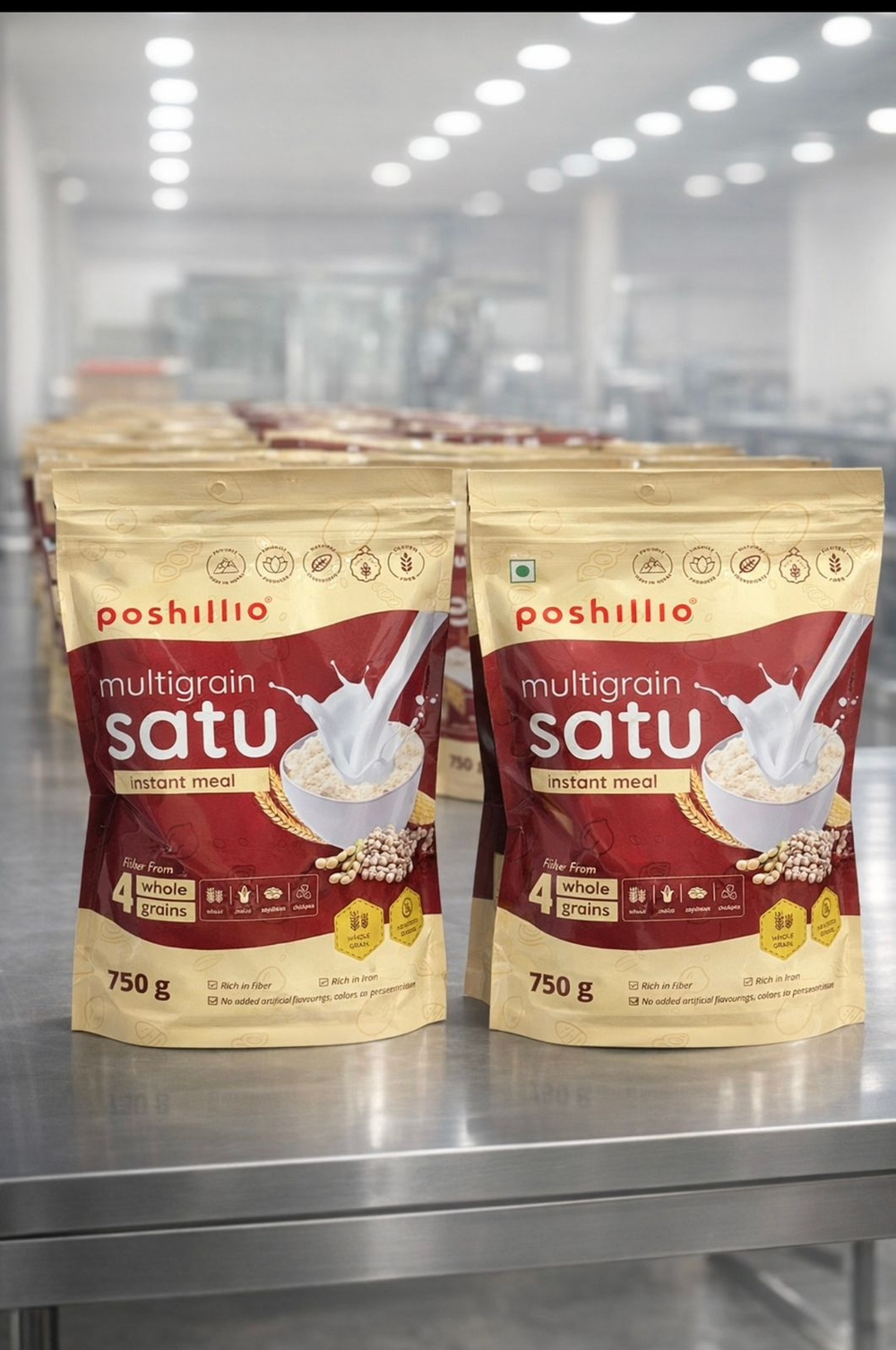
During the Corona pandemic, Parajuli had completed his BBA in business and marketing management. His dream was to have a business rather than a job. After a year of market research, he founded Posilo Foods Pvt. Ltd. at the age of 23. He raised an investment of Rs 10 million by selling shares, seeking family support, and taking a loan from a bank.
The industry, which started in Pokhara-18 Pokhara Valley, produced 100 kg of satu on the first day. Gradually, production increased to 150, then 200 and 400 kg. The consumer response was encouraging. Especially during the Covid period and the subsequent wave of health awareness, Posilo has made a good market.
The specialty of Posilo satu is its purity and nutrition. In addition to local grains like corn, millet, wheat, and gram, it is mixed with ground almonds, cashews, alas, chhokada, walnuts, sesame seeds, and various superfoods. Posilo currently produces 8 major types of satu, including ‘Multigrain’, ‘Nutty Delight’, ‘Protein Plus’ and ‘Nutri Plus’. Different blends have been prepared keeping in mind the nutritional needs of athletes, pregnant women, children and the elderly, who are especially interested in fitness.
These products are available in packets ranging from half a kilo to two kilos. According to the company, no artificial colors, flavors or preservatives are used in it, due to which it is 100% natural and health-enhancing. ‘I jumped into the business to reintroduce satu, which had been lost in the city, to the youth,’ said Chairman Parajuli. ‘Posilo satu is also the original nutritious snack of Nepalis. It is a truly highly nutritious product.’
Parajuli decided to partner with Manram Group a year ago. Manram Group entered Posilo with a 50 percent share and closed the Pokhara factory and established a new state-of-the-art factory in Birtamod, Jhapa. The factory, which has Nepal's first automated satu processing system, has a daily production capacity of 10,000 kg.
Parajuli said that the factory is currently producing 3,000 kg of satu daily. According to him, 45 people have been employed in various fields including production, marketing, sales, administration and purchasing. 'The journey that started from Pokhara has reached Jhapa. Now we have Nepal's first automated satu processing technology,' he says, 'Our products have been able to compete in the foreign market only because of the international standard grain processing system.'
The story of Posilo's entry into the US is linked to its collaboration with the Manram Group. The produce of Manram's agricultural farm is currently used in Posilo. Manram is the same group whose company 'Himalaya Dog Chew' has been exporting Nepalese chhurpi to the US as a healthy dog food for the past two decades. This same network and experience is now being used for Posilo satu.
According to Chairman Parajuli, more than one and a half tons of satu have reached the US in two batches within 6 months of the partnership. Posilo Satu is available in more than 200 stores. Distribution and online marketing in the US is also handled by Manram Group itself. Not only in the US, Posilo is also establishing a good foundation in the vast Indian market. Posilo Satu is being sold across India through Amazon, in stores in Kolkata and Mumbai through Blinkit, and in places including the Modern Bazaar chain store in Delhi.
Last year, Posilo introduced its product at the prestigious 'Food Expo' in Delhi, India. Earlier, Satu was roasted and ground using whatever grain was available in the village. Now, Posilo has been producing eight varieties of Satu for different age groups and lifestyles by beautifully blending science and tradition.
The production process of Posilo starts from the fields of Nepalese farmers. Nepali grain is purchased through various agricultural cooperatives. Maize, millet, and wheat are produced in Nepal. After purchasing, automatic cleaning and grading are done, and the product reaches the market after going through the process of roasting, milling, mixing, and packaging.
The machine is sanitized every day. Our own quality control team checks every batch. Our employees are trained in product hygiene. Most importantly, none of our products contain artificial colors, preservatives, or flavors, and there is no added sugar. We have also started grading and marketing Nepali grains. This will help farmers get fair prices and establish a reputation for quality Nepali grains.
Young entrepreneur Parajuli says that Posilo is not just a business. “We are also conscious of social responsibility,” he said. “The company has been sponsoring and supporting Nepali athletes, educating children about nutrition, and empowering farmers in advanced agricultural practices.”
He said that the company’s goal is to introduce Nepali grains and products made from them to the world, and to contribute to the country’s GDP by increasing Nepal’s exports. The company plans to add 100 direct jobs by the next fiscal year, further expand the markets in Nepal, India, and the US, enter new countries, and develop new products from Nepali grains. "I was wondering what would happen when I started a new business. But now that I see that consumers are liking it, I feel like I did the right thing," he said. "The goal now is to bring this nutritious snack from Nepal to more corners of the world."