Nepal Airlines Corporation, Himalaya Airlines, and Kathmandu Airport, which are directly involved in Nepal's international aviation trade, are losing direct income of at least 70 million rupees every day.
We use Google Cloud Translation Services. Google requires we provide the following disclaimer relating to use of this service:
This service may contain translations powered by Google. Google disclaims all warranties related to the translations, expressed or implied, including any warranties of accuracy, reliability, and any implied warranties of merchantability, fitness for a particular purpose, and noninfringement.
Although the direct impact of the conflict that has flared up in West Asia following the military attacks by the United States and Israel on Iran has not reached Nepal, its deep vibrations have caused Nepali skies to suffer economic losses worth hundreds of millions of rupees every day for the past 21 days. This has put pressure on the country's aviation-dependent businesses.
Nepal Airlines Corporation, Himalaya Airlines, and Kathmandu Airport, which are directly involved in Nepal's international aviation business, have lost more than 1 billion rupees in business in the past 21 days, at a rate of at least 70 million rupees per day, according to these bodies. Stakeholders also say that the fares for air cargo exported from Nepal have increased by at least 25 percent.
As regular flights are disrupted due to daily air strikes in the Gulf region, uncertainty and anxiety are deepening among Nepal's aviation entrepreneurs. While it is not clear how long this crisis will last, Nepali aviation-dependent entrepreneurs are forced to recall the difficult experiences they have experienced over the past decade. Whether it was the economic crisis seen during the Covid pandemic 7 years ago or the supply crisis caused by the economic blockade imposed by India on Nepal 11 years ago and the widespread economic impact after the earthquake at that time.
Businessmen have started expressing their doubts that the current situation will have a long-term and serious impact like those events. ‘Our balance sheet for this March period will be a complete mess,’ Vijay Shrestha, vice-chairman of Himalaya Airlines, which relies on Qatar, Dubai and Dammam in the Gulf for 80 percent of its total air trade, told Kantipur. ‘We suffered a bad trade loss during the earthquake, blockade and Covid. There is a concern that a situation similar to that time will arise now. But how long will this war last. That is why the profit and loss will be determined.’
After the attack on Iran on the afternoon of March 16, nine countries in the Gulf region, including Qatar, the United Arab Emirates (UAE), Kuwait, Iran, Iraq, Israel, Jordan, Lebanon and Bahrain, banned commercial flights over their skies from that day. The restrictions imposed by these countries on commercial flights are still not fully lifted.
At least a dozen flights were operating daily from Doha in Qatar, Dammam in Saudi Arabia, Kuwait, and Dubai and Sharjah in the UAE to Nepal. Himalaya Airlines was flying from Nepal to Doha in Qatar, Dammam in Saudi Arabia, Dubai and Kuwait. Nepali flag carrier Nepal Airlines Corporation was also operating commercial passenger flights to Doha, Dammam and Dubai. Jazeera and Kuwait Airways in Kuwait, Air Arabia, Fly Dubai from the UAE and Qatar Airways from Doha used to fly to Nepal.
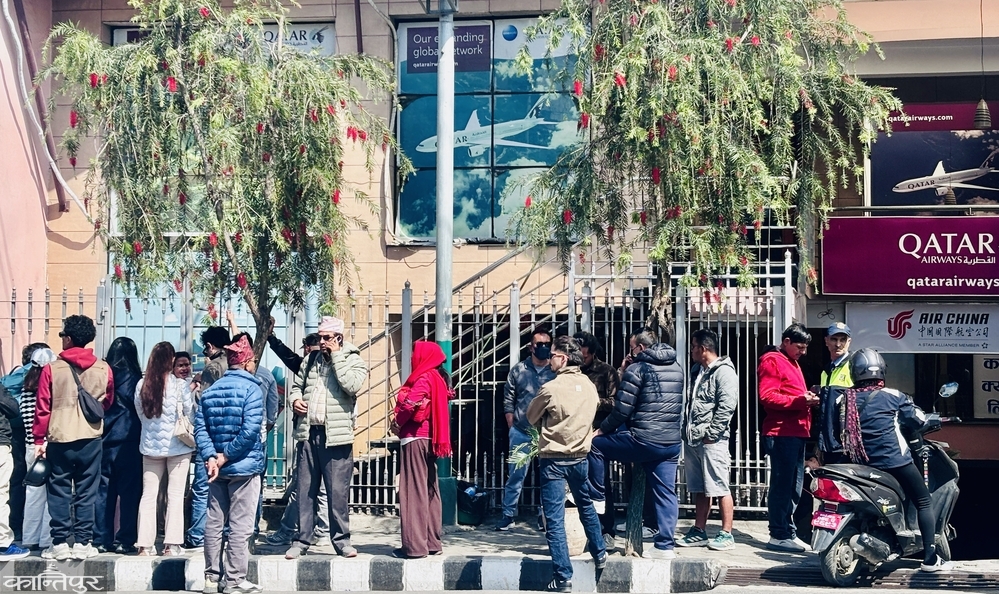
After the closure of these airlines, there is a rush of passengers every day at ticket counters and travel agency offices in Kathmandu to get their tickets refunded or rescheduled. Additional security personnel are being deployed at the ticket counters of Qatar Airways in Naxal, Himalaya in Gairidhara and Nepal Airlines Corporation in New Road to manage the passengers. Airlines have been releasing information on a daily basis in recent days, updating their flight schedules. Kathmandu Airport has released information on Gulf flights 22 times as of Friday.
Himalaya Airlines, which had a turnover of Rs 17 billion last year, has claimed that its cash flow will be negatively affected by 80 to 90 percent if flights to the Gulf region are canceled. “It is difficult to say how difficult it will be in 20-22 days. But since the airline’s business is based on cash flow, the impact has been seen,” said Vice President Shrestha. “Himalaya is losing around $200,000 (Rs 29.9 million) in daily turnover due to the lack of flights to the Middle East.”

Himalaya is losing 24 weekly flights to Doha, Dubai, Dammam and Kuwait according to the current winter schedule. It has been operating four aircraft on these routes, including three Airbus A-320s with a capacity of 180 seats and an Airbus A-319 with a capacity of 144 seats.
Nepal Airlines Corporation is also facing the same economic impact as Himalaya. But the corporation's operating loss is less compared to Himalaya. Because the corporation flies to three Indian cities, Delhi, Bangalore, Mumbai and Bangkok, Kuala Lumpur, Hong Kong and Narita in Japan. Himalaya does not fly on these routes.
Himalaya flies daily to Kuala Lumpur, Malaysia, from Nepal in East Asia. This is the only destination it has regular flights to. Himalaya has flights from Pokhara once a week and from Kathmandu twice a week to Lhasa in Tibet. 'Passenger demand on this route is very low. We have also had flights to Dhaka in Bangladesh, but that only happens when there is demand for passengers. That is why 80 percent of our business is from the Gulf, which has affected us,' said Vice Chairman Shrestha.
Domestic airlines do not usually incur losses as the two-way passenger traffic on the Gulf route is more than 80 percent. Because the movement of workers on the ‘point-to-point’ route to these labor destinations is seen in the statistics throughout the year.
Meanwhile, Nepal Airlines Corporation is also losing business worth Rs 2.25 crore per day from flights to the Gulf, according to the corporation’s projection. ‘There used to be 13 flights a week to Doha, Dubai and Dammam,’ said Amritman Shrestha, executive director of the corporation. ‘Due to the impact of the war in the Gulf, the corporation is losing business worth around Rs 2.25 crore from passengers and cargo.’
The corporation also provides ground handling services to domestic and international passenger flights and to Tribhuvan International Airport for domestic and foreign airlines. 30 airlines operate international flights in Kathmandu. Out of these, the corporation provides ground handling services to 27 airlines, including equipment, luggage transportation, general maintenance and cleaning of aircraft. The corporation earns an annual income of Rs 3 billion from this business.

Due to the Gulf disruption, the corporation is currently losing ground handling of at least 15 airlines per day. The corporation is losing $2,200 (Rs. 324,000) in revenue from narrow-body aircraft and $2,400 (Rs. 354,000) from wide-body aircraft. Accordingly, the corporation is losing Rs. 5 million per day from ground handling. It can be estimated that the corporation has lost at least Rs. 550 million in revenue from international flights and ground handling in the 21 days until Friday. The corporation is scheduled to repair four engines of its two wide-body aircraft in the next few months. It will need Rs. 10 billion for this work. Executive Director Shrestha says that the overhaul of the wide-body engine will be affected if the Gulf business is lost.
Due to the impact of the Gulf War, the Nepal Airlines Corporation is discussing adding flights to Japan and New Delhi, which are currently in operation. Executive Director Shrestha confirmed that discussions are underway with directors to increase the number of flights to Delhi, Dhaka in Bangladesh, Oman, Narita, and Malaysia. ‘We are currently operating 10 flights a week in Delhi. We are operating 10 flights a week, two in the morning and two in the evening on 3 days and one on the remaining 4 days. Permission has also been received from India,’ said Shrestha, ‘Due to the impact of the Gulf, the corporation has now lost one-third of its total income from both ground handling and flights.’
The corporation does a two-way business of at least 7 million rupees when sending narrow-body aircraft on regional flights and 13 million rupees on wide-body flights. The corporation’s annual income is around 22 billion.

In the three weeks since the Gulf was affected, the corporation had operated two Kathmandu-Dubai-Kathmandu passenger rescue flights and Himalaya Airlines had operated 7 Kathmandu-Dubai-Kathmandu passenger rescue flights. In such a situation, additional insurance is mandatory when flying than in normal conditions. According to high-ranking officials of the corporation, such insurance requires an insurance of 92 thousand dollars per flight. This is an additional expense for airlines. If you do not have insurance while flying in a war zone, there will be no risk coverage in the future.
Like the Corporation and Himalaya Airlines, Kathmandu Airport is also losing revenue from airlines in terms of air navigation, landing, parking, passenger service fees, security fees, etc., due to the cancellation of at least 17 daily flights to the Gulf region, said Gyanendra Bhul, associate spokesperson of the Civil Aviation Authority of Nepal. “Kathmandu Airport has lost an average of Rs 21 million per day since March 16 due to the cancellation of flights from the Gulf,” said Bhul. Kathmandu Airport charges a minimum of $4,000 and a maximum of $8,000 for wide-body aircraft, depending on the type and maximum weight of the aircraft. Like Kathmandu Airport, the Oil Corporation is also losing its aviation fuel business.
Kathmandu used to export a large amount of green vegetables to Qatar and Dubai in the Gulf. But due to the flight cuts, Nepali farmers have not been able to export vegetables for the past three weeks. According to Rajendra Sangraula, president of the Nepal Freight Forwarding Association, the flight cuts have also affected short and long-distance air cargo transportation from Nepal. ‘Cargo was being transported at a rate of Rs 100 to Rs 1.50 per kilogram to short-distance international destinations including India, but it has increased by Rs 50 to Rs 200,’ said Sangraula. ‘Cargo was at Rs 550 per kilogram to long-distance countries including the US and Australia. The air freight rate has increased by Rs 200, reaching Rs 7.50 per kilogram.’
Freight traders in Nepal ship 35 to 50 tons of cargo from Kathmandu to various countries including India on a daily basis. Chairman Sangraula said that on a normal day, only about 10 tons of green vegetables go to the Gulf from Nepal. He said that the price of air cargo has now increased by an additional Rs 14 million per day.
Travel agents say that the current losses may be just the beginning. If the tension in the Gulf region continues, its impact could spread to tourism, hotels, foreign employment, trade and the overall economy, they claim. "For an import-dependent and aviation-dependent economy like Nepal, such an external crisis can affect many structures," said Kumarmani Thapaliya, a board member of the Nepal Tourism Board and travel entrepreneur. "If flights continue to shrink, the first direct impact will be seen in travel agencies in Kathmandu."