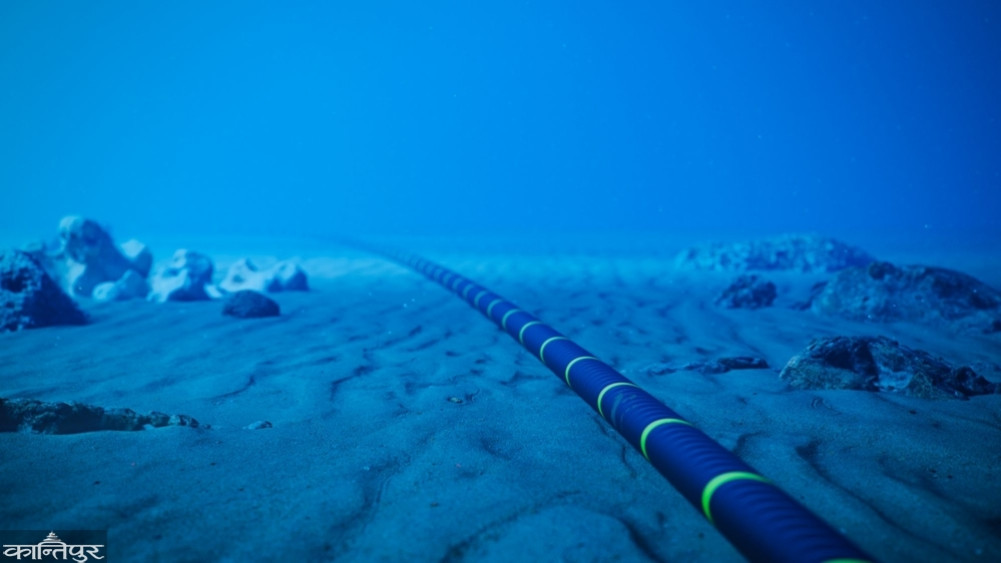
Since India's main digital communications route passes through the Gulf region, there are concerns that cutting the submarine cables there will cause a major disruption to India's cloud services and internet speeds.
We use Google Cloud Translation Services. Google requires we provide the following disclaimer relating to use of this service:
This service may contain translations powered by Google. Google disclaims all warranties related to the translations, expressed or implied, including any warranties of accuracy, reliability, and any implied warranties of merchantability, fitness for a particular purpose, and noninfringement.
The military war raging in West Asia has not only affected fuel and supply chains, but there are also concerns that it could cause a major crisis in the operation of the world's internet. After the US and Israel attacked Iran, Iran has closed the waterway called the Strait of Hormuz.
Since the main route of India's digital communication passes through the Gulf region, cutting the sea cables there will be a huge blow to India's cloud services and internet speed, according to the analysis of The Hindu's information technology journalist Jan Xavier. Thousands of kilometers of optical fiber cables have been laid on the seabed. These cables are considered the backbone of the world's digital network. Now that Iran has closed this waterway and tensions have increased in the Red Sea region due to the Houthi rebels, there is a risk that internet services will be affected.
Neighboring country, India, is very concerned about this crisis. India has recently been building its cloud and artificial intelligence (AI) related infrastructure in data centers in the Gulf region. India is worried because all that infrastructure is now in the middle of a war zone.
Since India's main digital communication route passes through the Gulf region, cutting the submarine cables there will cause a huge blow to India's cloud services and internet speed, according to the analysis of The Hindu's information technology journalist John Xavier.
India's major international cables like Tata-TGN Gulf and Falcon are connected to Europe through this region. 'Now, for the first time in history, two of the world's most important maritime data corridors, the Strait of Hormuz and the Red Sea, have been closed simultaneously. As India is building its cloud and AI infrastructure in large data centers in the Gulf region, the digital lifeline connecting those data centers is now in a war zone,' Xavier wrote. 'A large part of India's international bandwidth is brought in through submarine cables in this region. If these points are closed, the internet speed in India may slow down significantly or even lead to a digital blackout.'
A large part of the internet used by Nepal comes through Indian service providers like Airtel and Tata. According to sources, India depends on cables in the Gulf region and if there is a disruption in this region, there is a possibility that Nepal's internet speed will also slow down or blackout along with India. Since the data centers of big companies like Google, Amazon and Microsoft are also located in the Gulf region, some believe that cloud services, email and other online services used by Nepali users may also be affected.
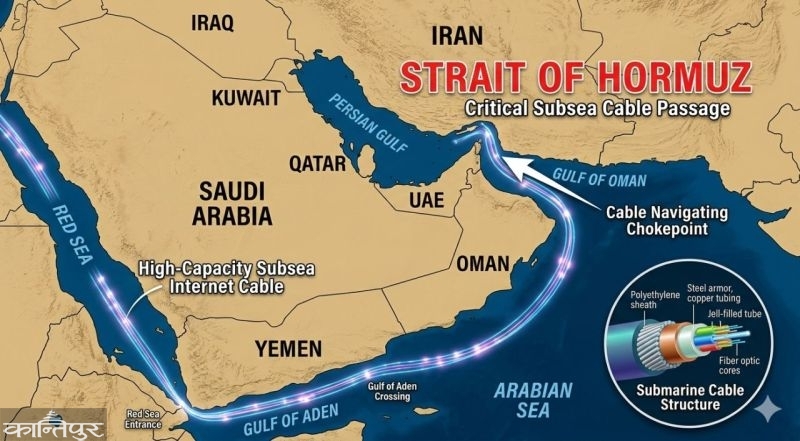
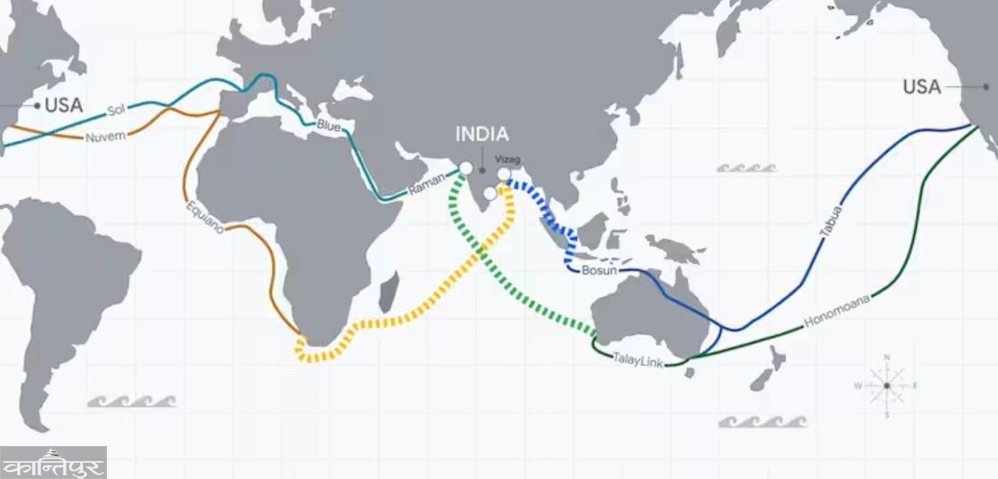
Due to this, there has been increased interest in how this tension in the Gulf will affect Nepal's internet service flow. Sudhir Parajuli, president of ISPAN, an umbrella organization of internet service providers, has clarified something on this issue. According to him, India has connected internet access from both the Pacific and Atlantic Oceans. He said that if there is a problem in the Gulf region, the internet will not be completely stopped but the speed may slow down a bit. He said that although India is the first node for Nepal, the Asia Pacific region is the second important node, so there is no need to panic.
According to Parajuli, even if the data centers of companies like Amazon and Microsoft in the Gulf region are affected, Nepal will not be affected much as it mainly receives services from centers in India and Asia Pacific. ‘There is certainly a risk of fiber being cut or problems occurring in war-torn areas, but this will not cause our internet to stop,’ he said. ‘The internet speed may slow down for some time. However, this problem will not be resolved once the capacity of alternative routes is increased.’ He clarified that initially, the alternative routes will be overcrowded and this will slow down the internet speed until the capacity is expanded.
Wireless is also a wire
Although it seems like the signal comes from the air when we use the internet via mobile or WiFi, in fact, information is being exchanged through long, delicate and thin wires laid under the sea. An email or Facebook message you send actually reaches the other side of the world through thousands of kilometers of fiber optic cables on the seabed.
It is interesting how these wires are laid. Special types of large ships slowly move on the surface of the sea, laying these wires on the ground. In some places, these wires are connected to centers called 'landing stations' on the ground. From there, the internet reaches our cities and homes through underground wires.
'Wireless' technologies like 4G and 5G are limited to only your mobile phone and the nearest tower. The signal that reaches the tower is then sent to the underground wire and connected to the main underwater wire (subsea cable). For this reason, no matter how wireless it is, more than 95 percent of the world's internet traffic travels through these physical wires.
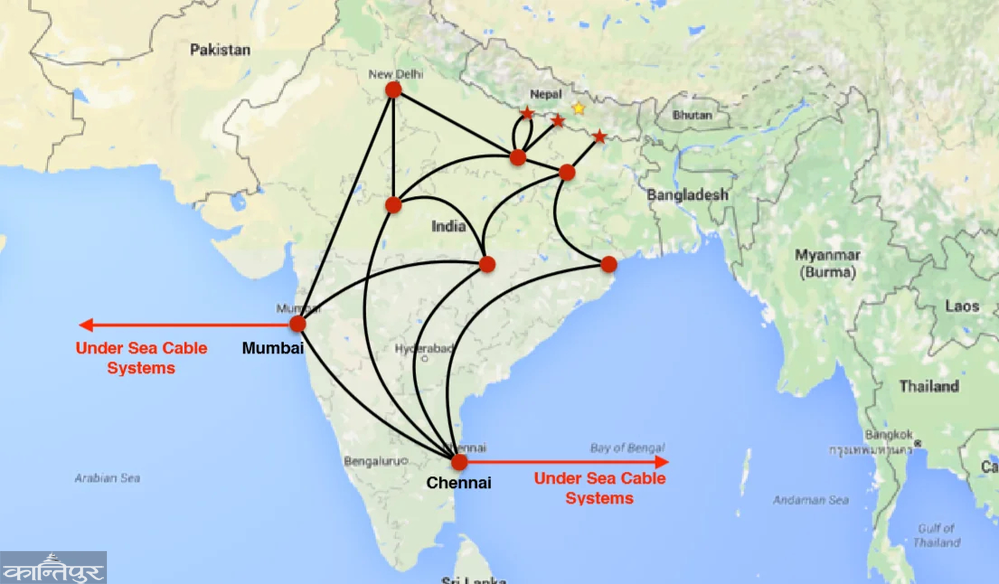
In the case of Nepal, we are connected to our neighboring country, India. In the language of the Internet, it is called the 'first node'. India has once again established digital connectivity with Europe through the Strait of Hormuz and the Red Sea and with America through the Pacific Ocean. The concern is that the wires on this underwater route will be cut or damaged when there is a war in the Middle East. In places like Hormuz, the sea is only 200 feet deep, and ships' anchors or bombs can easily cut the cables.
Repair difficult, digital infrastructure expansion uncertain
Even if the cables are not deliberately cut during war, when the border is blocked, the anchors of ships (large iron hooks that hold ships) are buried in the ground, there is a risk of severing the fiber optic cables. The thousands of kilometers of fiber
fiber optic cables under the floor of the Strait of Hormuz and the Red Sea are considered the backbone of the world's digital world. Military clashes in these areas are at risk of cutting or damaging these cables. Although under normal circumstances, if the cables are damaged, they are repaired within a few days, Indian media experts have pointed out that the internet disruption could last for weeks or months because repair ships cannot go to war-torn areas.
India aims to build itself into a $270 billion global data center hub, according to Winston Chiu’s report on how the Iran conflict could affect global communications, published in Submarine Cable Networks. He also noted that India is completely dependent on the Gulf and Red Sea routes for digital communications with Europe. “The closure of this route will weaken India’s international connectivity,” he wrote, “and the operating costs of data centers (due to rising electricity prices) are likely to increase.”
Due to the instability in the Middle East, work on major subsea cable projects such as ‘Two Africa Pearls’ and ‘SEA-ME-WE Six’ (Al Khaleej Cable System), ‘Fiber in the Gulf’,
‘WorldLink Transit Cable Project’ has been halted or uncertain. Work on ‘Two Africa Pearls’, which is being built by Meta (Facebook) and its partners to create the world’s longest
submarine cable system, has been completely halted since the war began. The ‘To Africa’ project aims to provide internet services to over 3 billion people in Africa, Europe and Asia through a total of 45,000 km of cables. The ‘Pearls’ section was specifically planned to connect the Gulf countries with South Asian countries. For this, Airtel had signed an agreement to lay the cable in Mumbai, India, and Vodafone in Qatar. The optical cable laying ship is currently stranded off the coast of Dammam, Saudi Arabia, according to international media outlets including Bloomberg.
The main digital routes connecting Asia, Europe and Africa pass through the Strait of Hormuz and the Red Sea, so a prolonged war would likely affect the global digital economy. Due to this crisis, countries are now looking for alternative routes that bypass the Middle East. These include the ‘Northern Corridor’ through Russia, the ‘Middle Corridor’ through Central Asia, or the ‘Polar Connect’ under the ice of the Arctic Ocean.
However, experts on submarine cable networks say these are very expensive and geographically challenging options. (With the help of the agency)