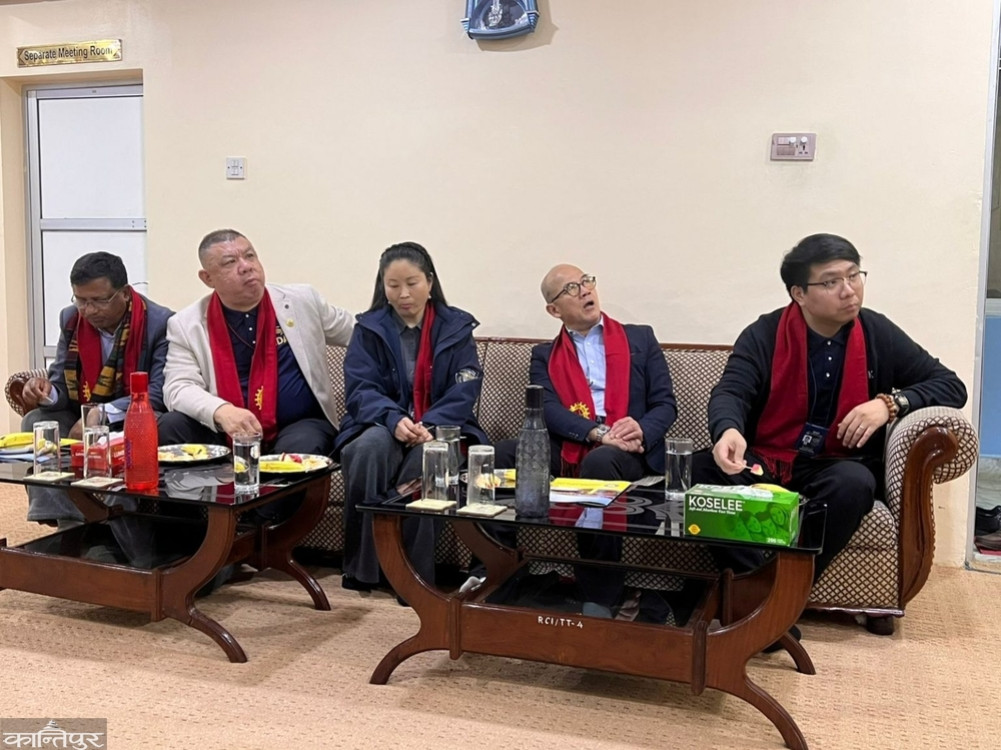
Request to sign an MOU with the provincial government for legal facilitation and land management, preparation to open a biodiesel production industry in Sainamaina with an investment of $30 million in the first phase.
We use Google Cloud Translation Services. Google requires we provide the following disclaimer relating to use of this service:
This service may contain translations powered by Google. Google disclaims all warranties related to the translations, expressed or implied, including any warranties of accuracy, reliability, and any implied warranties of merchantability, fitness for a particular purpose, and noninfringement.
A Chinese company has proposed to establish 50 industries in various districts of Lumbini Province. Stating that there is a suitable environment for establishing industries, the company has submitted such a proposal to the provincial government. The company has also called for partnerships with private business organizations and entrepreneurs.
Chinese company Jingsheng (Hainan) Investment Holding Company Limited has proposed cooperation with the provincial government for development and employment. This company is an investment partner company of the Chinese government and private entrepreneurs there. It has proposed to sign a Memorandum of Understanding (MoU) with formal information that it wants to establish a strategic partnership with the government with the aim of industrial development, job creation and promotion of international trade in the province.
Although the Chinese company proposed a partnership to establish 50 industries in the second week of Magh, the government has not taken any decision yet. The company's team that came before the elections returned due to the implementation of the election code of conduct. The team arrived in Kathmandu again on Wednesday. Lumbini Provincial Assembly member and former minister Bishnu Panthi, who is taking the initiative for coordination with the government, said that the Chinese team that arrived in Kathmandu on Wednesday held discussions with the Provincial Planning Commission on Thursday. ‘The federal government is positive about investment in Lumbini,’ he said. ‘In the first phase, discussions are underway to establish a biodiesel, fertilizer and energy production company with an investment of $30 million in Sainamaina, Rupandehi.’ In the fields of the Terai, it is customary to burn wheat stalks and rice straw to dispose of agricultural products. He said that in the first phase, the Chinese company has initiated the necessary facilitation and process for establishing an industry to produce bio energy by processing wheat stalks and straw, which are not useful to farmers.
In a letter sent to the Lumbini Provincial Government on February 1, 2026, Steward Chong, the Chief Executive Officer of the Chinese company, mentioned that he was willing to cooperate on industrial development, branding of Nepali products and promotion of exports to China. The letter proposes that Chinese government officials and business partners will pay an official visit to Lumbini Province and sign a memorandum of understanding (MOU) with the government to establish 50 industries on that occasion. The delegation of Jingsheng (Hainan) Investment Holding Company Limited had also proposed to visit various districts in the first phase on February 1 and discuss the policy priorities, industrial potential, investment-friendly environment and long-term development of the province. Chinese businessman Steward Cheng, who is also the chairman of Malaysia's JBC and JDF, who led the team, said that Lumbini can produce exportable goods instead of importing. 'There is a neighboring country with such a large population in the southern region, there is such a huge potential area for industries, now you should plan to send goods instead of bringing them from outside,' he said during the visit, 'We will create the technology and investment environment, you can end the legal hassles and manage the land.' We can't import forever, now we should produce goods for export in large quantities, and then send them to European countries after India.' He said that investors in China, Malaysia, and Europe see a lot of potential in Lumbini. He believes that there is no problem on the border with India and that the international airport will also support investment.
The proposed memorandum of understanding has made three major areas the basis for cooperation. First, there is a proposal to establish 50 manufacturing industries and factories within Lumbini Province under industrial development. This is expected to contribute to job creation, utilization of local resources, and sustainable economic growth. It has been mentioned that the company will expand the industrial base of the province through manufacturing industries. Second, it has been proposed to collaborate in the development, production, and branding of Nepali products. The goal is to add value by developing high-quality Nepali products commercially and to develop Lumbini Province as a center for nationally branded products. This is expected to directly benefit local farmers, entrepreneurs and small and medium industries.
Third, it is mentioned that the export promotion of Nepali products in China will be made an important aspect of the collaboration. The letter states that this will expand the access of Nepali products to the Chinese market, strengthen bilateral trade relations and connect Nepali industries to the international market. The company has also stated that it will provide the necessary facilitation, network and market access for the promotion of Nepali products in the vast market of China.
Stating that the objective of the potential collaboration with the provincial government is to make it long-term and result-oriented, Provincial Assembly member Panthi said that the company expects the guidance, facilitation and cooperation of the provincial government. He said that after the signing of the memorandum of understanding with three objectives, a clear framework for project implementation, investment structure and action plan will be determined.
Lumbini is an important and infrastructure-developed area for provincial trade, industrial sector expansion, production and marketing. The open border with India, wide roads reaching the border area, Gautam Buddha International Airport, industrial corridors and special economic zones, and sufficient land for establishing industries are increasing the attraction of investors in Lumbini Province. Lumbini Province's Minister for Industry, Tourism and Transport Prachanda Bikram Neupane said that a Chinese company has proposed to establish 50 manufacturing industries and that the process for facilitation with the federal government has been initiated for Lumbini's potential. 'The Lumbini Province Government is positive about this,' he said, 'However, further work has not been initiated as permission and facilitation from the federal government are also required.' He said that further work will be initiated after the federal government is formed.
If the proposal is implemented, it will bring about a qualitative change in the industrial structure of the province, said Provincial Planning Commission Vice-Chairman Dr. Dilliraj Aryal. ‘It will have a positive impact on job creation, import substitution, export growth and market expansion of local products,’ he said. ‘A clear action plan, transparency and long-term commitment are necessary in such collaborations.’ He said that although there was information that the Chinese company had proposed before the election, he was not aware of the subsequent issues.
Chinese investors claim that this region will be easy to produce and export due to the international airport, easy access to raw materials, proximity to the mountains in terms of temperature and easy access to manpower, and an easy transportation environment. The team of China’s Joeson Qin, Valeryn Queen and Mark Like have come to Rupandehi with the possibility of processing the waste that is stagnant in this region and producing many products and exporting it with great results. Chinese investor Joeson Qin said that he has requested the provincial government for legal hassles and procedural ease, stating that there is an easy possibility of investment after studying Rupandehi, Kapilvastu and Nawalparasi.
Rupandehi Industries Association President Krishna Prasad Parajuli said that the Chinese team visited various areas of Lumbini Province and had a long discussion with the association on the investment environment. He said that he found that they were keen to invest after seeing the infrastructure development, investment-friendly environment, and ease of import and export of raw materials. ‘The Chinese seem to be fully prepared for investment,’ he said, ‘They have requested for government support, facilitation of procedural hassles, and land management.’