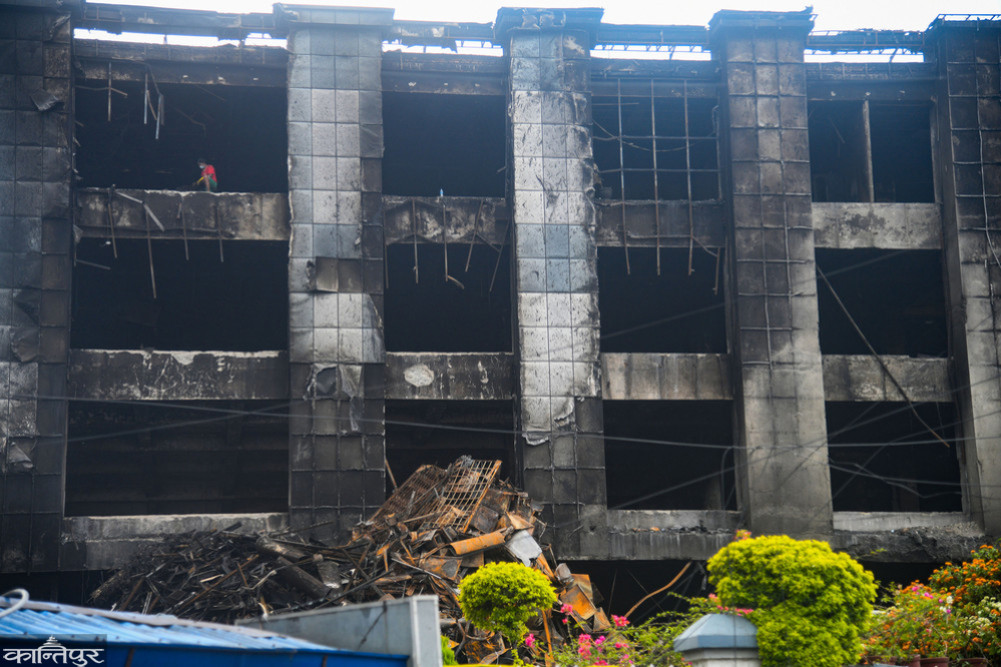
The private sector, whose property was damaged during the protests, will receive six to ten types of benefits.
We use Google Cloud Translation Services. Google requires we provide the following disclaimer relating to use of this service:
This service may contain translations powered by Google. Google disclaims all warranties related to the translations, expressed or implied, including any warranties of accuracy, reliability, and any implied warranties of merchantability, fitness for a particular purpose, and noninfringement.
The reconstruction of government buildings and properties damaged in the Gen-G movement of 23 Bhadra and the protests of 24 Bhadra will be completed within two years. The Action Plan 2082 for the reconstruction of physical structures damaged by the movement and the re-management of physical properties states that all physical structures will be reconstructed within the next two years. A committee was formed under the coordination of the Vice Chairman of the National Planning Commission, Prakash Kumar Shrestha. The committee has submitted the action plan to the government.
‘Work will be taken forward to complete the reconstruction of partially and completely damaged government buildings and structures within the next two fiscal years. For this, it will be implemented by entering the National Project Bank, Medium-Term Expenditure Structure and the Ministry-level Budget Information System,’ the action plan states. ‘For reconstruction, only the buildings and physical properties necessary for level-level cost sharing coordination, facilitation and support mobilization and service operation will be reconstructed by estimating the cost.’
The government will reconstruct all damaged structures from internal resources. The action plan for the reconstruction of physical structures damaged by the movement and the reorganisation of physical assets mentions that the internal resources of all three levels of government will be mobilized for the reconstruction of damaged government buildings and assets. However, if reconstruction is deemed impossible from internal resources, the Government of Nepal will provide support to the provincial and local levels. The action plan states that ‘coordination and collaboration will be carried out between the three levels of government bodies, the private and non-governmental sectors in the reconstruction work’ and that ‘relief, concession and incentive programs will be introduced for the revival of affected enterprises and businesses.’ The government is prepared to implement the reconstruction preparations by transferring the allocated funds to the relevant bodies in the current fiscal year. The action plan also proposes that the government provide some relief and facilities for the reconstruction of private structures damaged in the movement. For the reconstruction of government physical infrastructure, the federal government ministries and agencies will have to provide a budget of Rs 4.34 billion in the fiscal year 2082/83 and Rs 10.18 billion each year for the next two years. It is also stated that an estimated expenditure of Rs 804.2 million will be required for the preparation of the reconstruction of these structures.
The action plan suggests that insurance should be arranged by the relevant agencies that insure and own government vehicles and buildings. For this, it has been said that an annual budget of Rs 10 billion should be ensured for the next two fiscal years. It seems that for the reconstruction of the structures, an amount of Rs 812.5 million is required for the ministries and agencies under the provincial government in the current fiscal year and Rs 1.465.2 million each year for the next two years. The action plan states that a budget of Rs 1.424.7 million is required for the current fiscal year and Rs 3.219.2 million each year for the next two years for the local level. The government is also going to provide 10 different types of facilities to the private sector that has suffered damage to their homes and property in the protests.
The government had formed a committee under the coordination of National Planning Commission Vice Chairman Shrestha to prepare an action plan for the reconstruction of physical infrastructure damaged by the movement and the re-management of physical assets for 2082. The committee has submitted an action plan to the government, which includes cost assessments and policy arrangements for the reconstruction of government physical infrastructure.
The movement has caused damage to physical assets, including buildings of private sector businesses and private households. Private businesses have suffered a total of 27.49 billion rupees and private households have suffered 6.58 billion rupees, resulting in a total of 33.54 billion rupees in damage. Of this damage, 45.5 percent (15.28 billion rupees) have been damaged to buildings and houses, 5.5 percent (1.85 billion rupees) to vehicles, and the rest to other assets. Of the damage, claims have been filed with insurance companies for about 23 billion rupees.
During the movement, government, public institutions, private establishments, individual buildings, vehicles, and other physical assets worth 84.44 billion rupees have been damaged. Of this, the government/public sector has suffered losses of 44 billion 937.3 million and the private sector has suffered losses of 33 billion 548.7 million. The community and other sectors have suffered losses of 5 billion 971.7 million. Of the government/public sector, the Government of Nepal has suffered losses of 29 billion 672.2 million, the Provincial Government has suffered losses of 4 billion 495.9 million and the Local Level has suffered losses of 9 billion 815.1 million.
It is estimated that 36 billion 302.2 million will be required for the reconstruction and reorganization of the three levels of government. Of this amount, 24 billion 695.9 million will be required for the Government of Nepal, 3 billion 743.0 million for the Provincial Government and 7 billion 863.2 million for the Local Level. Of the total amount, 19 billion 989.8 million will be required for building repair and reconstruction, 6 billion 168.1 million for the purchase of vehicles and 10 billion 144.2 million for the acquisition of other assets.
These are the facilities proposed for the Private Sector
– Request the local level to waive the amount for the map approval in cases where the map approval is required for the purpose of rebuilding damaged private establishments and private physical structures
– Request the local level to provide property tax exemption for three years to damaged private commercial establishments based on the damage
– Make arrangements to provide the insurance amount of insured physical structures immediately, and if the insurance company lacks liquidity to provide the insurance amount, make arrangements to take short-term loans at concessional interest rates from the Nepal Rastra Bank, the Employees Provident Fund, and the Citizens Investment Fund
– Request the provincial government to waive the vehicle tax levied on the registration of private vehicles that were completely damaged during the movement
– Make arrangements to convert the loan into an installment loan if the borrower wishes in cases where the current assets of a company/firm/organization that is using a working capital loan are completely damaged, and make arrangements to classify the converted loan as of mid-Ashar 2082
– If arrangements have been made to reschedule and restructure loans to businesses affected by the protests by mid-December, the said period will be extended until mid-June 2083
– To set a grace period based on the time frame required to bring the business back into operation and to classify the restructured loans in the same category as mid-June 2082 by extending the grace period;
– To provide a loan for a fixed interest rate for a fixed period of time for the reconstruction of personal and commercial buildings and physical assets damaged during the protests, with a premium of only 0.5 percent added to the current base rate for up to five years
– To provide relief for private vehicles, mobile phones, laptops and clothes damaged while receiving services from government offices or in the course of performing duties
– In this way, relief will be provided at the rate of 25 percent of the total cost through the concerned District Administration Office only on the basis of the police report after the incident that took place on 23 and 24 Bhadra 2082