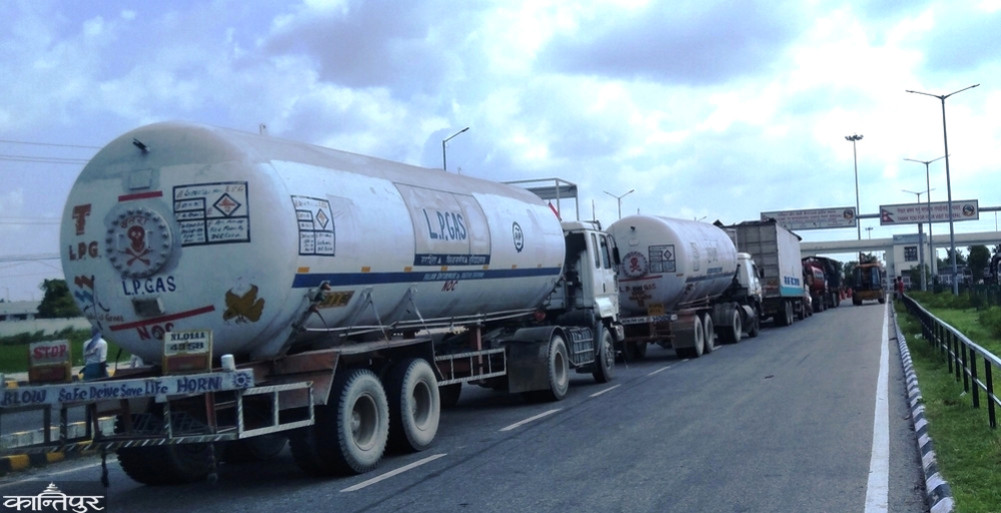
Businessmen say that they have not received the certificate because the Nepalese government has not taken sufficient initiative. Therefore, Nepali industrialists are currently dependent on Indian Bullet to import gas.
We use Google Cloud Translation Services. Google requires we provide the following disclaimer relating to use of this service:
This service may contain translations powered by Google. Google disclaims all warranties related to the translations, expressed or implied, including any warranties of accuracy, reliability, and any implied warranties of merchantability, fitness for a particular purpose, and noninfringement.
The need for storage space is felt only when there is a gas shortage in the country and the consumer line is stretched. On the other hand, when the country depends on Indian gas bullets to import gas, sometimes the import of a company is affected. Nepal has been paying India Rs 6 billion annually for transportation due to Indian bullets.
It is not that Nepali industrialists have not purchased bullets for gas imports. Industrialists say that even when they purchased gas bullets as per the government's decision, they had to sell them at a loss. According to the information issued by Nepal Oil Corporation in Asoj 2072, businessmen were allowed to buy 775 bullets. The government had also given two-thirds customs duty exemption on bullets through the budget for the fiscal year 2073/74.
 Dharmaraj Bartaula, who bought 21 bullets with the government's permission, complained that they had to sell them at a loss without using them. He said that even though the bullets were purchased because the corporation had allowed tankers, they incurred a loss. 'After getting permission from the Oil Corporation, we also placed an order to manufacture 21 bullets in India,' he said, 'but India did not give an explosives license. Without it, our bullets could not be driven in India.’
During the visit of then Prime Minister Sher Bahadur Deuba to India in 2074, the agenda of the Nepali gas bullet license was raised, but nothing happened. Bartaula says that after buying a bullet for 1.75 million rupees and not being able to use it, he had to sell it for 300,000 rupees. ‘The government did ‘lobby’ with the Indian government for an explosive license. But it was not enough, it ruined many businessmen like me,’ he said.
Bartaula has the experience of having to sell the chassis of the vehicle in the same way. He said that he sold the vehicle and the bullet at a loss of 700,000 rupees. ‘I had given 21 vehicles and the same number of bullets to be made in India, 150 to 160 million rupees were wasted, interest had to be paid, everything was ruined,’ he said.
As India did not provide the ‘explosive certificate’ required for the operation of the bullet, the bullet could not be transported. Finally, the businessmen sold the bullets in India at a loss.
The businessmen say that the Nepal government did not take sufficient initiative and did not get the certificate. That is why Nepali industrialists are now dependent on Indian bullets to import gas.
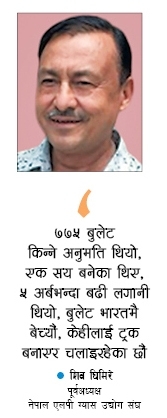
Shiva Ghimire, former president of the Nepal LP Gas Industry Association, says that the two bullets he brought for the trial are still sitting in storage. ‘We had received permission for 775 bullets, more than 100 of them were manufactured, and more than 5 billion rupees were invested in them,’ he said, ‘We sold the bullets on the spot. We also sold some vehicles, and some are being used as trucks.’
He argues that if gas were supplied through pipelines and stored in the country, there would be no shortage of gas. He said that since industrialists keep bringing and selling, there would be no stock. He said that even though the corporation has promised to build a gas pipeline and storage, it has not prioritized it.
The Corporation has stated that transportation has become easier and technical losses have decreased after the petroleum pipeline from Motihari, India, to Amlekhgunj, Nepal came into operation on 24 Bhadra 2076. The Corporation itself had been claiming that the pipeline needed to be built since Indian gas is transported by bullets. Accordingly, the Corporation had taken forward the work of the Motihari-Pathlaiya Sarlahi LP gas pipeline. Although the Indian Oil Corporation (IOC) had conducted a 'route survey' for the gas pipeline two years ago and submitted a report, no further process has been taken forward.
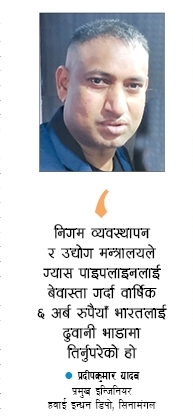 Pradeep Kumar Yadav, Chief Engineer of the Air Fuel Depot Sinamangal, says that despite the completion of the route survey with the investment of IOC, no further work has been taken forward. According to Yadav, who has also been the head of the Motihari-Sarlahi Gas Pipeline Expansion Project, which is paying an annual transportation fee of Rs 6 billion to India while the Corporation's management and the Ministry of Industry have ignored the gas pipeline. He claims that the Corporation has ignored it even though the IOC has shown interest in the gas pipeline along with storage.
A gas pipeline of about 130 kilometers should be built from Motihari in India to Pathlaiya-Sarlahi in Nepal. There was a plan to build a gas storage facility with a capacity of 10,000 tons in Sarlahi itself. Yadav also said that the Corporation has allocated Rs 50 million for the pipeline and storage facility in the budget for the current fiscal year. Stakeholders say that the gas pipeline has not been given priority because electricity production in the country is sufficient. Yadav says that consumers in the Kathmandu Valley have not been able to switch to electric stoves due to the lack of quality and reliable electricity and it will take another 10-15 years.
According to the 'route survey' conducted by the IOC, it is estimated that the pipeline and storage will cost Rs 15 to 20 billion. However, the Detailed Project Report (DPR) has not been completed. The Corporation owns 16 bighas of land in Sarlahi. In Mangsir 2081, the then Industry Minister Damodar Bhandari had proposed to build a pipeline on a grant to facilitate the storage and supply of fuel as it could not be replaced immediately.
As pipelines are the best option for fuel transportation, preparations for gas have also been taken forward. Currently, gas is transported from Raxaul to Muzaffarpur via bullets for a distance of 140 km.
IOC has already extended the gas pipeline to Motihari. The gas pipeline will prevent Nepali money from being sent abroad for transportation fares.
Due to the monopoly of Indian transporters in gas transportation, billions of rupees have been lost in transportation itself. According to the corporation, the average monthly consumption of gas is 45 to 50 thousand tons. This quantity is being transported through bullets of 5/7 transporters in India. The corporation's executive director Chandika Bhatta said that the initiative is being taken as the gas pipeline is necessary in all respects, including transportation fares. 'Gas pipelines and storage are necessary, they should be built, we are committed to this,' he said.