Waiting for support for pocket areas and commercial farming.
We use Google Cloud Translation Services. Google requires we provide the following disclaimer relating to use of this service:
This service may contain translations powered by Google. Google disclaims all warranties related to the translations, expressed or implied, including any warranties of accuracy, reliability, and any implied warranties of merchantability, fitness for a particular purpose, and noninfringement.
Chomansin Rayamajhi of Tinau Rural Municipality-1, Kachalphant, is from Rainadevi Chhahara-4, Chhahara. But he has been living in Kachalphant for three decades. He moved to the valley after the yield in the lake was low and it was difficult to work. ‘When we migrated, there was a lot of problem with irrigation canals in the field,’ he said, ‘but since it is a fertile field, the yield is good.’ He used to cultivate two crops at most until three years ago. Now, three crops are being cultivated.
The Kachalphant irrigation project, which had been lying idle for 39 years, was completed three years ago. After that, there has been no problem with water. ‘Now, not only me, but everyone here has started cultivating three crops,’ he said, ‘but we depend on the traditional farming system.’ We have not been informed about the farming system by any government agency.'
Four/five years ago, rice or millet used to be grown in the fields of Kachalphant when it rained regularly. Now, rice is grown in the rainy season. In addition to vegetable farming, mustard, lentils, wheat, and corn have also been grown. 'After cultivating pulses and oilseeds, we have gained a lot of profit from this,' said local Sita Bagale. 'I grow vegetables commercially, but I cannot sell them in the village. It is also difficult to get a price because of the distance to Butwal due to the road.' After the irrigation canal was built in the fields, the living standards of not only Rayamajhi and Bagale, but also 90 percent of the farmers have changed.'
Nearly 300 families here have said that they have started growing other grains in their fields besides rice and corn. This has increased the busyness of farmers in the fields and their financial situation has also started to change.
‘For the past 12 months, irrigation facilities have been provided in the fields to make them lush and green,’ said farmer Bagale, ‘Crops like rice, corn, mustard, wheat, lentils, as well as vegetables have also benefited. This has also changed the standard of living of farmers living in remote areas like us.’ Earlier, it was difficult for farmers here to make ends meet. Those who migrated from the lake to the valley used to be in a state of poverty. But now it is not like that. Only 6 families have left in the past one and a half years. But there are 26 families who have come.
Most of the houses have rice stored from two years ago. With sufficient water, income has also started being generated through vegetable farming, animal husbandry, and horticulture. But she complains that no body has noticed the farmers’ plight. The Agricultural Knowledge Center, National Agricultural Modernization Project, Project Implementation Unit, and local levels have not taken any plans for the three years since the irrigation canal was built in Kachal. Locals complain that the district offices have not been able to reach Kachal. 'No agency has come to Kachal Phat regarding pocket areas and commercial farming,' said local Shanta Khadka. 'Maybe they have not reached remote areas because government agencies only conduct programs around the offices.' 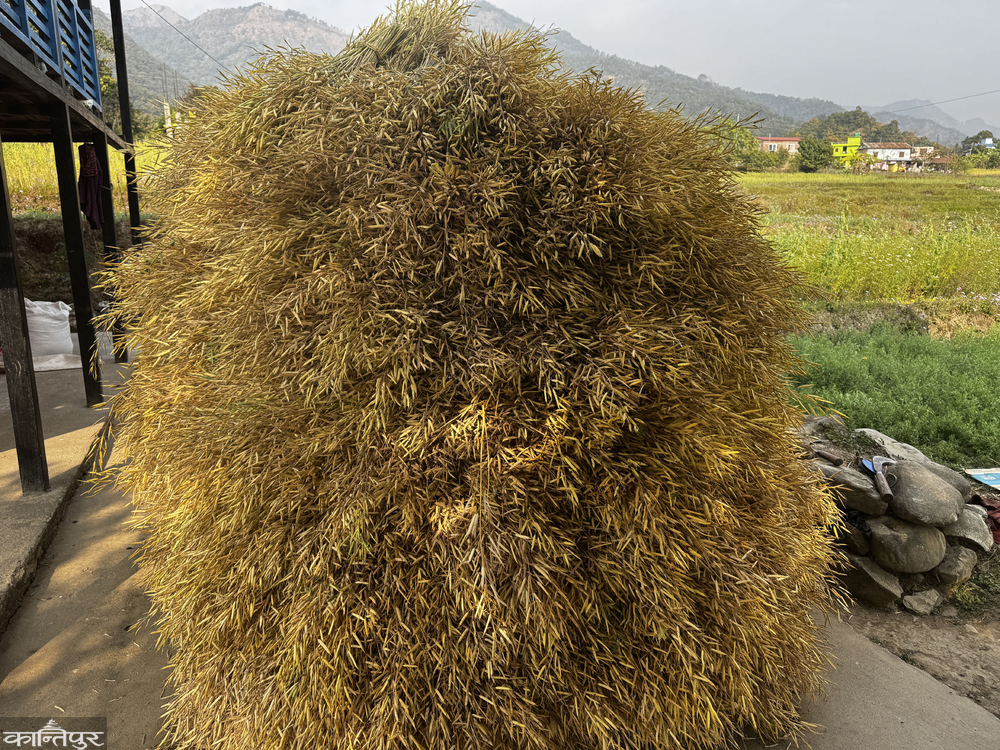
Even though irrigation facilities have been provided in Kachal Phat, they have not been able to grow vegetables commercially. There is no program to generate cash income for households. Krishna Bahadur Chhahari Magar of Kachal Phat is 84 years old. He said that when he was a young man, he had contributed to the project to bring an irrigation canal to Kachal Phat. He still remembers carrying goods from four hours away to build an irrigation canal. But he said that he did not realize that three and a half decades had passed since the work on the irrigation canal was completed. ‘I am old now, but water is flowing only in the planned canal,’ he said, ‘Planned vegetable cultivation and commercialization have not been done here. I think attention should be paid to this. Attention should still be paid to the expansion of the branch canal.’
In 2040 BS, when the then King Birendra was on a visit, the locals had demanded an irrigation canal in the Kachal field. In accordance with the same demand, work began in Kachal from 2043/44 by the order of the then king. At that time, work was done from the budget of 30 million for the plan until 2047/48. The plan could not be completed. The work that should have started from the source was done in the field in the lower area. Then, former MP Hari Prasad Nepal said that there was no budget for the plan. After that, the work was left unfinished. He said that the construction businessmen started work from the field area after seeing the cliffs and mountains towards the source, and the district office did not proceed with the work due to corruption.
That is why the water of the Dobhan (Kachal) river could not reach the field here. The project remained stalled. He claimed that former MP Nepal himself took the initiative to complete it after 2070 BS. This is the Kachal Field Irrigation Sub-project. Its source is in the Dobhan (Kachal) river. There is a 7-kilometer main canal distance from the source to the Kachal Field. The Water Resources and Irrigation Development Division Office, Palpa, has stated that the plan was designed to irrigate 6,000 ropanis (300 hectares) of land here. The project, which was stalled for a long time, resumed work in 2062/63. 'There was a situation where little budget was allocated every year, but no progress was seen in the work.'
In 2073/74, the contract for the work was awarded with a budget of Rs 139.5 million. After the work started in three packages, a contract agreement was signed between the division and Natural Construction Services Pvt. Ltd. in the first package. The second package was for the purchase of pipes, while the third package was for the work to be done through the consumer committee and the work was progressed by paying the consumer committee. Even after the steep cliff could not be broken, water is still being brought through three large pipes for 1,100 meters.
According to locals, the dream of the late social worker Lal Singh Bucha of the fake village panchayat (Kachal) of Saviko has finally come true. He had taken the plan to the king to complete the irrigation project in Kachal. ‘The dream of the late Bucha has now come true,’ said Rewant Bahadur Chhahari, secretary of the Kachal Irrigation Water Consumer Committee.
Even though the main canal has reached the village, it is yet to be taken to the lower reaches. ‘We have succeeded in bringing water from the river,’ he said, ‘now the work of a concrete canal in the branch will also be done soon.’ Despite having a large field, they could not plant more than one crop. Many also migrated due to the lack of irrigation facilities. Farmers who planted rice beds only when Asar started last year have now prepared seeds for planting. There are about 400 households here. It is believed that fertile land and irrigation will help energetic farmers become professional.

