Advice to the new government to focus on development, job creation, productivity growth, and good governance
We use Google Cloud Translation Services. Google requires we provide the following disclaimer relating to use of this service:
This service may contain translations powered by Google. Google disclaims all warranties related to the translations, expressed or implied, including any warranties of accuracy, reliability, and any implied warranties of merchantability, fitness for a particular purpose, and noninfringement.
The preliminary results of the election show that the Rashtriya Swayamsevak Sangh (RSS) will get a clear majority. In this case, a new government will be formed under the leadership of the RSS and it will be able to run the government with confidence for the next five years. In the meantime, economic experts expect that economic issues will receive priority and the country will move on the path of economic growth as there is no game of forming and toppling the government.
Industrialists, businessmen and economists have suggested that the new government to be formed under the leadership of the Rashtriya Swayamsevak Sangh (RSS) should focus on stable government, development, job creation and good governance. In the past, 32 governments were formed in the 35 years since 2047. No government was able to work for five years. Citizens gave a majority to the then Maoists in 2064 and the left alliance of UML-Maoists in 2074. The government formed at that time also did not complete its five-year term. This is why the country's politics became very fluid.
Economists say that when political parties were involved in the game of forming and toppling governments in the past, development issues did not get priority and the country was in a critical situation. They argue that the failure to achieve the expected goals in 35 years is due to political instability, increasing corruption, and the resulting distortions in the judiciary, bureaucracy and private sector.
'In the past, the private sector was encouraged through privatization. As a result, the country could not progress because the private sector had to compete, turning into syndicates and middlemen,' said an expert. 'At that time, the middlemen were the ones who had to be born in the country. The new government that will be formed now should control this, change the situation of the country, and implement the expected economic reforms.'
Ram Prasad Gyawali, head of the Central Department of Economics at Tribhuvan University, says that the new government should identify and address the basic problems of the economy and move forward. 'The Gen-G movement has caused losses of Rs 84.45 billion, both government and private, and the new government should first rebuild those structures,' he said.
Since one of the main agendas of the Gen-G movement is job creation within the country, Gyawali said that the new government should focus on fulfilling that. 'The situation has changed today due to the Iran war. There is a challenge in the security of Nepali workers in the Gulf region. But many of them do not want to return home. Because there are no opportunities here. The new government should create jobs in a way that encourages Nepalis abroad to return,' he said.
Gyawali suggests that investors' confidence should be increased now. 'Investable funds have been accumulated in the banking sector for a long time. It should be used in the productive sector to make the economy dynamic,' he said. 'For this, the government should be able to reassure investors, only in that case will investment increase.'
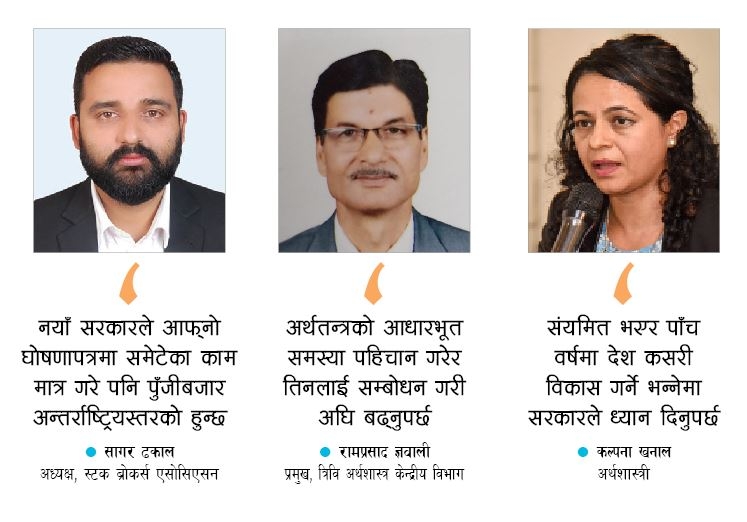
He suggests that the new government should adopt a policy of increasing production, import substitution and encouraging exports. Economist Kalpana Khanal said that the public's opinion has given great hope and confidence when the country has not been able to get a stable government for the last three to four decades. 'The government that is formed now should not panic and get carried away. They should pay attention to how to maintain this majority for five years, how to work for the development of the country, and what priorities to give to it,' she said.
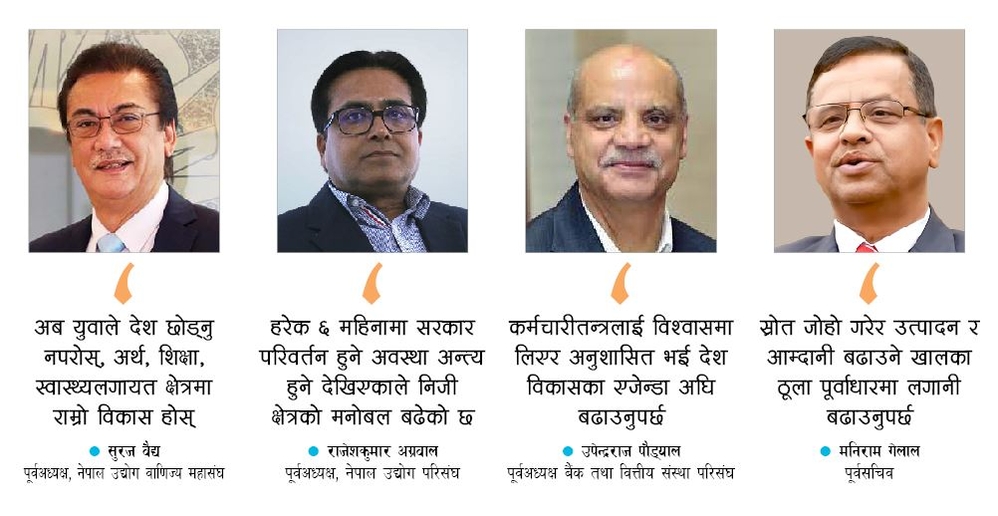
Suraj Vaidya, former president of the Federation of Nepalese Chambers of Commerce and Industry, said that there is a strong possibility of maintaining political stability in the country with the new mandate. 'It is seen that the number of youth will be large in the new government. They understand the problems and expectations of the general youth well. The government should work to fulfill the expectations of the youth,' he said, 'so that the youth do not have to leave the country.' He said that the government should work to ensure good development in the economy, education, health and other sectors.
'The Iran war has increased the price of crude oil in the world market. Its direct impact has also started to be felt in Nepal,' he said, 'Now instead of pointing out the shortcomings of other parties like yesterday, the government's attention should be focused on how the country can be developed.' Baidya said that he is fully confident that the new government can bring economic prosperity to the country.
Now the situation of changing governments every six months has come to an end, said former president of the Confederation of Nepalese Industries Rajesh Kumar Agrawal. 'Since the RSN was able to form the government alone, the country saw the possibility of getting a stable government,' he said, 'After the Gen-G movement, the country was looking for structural changes in all sectors. Now that opportunity has arrived.'
Since many MPs are coming for the first time and with new ideas, it will take time to understand everything in the first year, but development work can be carried out in the following years, he said. ‘This result has raised great hopes in a situation where the country has not had a stable government since 2046 BS,’ Agrawal said. He said that the private sector has gained confidence as a single-party government is expected to be formed. Agrawal said that the country is off to a good start as the country will be able to carry out structural work for reforms starting from laws and regulations after a majority government.
Financial sector expert and former president of the Confederation of Banks and Financial Institutions Upendra Raj Paudyal said that the new government should take the bureaucracy into confidence and make it disciplined and move forward with the development agenda. ‘Since the country is in a difficult situation, the new government should work very determinedly to overcome it,’ he said.
Nepal is currently on the ‘grey list’ of the Financial Action Task Force (FATF), an international organization that monitors money laundering and terrorist activities. Nepal has only one year left to get out of the list. Poudyal said that the country should be removed from the list by making, amending and implementing the necessary laws as soon as possible.
‘Nepal is being upgraded from a least developed country to a developing country. In such a situation, we should study and research and work on how Nepal can benefit,’ he added, ‘Since we are located between China and India, which are making great progress economically, we should be able to gain comparative advantage by balancing geopolitics.’
Maniram Gelal, former secretary to the government, said that since the RSVP will be going to the government with the great responsibility of the hopes and trust of the citizens, a lot of work needs to be done for the development of the country. He said that now we need to work in a way that increases productivity. ‘After the formation of a single-party government, there will be stability in policy and leadership. Now the government can move forward in a planned manner, including the five-year master plan and options for raising resources,’ he said.
Gelal said that capital expenditure has been completed while fulfilling the interest obligations on foreign loans. ‘Money for development is becoming insufficient. Now, we need to increase investment in large infrastructures that will increase production and income by securing resources,’ he said. Since the size of Nepal’s economy (GDP growth rate) is small, he said, expanding investment in large infrastructure is also essential to increase it.
Sagar Dhakal, President of the Stock Brokers Association, said that the initial results of the election have raised high expectations for them. ‘We have studied the manifestos of many political parties in this election, among which the Rashtriya Swayamsevak Sangh (RSS) has included many agendas for capital market reform in its manifesto,’ he said. ‘If those agendas are implemented, the Nepali capital market will reach much higher heights.’
In the manifesto, the Rashtriya Swayamsevak Sangh (RSS) has stated that it will strengthen regulatory reforms, technology-friendly transaction systems, and investor protection mechanisms to make the capital market transparent, secure, and investment-friendly. ‘We will restructure the Securities Board by making necessary amendments to the Securities Act, 2063, provide adequate manpower, enhance efficiency and provide necessary autonomy, restructure Nepal Stock Exchange (NEPSE) and CDS and Clearing Limited to increase private sector share participation and develop competitive depository services,’ the pledge states. ‘We will make NEPSE an international standard by increasing the liquidity, transparency and risk management capacity of the capital market, and by gradually introducing intraday trading, short selling and derivative financial instruments including futures, options and others with a clear legal structure and strict regulation.’
The pledge also mentions implementing a zero-tolerance policy against insider trading and market manipulation, radically reforming the IPO system, ensuring fair distribution, book building reform and timely listing. Dhakal says that even if only the work mentioned in the pledge is completed, Nepal’s capital market will be of international standard.

