The largest number of electric vehicles in the country comes from China, with electric vehicles from India, Thailand, Germany, the US, Korea, the UK, and Austria also in the market.
We use Google Cloud Translation Services. Google requires we provide the following disclaimer relating to use of this service:
This service may contain translations powered by Google. Google disclaims all warranties related to the translations, expressed or implied, including any warranties of accuracy, reliability, and any implied warranties of merchantability, fitness for a particular purpose, and noninfringement.
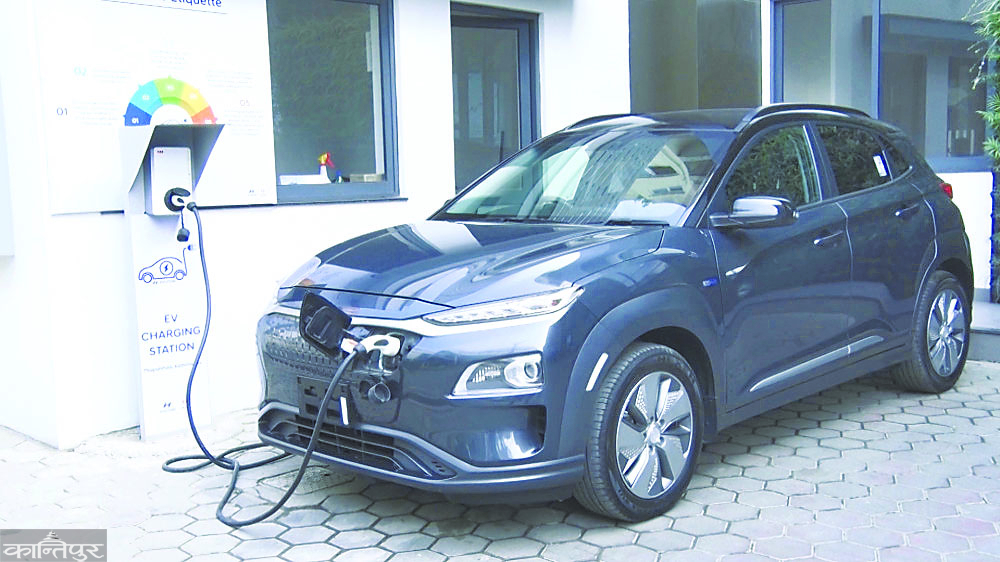
Electric vehicle imports have decreased in the seven months of the current fiscal year (Shrawan-Magh) compared to the previous fiscal year. This year, 5,894 units of electric vehicles worth 13.84 billion 7.7 million rupees have been imported till Magh. This is less than the same period of the previous fiscal year. The Customs Department has stated that 6,254 units of vehicles worth 14.66 billion 6.9 million rupees were imported in the same period of the previous fiscal year.
In the seven months of the current fiscal year, 3,402 units of vehicles ranging from 51 to 100 kilowatts have been imported. This is equivalent to 8.76 billion 41 million 73 thousand rupees. The highest import during the same period of the previous fiscal year was 3,491 units of vehicles ranging from 51 to 100 kilowatts worth 8.70 billion 237 thousand rupees.
According to the department, 1,992 units of vehicles up to 50 kilowatts worth 3.50 billion 13 million 13 thousand rupees have been imported. In the seven months of the last fiscal year, 2,159 units of vehicles up to 50 kW were imported, worth Rs 3.88 billion. In the seven months of the current fiscal year, 493 units of vehicles between 101 and 200 kW were imported, worth Rs 1.53 billion. In the same period of the previous fiscal year, only 7 units between 201 and 300 kW were imported, worth Rs 46.9 billion. In the same period of the previous fiscal year, 593 units between 101 and 200 kW were imported, worth Rs 2.76 billion. In the same period of the previous fiscal year, 11 units between 201 and 300 kW were imported, worth Rs 76 billion. The country imports the largest number of electric vehicles from China. Similarly, electric vehicles are also imported from India, Thailand, Germany, the US, Korea, the UK and Austria. In the fiscal year 2076/77, 575 electric vehicles were imported. By the fiscal year 2081/82, 13,569 electric vehicles have been imported this year alone.
The government has been adopting a policy of promoting electric vehicles to consume clean energy produced domestically and reduce environmental pollution. This is why the import of EVs has increased rapidly in recent years. However, businessmen have been criticizing the policy taken by the government for being unstable. The government has set a target of increasing the share of private electric vehicles in total vehicle sales to 25 percent and public electric vehicles to 20 percent by 2025. The private sector target has been met, according to NADA Automobiles Association of Nepal. The government has set a target of making 90 percent of private vehicles and 60 percent of public vehicles electric by 2030.
In the fiscal year 2080/81, vehicles up to 50 kW were subject to a 10 percent customs rate. In the fiscal year 2081/82, a 15 percent customs rate and a 5 percent excise duty were imposed. Similarly, in the fiscal year 2081/81, the customs rate was 15 percent and the excise duty was 20 percent, while in the fiscal year 2081/82, the customs rate was 20 percent and the excise duty was 15 percent. In the fiscal year 2081/82, the customs rate was increased to 30 percent, while the excise duty was kept constant.
In the fiscal year 2019, the customs rate was 60 percent and the excise duty was 35 percent, while in the fiscal year 2081/82, the customs rate was 60 percent and the excise duty was 35 percent. In the fiscal year 2081/82, the customs rate was 80 percent and the excise duty was 50 percent, while in the fiscal year 2081/82, the customs rate was 60 percent and the excise duty was 60 percent and the excise duty was 50 percent, while in the fiscal year 2081/82, the customs rate was 80 percent and the excise duty was 50 percent.
The Supreme Court has also ordered regarding the unstable tax policy on electric vehicles. The Supreme Court has issued an order to determine customs and tax rates and determine tax policies in a manner that promotes, protects and promotes the use of environmentally friendly technology and electric vehicles, discourages vehicles running on fossil/petroleum fuels, and promotes energy conversion.
The order was issued by a joint bench of Justices Binod Sharma and Meghraj Pokharel on 10 December in a case filed by Prakash Mani Sharma Academy for Public Interest Law against the Government of Nepal, the Office of the Prime Minister and Council of Ministers, Singha Durbar, the Ministry of Finance, the Ministry of Forests and Environment, and the Nepal Rastra Bank.

