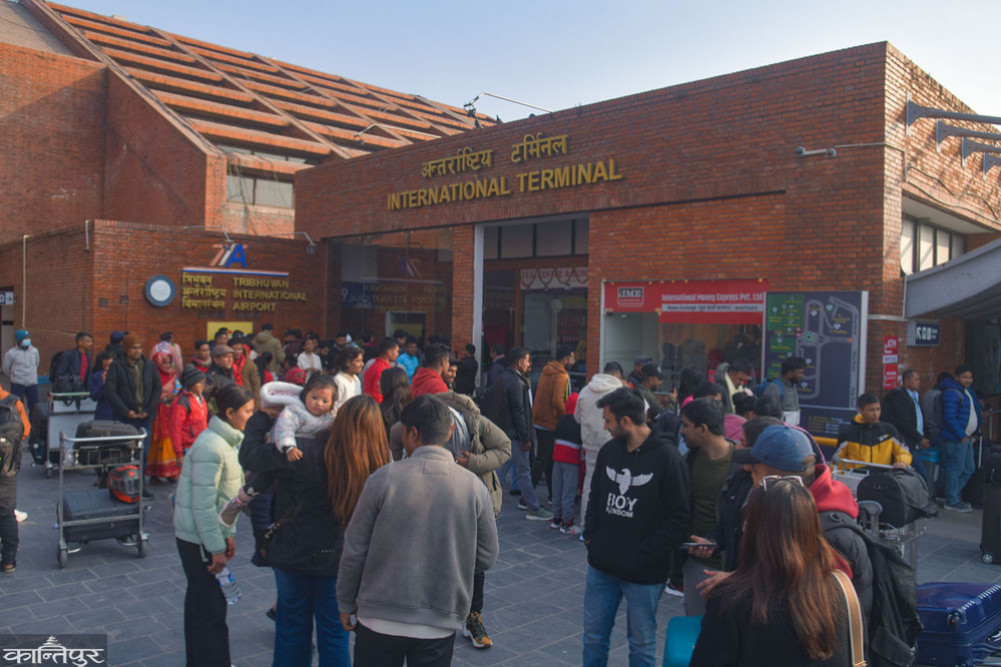
Without the option of foreign employment, millions of people would not have found employment nor would they have achieved a level of economic prosperity. This has made it possible to provide a temporary solution to the dire problem of unemployment in Nepal.
We use Google Cloud Translation Services. Google requires we provide the following disclaimer relating to use of this service:
This service may contain translations powered by Google. Google disclaims all warranties related to the translations, expressed or implied, including any warranties of accuracy, reliability, and any implied warranties of merchantability, fitness for a particular purpose, and noninfringement.
Political leaders and policymakers have been promising for years to ensure employment for every Nepali in the country. But the lack of jobs that pay enough to earn a living compels millions of Nepalis to seek foreign employment every year. Although foreign employment has improved the living standards of most, workers continue to face abuses ranging from exploitation, forced labor, and trafficking in the cycle of labor migration.
Every year, hundreds of Nepalis suffer from amputations, accidents, and even unnatural deaths abroad. Moreover, they are tired of living abroad for years and want to return to Nepal if there is a reliable alternative. But instead of decreasing, the number of people going abroad is increasing.
Nepal's constitution guarantees the right to employment. However, government surveys have shown that only one-third of the more than 20 million citizens of working age have found employment in the country, including part-time workers. According to those surveys, many of those who have found employment are not able to earn enough to meet their family's basic expenses.
For example, according to a study conducted by Tribhuvan University based on the cost of 2076/77, the monthly salary of each worker should be 21,799 to cover food and non-food expenses, while the average monthly earnings of those employed in Nepal at that time were only 17,809 and the minimum monthly wage set by the government was only 13,450 rupees. Similarly, the labor force survey has shown that about 85 percent of workers are in informal employment, which does not have job security and is not included in social security schemes such as gratuity, pension, insurance. This means that many of those who have found employment in Nepal are not in a position to live on such employment.
If there were no alternative to foreign employment, millions of people would not have found employment nor would they have achieved a level of economic prosperity . This has made it possible to temporarily solve the serious problem of unemployment in Nepal . Even if there is no paid employment, the argument can also be raised that it would be possible to earn a living by doing agriculture or entrepreneurship. But 55 percent of the population dependent on agriculture does not even have enough to eat from its own production throughout the year, only a negligible number (only 8 percent) of those who want to take loans for agriculture can get them, agricultural products cannot find markets, and climate change has increasingly affected agriculture, making it difficult to earn a living even while depending on agriculture.
Therefore, the number of people going for foreign employment is increasing every year . While 2,159 labor permits were issued in the fiscal year 2051/52, it has increased to 139,718 in 2061/62 and 499,102 in 2071/72, and it has increased to 839,266 in 2081/82 . Not only those who are going for the first time, but also those who have worked abroad once or more than once are returning.
From the fiscal year 2068/69 to 2081/82, 8.429 million labor permits were issued, out of which 3.173 million (i.e. 37.64 percent) are re-labor permits. This shows that they have to work abroad for not just one or two years, but for years. The Labor Migration Report 2024 recently published by the Government of Nepal estimates that more than 3 million Nepalis are currently working abroad.
The trend of using remittances also confirms that if they could have earned a regular income at home to earn a living, this number would not have had to go abroad. A recent study by Nepal Rastra Bank showed that 59 percent of the earnings of those who have gone abroad for employment are used for daily consumption expenses, 22 percent for education and health, and 10 percent for paying off debts.
Although the complex question of how right it is to rely on foreign employment to meet minimum needs is legitimate, the living standards of those who choose the option of foreign employment seem to have improved comparatively. Earnings from abroad have made it possible to fulfill their desires of buying a house, building a house, sending their children to 'good' schools, buying vehicles, and buying household goods and gadgets. In addition to remittances, they have also brought new skills, technological knowledge, and entrepreneurial experience to Nepal. On the other hand, remittances contribute more than a quarter of the country's gross domestic product.
In the previous decade, people mainly went to construction and domestic work, which did not earn much. But in recent years, Nepalis have been in a majority in jobs that offer lucrative income. It seems that many Nepalis have got ‘executive positions’ and ‘high-paid jobs’ not only in the Gulf and Malaysia but also in European countries.
One also has to think about what would have happened if the option of foreign employment was not available. If this option were not available, neither would millions of people have found employment nor would they have achieved a level of economic progress. What would have happened to the country’s economy? Foreign employment has made it possible to temporarily solve the serious problem of unemployment in Nepal. In this way, the role of entrepreneurs in connecting people with foreign employment is important.
The challenge in labor migration is also increasing, which has not made the situation of everyone going abroad pleasant. Having to stay away from family members for years is taking a mental and emotional toll. On the other hand, thousands of Nepalis have been subjected to exploitation, forced labor and trafficking at various stages of labor migration, while many have suffered limb amputations or unnatural deaths. The wrong practices of the businessmen who recruit workers have also become a major factor in putting them in such a situation.
The civil, political and economic rights of workers going for foreign employment must also be protected, including the right to keep their identity documents with them, not to suffer torture or abuse, to move or commute, safety at the workplace, not to be discriminated against, the right to rest or leave or to receive reasonable and timely remuneration for work, social security, the right to change employers, and the right to return to their home country.
Policies and regulations have been formulated and separate bodies have also been formed to manage labor migration and prevent problems and exploitation that may occur to workers. But state bodies are not able to intervene effectively to stop wrong practices in this area. But these rights are being violated. Many are deceived about basic issues such as the type of work, salary and benefits at the recruitment stage. According to international standards, the recruitment costs and immigration costs are not borne by the workers. However, although the policies implemented by the Nepalese government and the labor agreements signed with some destination countries state that such costs will be borne by the employers, Nepali workers are having to pay large amounts of money on loans taken out at high interest rates. Similarly, after reaching the destination country, the practice of providing different work and lower wages or facilities instead of the work, remuneration or facilities as mentioned earlier is widespread.
Even if they fall victim to such deception and fraud, the complaint process is expensive and takes a long time, the bodies that hear the complaint and make the final decision are not easily accessible since they are concentrated in Kathmandu, it can be challenging to file a complaint against a stronger businessperson in terms of the balance of power, and the civil judgment is not implemented. It is also difficult for workers at risk to get justice for the injustice done to them.
Policies and regulations have been formulated to manage labor migration and prevent problems and exploitation of workers, and separate bodies have also been formed. But state bodies are not able to intervene effectively to stop the wrong practices seen in this sector. Therefore, the number of cases of foreign employment crimes that come to light is not being punished to that extent. On the contrary, many cases have been confirmed in which the officials responsible for managing and regulating this sector are involved in financial embezzlement and corrupt activities. This is fueling extreme unrest and impunity.
The challenge of those going to India for employment is even more complex. Millions of people from different parts of Nepal (especially from the Terai and western Nepal) have gone to India for employment using the open border. But those who go in this way are not covered by Nepal's foreign employment management system. No body keeps records of them. They are not covered by the Foreign Employment Welfare Fund, and unlike those who go to third countries, they are not provided with insurance or orientation training before going to work. Therefore, it is almost impossible to receive support and compensation from state agencies if they encounter exploitation or other problems.
The Constitution of Nepal and international human rights laws and foreign employment laws to which Nepal is a party have ensured that there is no gender discrimination. However, the Nepalese government has been imposing discriminatory restrictions on women for more than two decades, sometimes by specifying an ‘age limit’ and sometimes on other grounds. Although such restrictions are said to have been imposed with the idea that ‘if women are unsafe in the destination country, then if they are banned from going abroad, they will be free from insecurity’, there does not seem to be any concrete and meaningful effort to make their migration safe.
On the other hand, the restrictions do not seem to have stopped those who send women abroad, and it is estimated that the number of women who have reached/been sent abroad informally is around 150,000. In this way, women are more at risk and exploited when they go abroad informally (without obtaining work permits).
Instead of going abroad formally (with work permits from the government), organized groups and middlemen send thousands of them informally (via India using visit visas or open borders) every year. In the event of a disaster, dismemberment or death, the workers who are taken/going in this way cannot receive financial assistance including insurance. Due to their informal and undocumented status, it is not easy to obtain legal assistance or compensation. Moreover, if a situation arises where they have to be searched and rescued, it becomes very difficult.
The failure to effectively address the problems in the labor migration sector, which has become a daily occurrence for years, and the risks faced by workers, has not only ruined the plans of thousands of people who went there with the hope of family happiness and a bright future, but has also plunged those workers and their dependent families into a serious crisis throughout their lives. Due to this, on the one hand, the provision made in the constitution to ‘regulate and manage this sector to make foreign employment free from exploitation, safe and orderly and to guarantee the employment and rights of workers’ is not being realized.
The trend of going abroad for employment will continue until livelihoods are ensured in the country. Therefore, the challenges and problems existing in foreign employment must be addressed. For this, responsible efforts should be made to amend the foreign employment law, restructure and enhance the capacity of service providers, make private sector practices clean and ethical, strengthen labor diplomacy, and make the services provided to workers and their families effective and easily accessible. In addition, the current forced situation of going for foreign employment should be gradually reduced by creating employment and entrepreneurship opportunities in the country. For this, arrangements should be made such as providing concessional loans and tax exemptions for a certain period on the enterprises/businesses they do.