According to CDSAC, the founder shares of 58 companies from various sectors are in the lock-in period, but the shares and amounts of those companies have not been disclosed.
We use Google Cloud Translation Services. Google requires we provide the following disclaimer relating to use of this service:
This service may contain translations powered by Google. Google disclaims all warranties related to the translations, expressed or implied, including any warranties of accuracy, reliability, and any implied warranties of merchantability, fitness for a particular purpose, and noninfringement.
The regulatory body's failure to resolve the issue of whether to keep founder and general shareholders' shares in the same class or separate them when listing on the secondary market risks stalling the expansion of the stock market. Energy producers claim that this poses a risk of founder investments worth about 87 billion rupees being held hostage.
There has been a dispute over whether or not to give separate International Securities Identification Numbers (ISINs) to general and promoter shares. The Central Depository and Clearing System (CDSC) has sent the ‘Securities Dematerialization Operational Guidelines 2082’ to the regulatory body Securities Board for approval, making a policy arrangement to classify promoter and general shares into two groups.
The Securities Board has not taken any decision on this matter till Tuesday, said spokesperson Niranjay Ghimire. The board had sent the guidelines to the Law Enforcement Committee for study. It was received with suggestions from there and has even been discussed in the board of directors, according to a source. ‘One of the agendas of the board of directors’ meeting on Monday was the ISIN issue. There was a discussion on it. However, it was not finalized,’ the source said. ‘Now it has been agreed to finalize it in the next meeting.’ Although the date of the next meeting has not been fixed, preparations are underway to hold it this week.
According to the source, the law The strengthening committee has given its opinion that it is not possible to distinguish between founder and common shares through the CDSC guidelines alone. For this, the committee has suggested that amendments should be made to the Companies Act, Securities Registration and Issuance Regulations, and the Central Securities Depository Service Regulations. Based on this, the source claims that the board intends to maintain the current arrangement and amend all laws and regulations in the future to make new arrangements.
There is a provision in the Securities and Exchange Board of Nepal (SEBON) to have a law strengthening committee under the coordination of the director (joint secretary) representing the Ministry of Law. In which expert directors of the board are also members. ‘It is too late to decide on this issue. Due to the employee agitation, discussions on the guidelines could not be held,’ Securities and Exchange Board Chairman Santosh Narayan Shrestha had said last week, ‘I have asked to complete the work quickly. The dispute whether two IGs are needed or one is enough should be resolved now, and should not be kept entangled.’
There has been a lot of opposition and little support in the market for the proposed arrangement of the CDSC. Founder and common shares Founder shareholders and private sector organizations have opposed the proposed arrangement, saying that it is against international policy and practice. Federation of Nepalese Chambers of Commerce and Industry, Independent Power Producers Association (IPPAN), Nepal Chamber of Commerce, etc. have opposed the proposed arrangement institutionally. General investors, on the other hand, have said that this policy is in the interest of the capital market and investors.
If the guidelines are passed as is, the companies concerned will get separate IINs for founder and general shares as per their memorandum of association and regulations. According to the law, after the period during which founder shares cannot be traded (three-year lock-in period), the companies will have to complete the duly prescribed process to convert them into general shares. Currently, in the case of banks and financial institutions and insurance companies, there is a provision that promoter and general shares remain in separate groups even after the lock-in period.
To sell promoter shares to the general public, the company must obtain prior approval from the relevant regulatory body, the National Bank of Nepal and the Insurance Authority. Now, the CDSC has prepared a guideline to have a similar arrangement for companies in banks, insurance and other sectors. Apart from that, for companies in the sector, promoter and general shares are kept in the same IIN. Even if they are in the same IIN, promoter shares cannot be traded for three years. After the three-year lock-in period, all promoter shares can automatically be converted (sold) to general shares.
The proposed directive proposes a system of giving different IINs to companies in all other sectors, like banks and financial institutions and insurance companies, for separating promoter and general shares. IIN is a number given for managing shares that have been converted into electronic media (dematerialized). After the directive is implemented as it is, in the case of companies in other sectors, like banks and financial institutions and insurance, promoter and general shares will have to be kept in different IINs throughout the lock-in period. Even after that period, promoter shares cannot automatically be converted to general shares.
The directive prepared by the CDSC regarding the registration of dematerialized shares of companies will affect 870 million shares worth 87 billion in 58 industries including energy, media, cement, etc., said the Independent Power Producers Association (IPPAN) Chairman Ganesh Karki said. However, this data is from about a year ago. In the current situation, this number and amount may fluctuate. According to CDSAC, currently, 58 companies from various sectors have founder shares in the lock-in period, but the shares and amount of those companies have not been disclosed.
‘Companies sell founder shares to the public after a three-year lock-in period and based on that, they create capital and make capital plans for projects or business expansion,’ he said. ‘Now, since they are not allowed to sell founder shares even after the lock-in period, all the capital plans of the company are stalled.’
Energy producers claim that this move will have a major impact, especially in the energy sector. IPPAN has stated that even the government’s target of generating 28,500 megawatts of electricity within 10 years will be impossible. IPPAN alleges that CDSC, after stopping the share dematerialization process for a long time, has finally sent a directive to the Securities and Exchange Board of Nepal to issue separate ISIN numbers for the shares issued to the founders and the public of all companies.
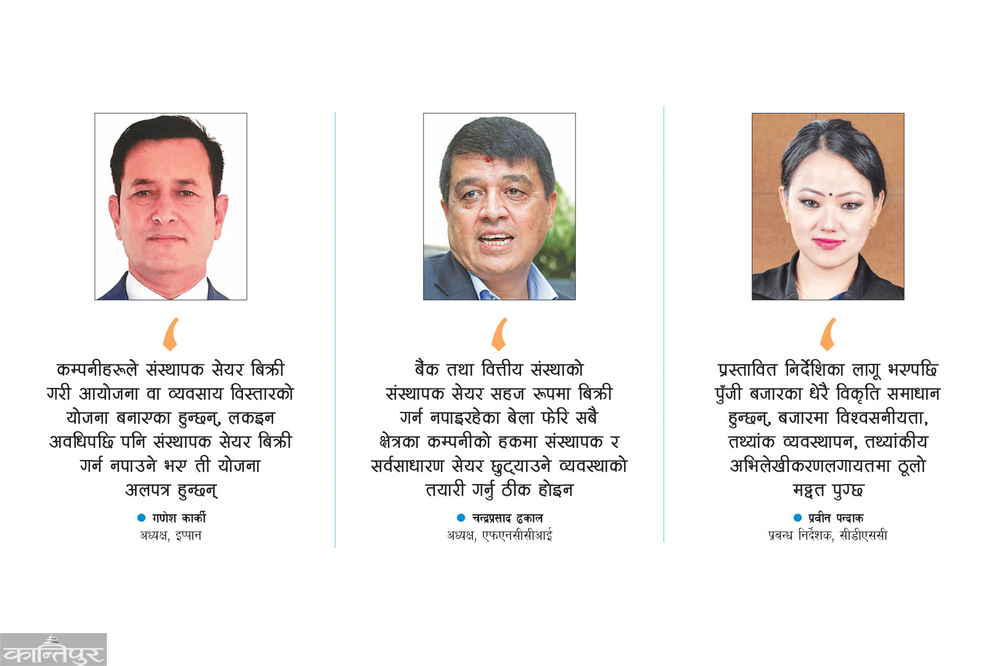
In the Act Chandra Prasad Dhakal, President of the Federation of Nepalese Chambers of Commerce and Industry, said that it is not right to prepare a system to separate founder and general shares for companies in all sectors when the founder shares of banks and financial institutions are not being sold easily despite the provision. “There is a rule in Nepal that does not allow founder shares to be sold anywhere else in the world,” he said. “There is a provision in Bafia that allows founder shares to be sold after 10 years. But that provision has not been implemented. When that law needs to be corrected, it is not right to make the same provision for companies in other sectors.” In recent years, the National Bank has been raising the issue of separating bankers and businessmen. Dhakal said that the founder shares of banks should be allowed to be sold for the implementation of that provision.
Nepal Chamber of Commerce President Kamlesh Kumar Agrawal said that the proposed provision on dual identity is impractical, investment-unfriendly and creates uncertainty in the stock market. “The provision that founder shares will not automatically be converted into general shares after the lock-in period is also not right,” he said. “If these provisions are implemented, it will have a long-term impact on the stock market. Investor confidence will be weakened. Especially in the energy sector, cement, hotels, It will have a negative impact on the manufacturing industry, media and other sectors.'
Agrawal also said that the proposed arrangement is against international norms and established practices. 'This directive is against the interests of investors. Such arrangements will add confusion and insecurity to the investment environment in Nepal's immature capital market,' Agrawal said.
Shareholder associations/organizations have claimed that two IINs are necessary to separate founder and general shares. 'Whether it is because of the CDSC system or for some other reason, it has been found that shares of some companies with the same IIN are being bought and sold in the market before the lock-in period ends. For this reason, the Securities and Exchange Board of Nepal has already taken action against two founder shareholders,' said Keshav Prasad Shrestha, President of the Nepal Stock Market Investors Association, 'A flagging code is required to separate founder and general shares. The CDSC system does not provide that code. For this reason, if someone wants to do something wrong in the meantime, they can also trade shares during the lock-in period and many such incidents are happening in the market.' To prevent such distortions, separate IINs for founder and general shares He argues that the IIN is necessary.
‘It has been seen that there is a possibility of unauthorized transactions if all shares are kept in a single IIN. From which the founders are taking unfair advantage. Not all the founders are aware of this. For this reason, two IINs are required at least for the lock-in period to prevent illegal transactions for limited founders,’ Shrestha said. Another issue is that the provision that all stock markets can be traded from the day after the lock-in period ends has adversely affected the share price since the shares are supplied to the market at once. He said that a new system is also needed to stop such a trend.
Badri Prasad Pyakuryal, Chief Executive Officer of Rastriya Banijya Merchant Banking, said that having separate IINs for the founders and the general public will not have any impact on the share price or when converting to general public in the future. ‘In the case of banks and financial institutions and insurance companies, there is a provision in the relevant act that even after the lock-in period ends, the founder shares cannot be automatically converted to general public, and special permission from the regulatory body is required. Therefore, ‘P’ is added after the founder shares even after the lock-in period ends,’ he said. He said, ‘Other than that, that is not the case for companies in the sector. Because in the case of these companies, there is a provision in the relevant law that they can be converted to general after the ‘lock-in’ period. Therefore, the regulatory body does not allow the conversion of promoter shares into general after the lock-in period.’
He said that stakeholders do not need to panic as CDS is going to arrange two IDs to separate promoter and general shares only for the lock-in period. ‘Currently, when promoter and general shares are kept in the same ID, they are kept during the lock-in period as well, if the company receives bonus shares, they remain outside the lock-in. In such a situation, some people sold their shares knowingly or unknowingly,’ he added, ‘CDSC must have arranged two IDs to prevent such irregularities seen in the market. No one needs to panic about this.’
Although the provision regarding dual IDs is only a very technical and data-recording issue of CDSC, it is being discussed outside as if it is theoretically changing the policy, as Priyaraj, former president of Nepal Stock Brokers Association, has been discussing Regmi said. ‘If the CDSC has a system in place where the promoter and general shares can be kept separate for three years and then converted into general shares after completing the normal process, then no one should panic,’ he said.
CDSC claims that the capital market will be organized
CDSC has claimed that many irregularities in the capital market will be resolved after the implementation of the proposed directive. ‘This directive will greatly help in market reliability, data management, data archiving, etc.,’ said Praveen Pandak, Managing Director of CDSC. ‘Although the law allows it, the directive that could not be made even after 15 years of the establishment of CDSC has now been made. This will make the capital market more credible.’

Chapter 8 of the Securities Central Depository Service Regulations, 2076 BS provides that the Central Depository Company can make the necessary regulations for the operation of deposit services by making an operational directive. According to the same provision, the CDSC has made an operational directive on dematerialization and sent it to the Securities and Exchange Board of Nepal for approval.
What is the process of IGIN? Yes?
Companies obtain permission from the Securities and Exchange Board of Nepal for initial public offering (IPO). After the IPO allotment, they apply to the CDSC for dematerialization (demat) of shares. After that, the CDSC dematerializes the shares and gives them an IGIN code. Legally, the CDSC is responsible for giving the IGIN code. However, since the guidelines have not been formulated yet, the CDSC requests a number (code) from NEPSE for the company concerned before giving it an IGIN. In this way, after the CDSC requests the code, NEPSE gives two codes for banks and financial institutions and insurance companies and one code for companies in other sectors.
The Nepal Rastra Bank and the former Insurance Committee have been giving two codes for companies to which they have granted licenses, as they have been giving them two codes for promoter and general shares. Since there is no separate regulatory body and no specific law for companies in the rest of the sectors, NEPSE gives a single code. In this way, in the case of banks and financial institutions and insurance companies to which NEPSE has given two codes, CDSC gives promoter and general shares separately. Register in the IIN. In the case of companies in the rest of the sectors, NEPSE has been keeping the founder and general shares in the same IIN, saying that it has given one code.
However, in the past, NEPSE has given two codes to about half a dozen companies other than banks and insurance. On the same basis, CDSC has given different IINs to the founder and general shares. Since the lock-in period of many of these companies has expired, the founder shares have also been converted to general shares. Among them, Kalinchowk Cable Car, Emerging Nepal, Citizens Investment Fund and other companies still have two IINs.
NEPSE has not been able to give any reason as to why only some companies were given two IINs. In the case of companies with two IINs, the IIN of the founder shareholder has been revoked after three years and all shares have been kept in a single IIN. Now, CDSC has claimed that it is going to make the same arrangement for all companies through the guidelines.
Founder shareholders of hydropower projects sell most of their shares after the lock-in period
Most of the founder shareholders of hydropower projects have already completed the ‘lock-in’ period A study conducted by the Securities and Exchange Board of Nepal (SEB) in the past has also shown that the trend of exiting the secondary market by selling shares immediately after the end of the lock-in period has increased. The report has pointed out that the founding shareholders of the companies themselves do not believe that the hydropower projects they have established will provide good returns in the long term. A study conducted by the Securities and Exchange Board of Nepal (SEB) on the ‘Current Status of the Share Structure of Listed Companies in the Hydropower Group and Its Impact’ has shown that most founding shareholders exit as soon as the ‘lock-in’ period (the period during which shares cannot be sold) ends.
Similarly, within the same ‘lock-in’ period, some founding shareholders in collusion with the sales managers have sold their founder shares illegally (before the end of the lock-in period), according to a SEB source. ‘A recommendation for action has been received with evidence that some founders sold shares before the end of the lock-in period, took loans by pledging their founder shares with the bank, and sold the shares after they were converted to public shares while they were still in the bank,’ the source said. ‘The details received The board is studying it.’
From time to time, there have been cases of promoter shares being bought and sold in the market before the lock-in period has expired. Problems keep arising in the systems of NEPSE and CDSC from time to time. Taking advantage of this technical weakness, clever promoter shareholders in collusion with sales managers have started selling shares in the market even after the lock-in period has expired. The Securities and Exchange Board of Nepal has stated that many investors have been recommended for action for this offense, along with facts.
Similarly, Section 9 of the Banks and Financial Institutions Act (BAFIA) provides that banks and financial institutions, if they wish, can convert the remaining portion of the promoter share group into a general share group by completing the process prescribed by the Nepal Rastra Bank and ensuring that the ownership of the promoter share group is not less than 51 percent. However, this provision has not been implemented. For this reason, the report of the ‘Banking Sector Reform Suggestion Task Force’ formed under the coordination of Rewat Bahadur Karki has also suggested that the provision for converting promoter shares into general shares should be implemented.
‘The NRB Act does not allow the conversion of promoter shares into general shares or "It is not right to not implement the existing provisions and to increase tension in the banking sector by introducing new provisions," said Coordinator Karki. "Isn't banking a social service? That is why the founders of banks should be allowed to sell shares to the general public. The law has given them that right." Guru Prasad Poudel, a member of the task force and spokesperson of the Nepal Rastra Bank, said that the provision on share conversion is in the Act but has not been implemented yet. "Even though the provision of the Act was there, it was not implemented. Now it should be implemented gradually. This will also facilitate the market," he said. "Founding investors of banks and financial institutions have panicked because they are not able to sell shares. In the case of founding investors of other companies, they have been selling shares and exiting. Now it is necessary to make it easier for shareholders of banks and financial institutions as well." The report on 'Systemic and procedural reforms to be implemented to increase the morale of general investors in the capital market' formed by Finance Minister Rameshwor Khanal last Asoj also suggested making the founder share modification system easier. "Founding shareholders of listed companies can sell all their shares and exit the company. "To discourage this trend, a scientific approach should be adopted when opening the lock-in period for the sale of shares by founding shareholders," the report suggests. "The process of buying and selling founder shares of banks and financial institutions is very complex and takes a long time to complete, so it should be reviewed."

