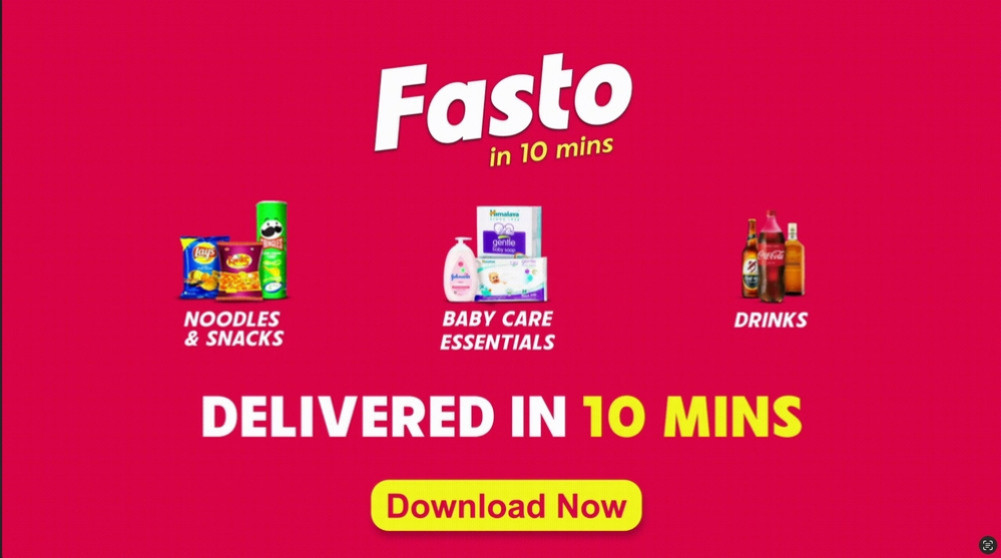
200 to 300 orders are being delivered daily. Currently, Fasto's service extends 2-3 kilometers inside and outside the Kathmandu Ring Road.
We use Google Cloud Translation Services. Google requires we provide the following disclaimer relating to use of this service:
This service may contain translations powered by Google. Google disclaims all warranties related to the translations, expressed or implied, including any warranties of accuracy, reliability, and any implied warranties of merchantability, fitness for a particular purpose, and noninfringement.
With time, the shopping habits and behavior of consumers have also changed. The Fasto app has come into the market targeting the changing behavior of consumers. Replacing the idea of ‘I will bring it tomorrow’ or ‘I will go to the store and get it’, the demand for ‘I want it now, at my doorstep’ is becoming increasingly strong. The quick-ecommerce startup ‘Fasto’, which has come into operation with this changing consumer behavior in mind, is expanding the market with the claim of delivering groceries and daily necessities within 10 minutes in the Kathmandu Valley.
Fasto, which officially launched its service on August 15, has registered more than 42,000 users in just three months. 200 to 300 orders are being delivered daily. Currently, Fasto's service extends 2-3 kilometers inside and outside the Kathmandu Ring Road.
According to the company, the order volume is gradually increasing. Fasto does not make age, gender or address the decisive basis when using consumer data. Instead, it considers shopping patterns as the main indicator.
CEO Prashant Ghimire said, "What the customer orders at what time, at what interval, which item they buy with which item - this data determines our decisions."
This is why the best-selling items on Fasto are noodles, chips, snacks, ice cream and alcohol. Ghimire said that the age group of 19 to 35-36 years has naturally become a large consumer group as the consumption of these items is linked to immediate needs and impulses. But Fasto does not want to be limited to this group. The company is now preparing to expand its range of products targeting family consumers, such as pulses, rice, oil, and cleaning supplies.
‘We decided to stabilize the service first,’ said Ghimire, ‘if we cannot reach the customer within 10 minutes of receiving the order, there is no point in marketing.’
Fasto’s main expansion is currently happening through ‘word of mouth’. Ghimire said that users are increasing because users are recommending the service to others after experiencing it.

He claims that Fasto is different from other e-commerce platforms in Nepal. When ordering on other e-commerce apps, it can take two to three days for the goods to arrive. The delivery fee also varies depending on the number of products. However, the company has stated that delivery will be free on orders above Rs 300 on Fasto. He says that only Rs 100 will be charged for purchases of goods worth less than Rs 300.
According to the company, this model will free consumers from the hassle of ‘ordering two items twice’. The most important aspect of Fasto is its ‘dark store’ model. He says that every item seen on the Fasto app is physically available in the company's own store.
Currently, 15 mini dark stores are operating in the densely populated areas of Kathmandu. Each store provides services within a distance of about 10 minutes. '10 minutes does not mean exactly 10, sometimes it can be up or down,' Ghimire said, 'But our goal is the time it takes to go to the grocery store and get the goods.'
In Western countries, it is customary to buy groceries weekly or monthly. But consumer behavior is different in Nepal and India. There is a tendency to buy goods repeatedly according to need. 'If I want to eat noodles today, I will buy it now,' Ghimire said, 'Fasto has put this consumer habit at the center of its business model.'
The company understands that if we also adopt the delivery model tomorrow, the consumer's habits will have to change. Therefore, Ghimire said that a service has been launched that matches consumer behavior.
The Fasto app was not launched all at once in 2024. The app was ready in 2022. But after the liquidity crunch in the banking system, the investment seemed risky. At that time, Ghimire recalled that he put Fasto on hold and went into ‘Pahadi Food’.
Fasto was revived as quick-commerce companies like Zepto and Blinkit were becoming successful in India, and consumers were becoming accustomed to online services due to ride-sharing and other e-commerce apps. The Fasto app was launched by rebranding a small startup called ‘Drop It’.
Since Fasto was launched, it has employed about 300 people, including store staff, riders, operations, and management.
He recalls that the biggest challenge was hiring riders. ‘When competing with ride-sharing platforms, the cost was double what was expected,’ he said, ‘but we had to accept that cost to continue the service.’
Fasto has adopted a 100 percent inventory model. Vendors apply through an online portal. The product is placed on the platform only after analyzing demand, sales potential, and margins. Initially, it is tested in a limited number of stores and then expanded to other stores.
Fasto has been operating completely on self-investment so far. Now, there are plans to increase the number of stores, expand the product range, and cover the entire valley. Ghimire says that although there is a lot of potential in quick-commerce, there are also risks. High operating costs, rider management, inventory planning, and cash flow are the main challenges.
But changes in consumer behavior, smartphone access, and the expansion of digital payments have created opportunities for Fasto. Fasto's goal is clear - to become the number one platform in Nepal's quick-commerce sector. Ghimire said, "This is not a trial project. If executed correctly, this model will run permanently in Nepal."