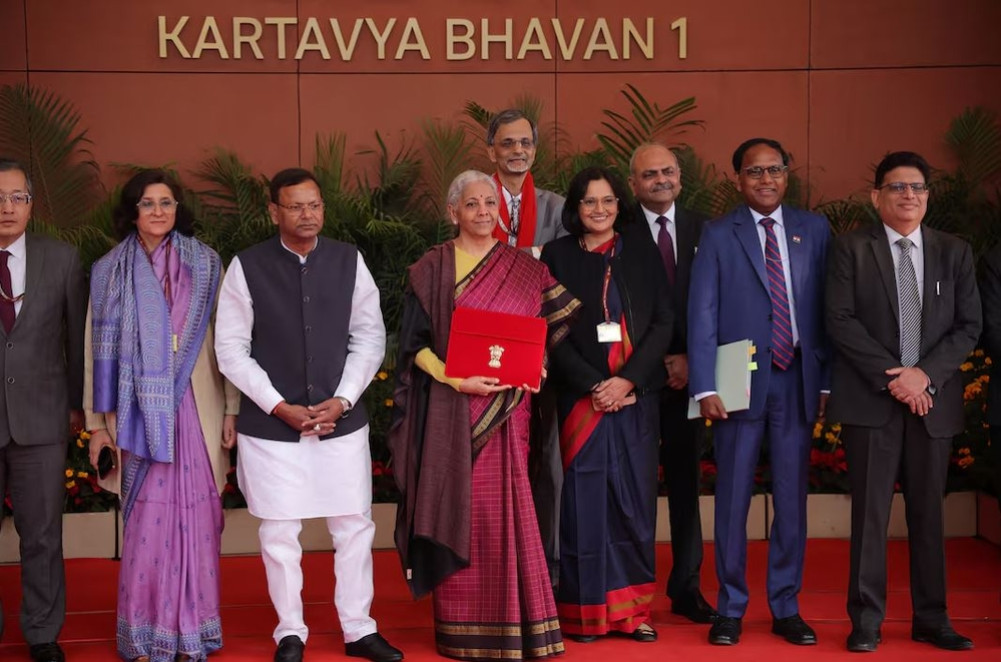
It was announced that a grant of 8 billion rupees would be provided to Nepal, the same as last year, and 22.88 billion rupees to Bhutan.
We use Google Cloud Translation Services. Google requires we provide the following disclaimer relating to use of this service:
This service may contain translations powered by Google. Google disclaims all warranties related to the translations, expressed or implied, including any warranties of accuracy, reliability, and any implied warranties of merchantability, fitness for a particular purpose, and noninfringement.
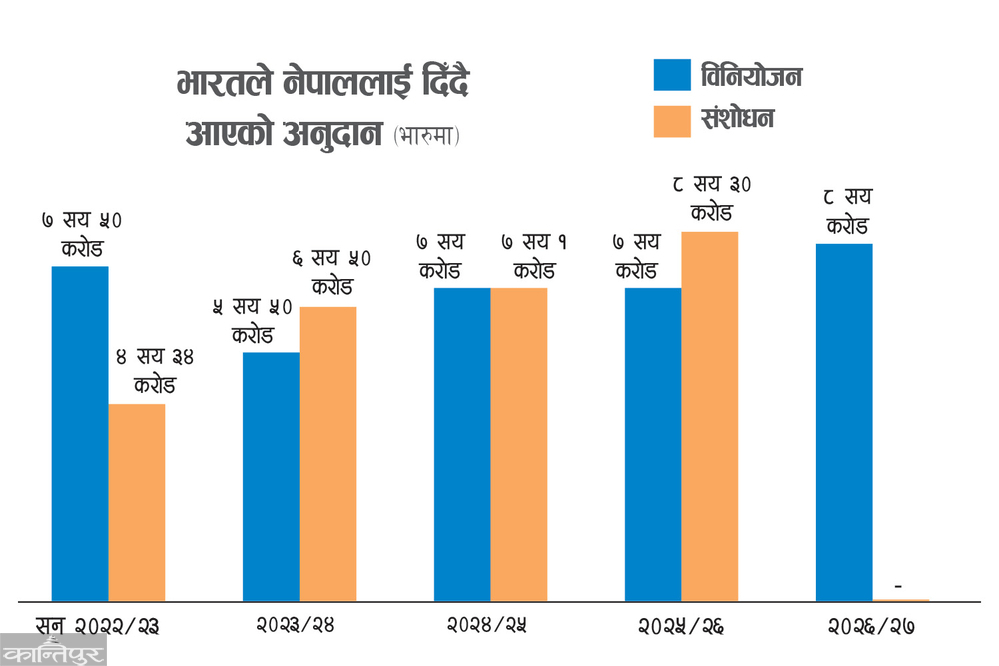
The Indian government is set to provide a grant of 800 crore Indian rupees to Nepal for the fiscal year 2026/27. The annual budget presented by Indian Finance Minister Nirmala Sitharaman in Parliament on Sunday mentions that a grant of 8 billion Indian rupees (12.8 billion Nepali rupees) will be provided to Nepal, the same as last year.
India has revised its estimate to provide Rs 830 crore to Nepal in the current fiscal year. Earlier, India had initially announced a grant of Rs 800 crore, but later revised it to Rs 830 crore. Among the neighboring countries, India has announced that it will provide the highest grant to Bhutan. India has announced that it will provide a grant of Rs 2,288 crore to Bhutan. This amount is more than this fiscal year. This fiscal year, India had allocated Rs 1,950 crore for Bhutan.
India's upcoming budget mentions that it will provide a grant of Rs 550 crore to Maldives, Rs 300 crore to Myanmar, Rs 400 crore to Sri Lanka, Rs 150 crore to Afghanistan, Rs 600 crore to Bangladesh, Rs 225 crore to African countries and Rs 250 crore to Mongolia.
 In the budget, the Indian government has reduced taxes on goods produced in India. It has reduced customs duties (tariffs) on goods imported for personal use. This arrangement seems to make such imported goods cheaper in India. India has reduced the tax on textiles, leather products, mobile batteries, electric vehicles and synthetic footwear from 20 percentage points to 10 percent. Bangladesh is likely to be more affected by the reduction in tax on textiles than Nepal. However, Nepal's import costs are likely to decrease as goods become cheaper in India.
Just a few days ago, India signed an open trade agreement with the European Union. This agreement was signed to boost exports of goods and make India an industrial zone. Accordingly, India has reduced the tax on electric vehicles imported from China not only to its own country but also to neighboring countries to increase exports. This may make electric vehicles imported into Nepal somewhat cheaper.
The federal budget presented by Finance Minister Nirmala Sitharaman seems to focus on the vision of a 'developed India' by ensuring inclusive development. The budget has emphasized a sustained growth rate of about 7 percent. The budget aims to maintain this momentum through structural reforms and productivity growth. The Indian government has fulfilled its commitment to reduce the fiscal deficit to less than 4.5 percent of GDP in 2025/26. It has set a target of 4.3 percent for the financial year 2026/27.
To maintain the momentum of public investment infrastructure, the Indian government has proposed to increase capital expenditure to Rs 12.2 lakh crore for the next fiscal year. The government has set a target of around 50 percent of the debt-GDP ratio by 2030/31. While the ratio is 55.6 percent in fiscal 2026/27.
In the upcoming budget, the Indian government has strategically revised the policy easing and initiatives, especially in the manufacturing sector, in which special facilities are sought for micro, small and medium enterprises.
A new plan with an expenditure of Rs 10,000 crore over the next five years has been brought in the budget to make India a global biopharma hub. For this, the launch of ‘ISM 2.0’ to expand the semiconductor supply chain and a budget of Rs 40,000 crore has been allocated for electronic component manufacturing.’
The budget mentions the establishment of a Rs 10,000 ‘SME Growth Fund’ to support small businesses with high potential. The government has announced an integrated program to modernize the textile industry. For this, an integrated program including the establishment of ‘Samarth 200’ and ‘Mega Textile Parks’ has been announced in the budget.
Infrastructure and connectivity have also been prioritized in the budget. For this, India plans to develop seven new corridors including high-speed rail Mumbai-Pune, Delhi-Varanasi and Chennai-Bangalore.
‘Establishment of new dedicated freight corridors (east to west), operation of 20 new national waterways and ‘Bharat-Vistaar’ program to turn second and third tier cities into growth engines under the urban economic zone have also been brought in the budget.
Rs 5,000 crore per CER has been allocated for agriculture and rural development. It is said that 500 reservoirs will be developed for high-value crops (coconut, cashew, plantains and fish farming) to increase farmers' income and 'Sea Marts' and community-owned retail stores for rural women-led enterprises will be operated to promote entrepreneurship.
India has allocated a budget of Rs 53.4 billion for the upcoming fiscal year 2026/27. Finance Minister Sitharaman has allocated Rs 41.2 billion for current and Rs 12.2 billion for capital expenditure in the budget. She said that the government has given priority to industrial development.