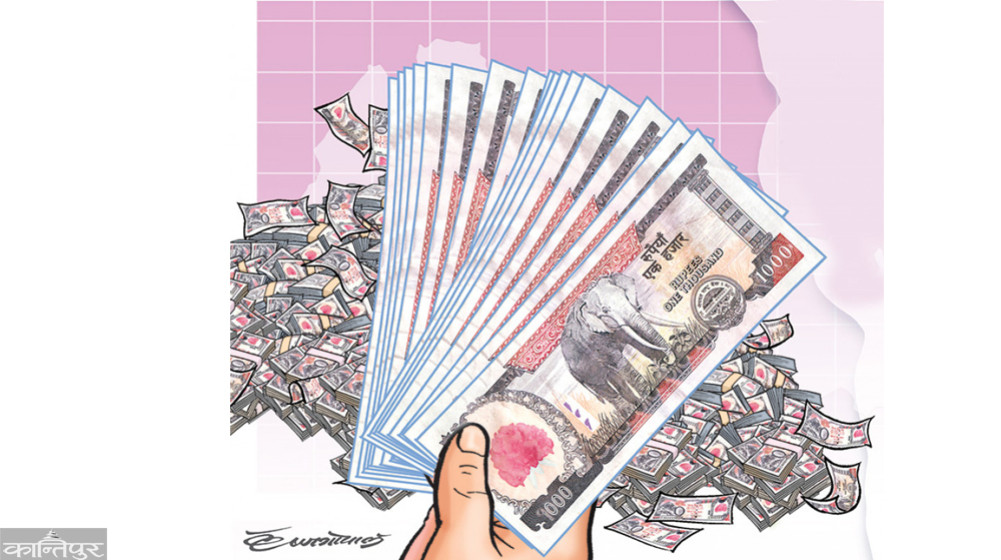
In November 2082, the buying exchange rate of one US dollar reached 144.37 rupees.
We use Google Cloud Translation Services. Google requires we provide the following disclaimer relating to use of this service:
This service may contain translations powered by Google. Google disclaims all warranties related to the translations, expressed or implied, including any warranties of accuracy, reliability, and any implied warranties of merchantability, fitness for a particular purpose, and noninfringement.
Nepal Rastra Bank has set the exchange rate of one US dollar at 147.41 rupees (selling rate) for Tuesday.
This is the highest ever. The Nepali rupee has been continuously weakening against the US dollar in recent weeks.
At the same time, the dollar exchange rate has been continuously setting new records. However, last Saturday the exchange rate of one US dollar was 147.41 rupees.
A week ago, such an exchange rate was 146.81 rupees. The monthly report of the Nepal Rastra Bank has shown that the Nepali rupee has depreciated (weakened) by 5.1 percent against the US dollar as of last Mangsir compared to Asad 2082.
The Nepali rupee had depreciated by 1.5 percent in the same period last year. In Mangsir 2082, the buying exchange rate of one US dollar reached 144.37 rupees. In mid-Asad 2082, the exchange rate was 137 rupees.
What are the benefits and losses of an appreciation of the dollar?
Nepal also benefits when the dollar becomes stronger. In the current situation, the greatest benefit falls on remittance inflows. When the dollar is strong, on the one hand, remittance inflows (money entering the country) increase, and on the other hand, the number of remittance senders also increases.
Nepalis living abroad send large amounts of remittances as they benefit from the strengthening dollar. One reason for the continuous increase in remittances in recent months is the strengthening dollar. When the dollar is strong, it also has a positive impact on foreign direct investment (FDI).
Thus, the improvement in remittances and FDI helps greatly in keeping the country's balance of payments in surplus. Nepal could have benefited from the strengthening dollar by making good improvements in tourism and exports. Although tourists are now gradually increasing, it has not been able to increase as expected. Exports remain high.
However, Nepal has not been able to benefit from the increase in exports due to the increase in domestic production, but rather due to the increase in the import of crude oil from India and the increase in the rate of export to India.
When the value of the dollar increases, the biggest loss is in payments for imports of goods and services. As imports are increasing, the liability to pay for them is also increasing. When the rupee weakens, the liability to pay foreign debt increases. A lot of money is also needed to pay the principal and interest on loans taken from abroad. The cost of going abroad for medical treatment, studies, and travel is expensive.