Most previous elections have seemed to change the direction of the stock market. This is confirmed by the periodic elections and the state of the stock market at that time.
We use Google Cloud Translation Services. Google requires we provide the following disclaimer relating to use of this service:
This service may contain translations powered by Google. Google disclaims all warranties related to the translations, expressed or implied, including any warranties of accuracy, reliability, and any implied warranties of merchantability, fitness for a particular purpose, and noninfringement.
The country is currently in the midst of an election. Political parties have easily registered their candidacies in all 165 constituencies of the country. As preparations for the general election continue, speculation has begun about who will lead what kind of government and how it will affect the stock market.
Political parties have only rarely declared their future prime ministers and gone to the polls. In 2056 BS, the Congress had declared Krishna Prasad Bhattarai as the future prime minister. Since then, this year, for the first time, three parties, the Congress, the UML, and the National Independent Party, have declared their future prime ministers and gone to the polls. Therefore, investors are curious about what the relationship between the government formed after the election and the stock market will be.
Most previous elections seem to have changed the direction of the stock market. This is confirmed by the occasional election and the stock market situation at that time. Because there is a direct relationship between political events and investor psychology. When a strong government and the country's politics are stable, the stock market tends to rise, while changes in government and political instability in a short period of time cause the market to fall.
With every election in Nepal, there are fluctuations in the stock market. Analysts say that the election results in the stock market, which are directly linked to political stability or instability, have been affecting investor psychology and the direction of the market.
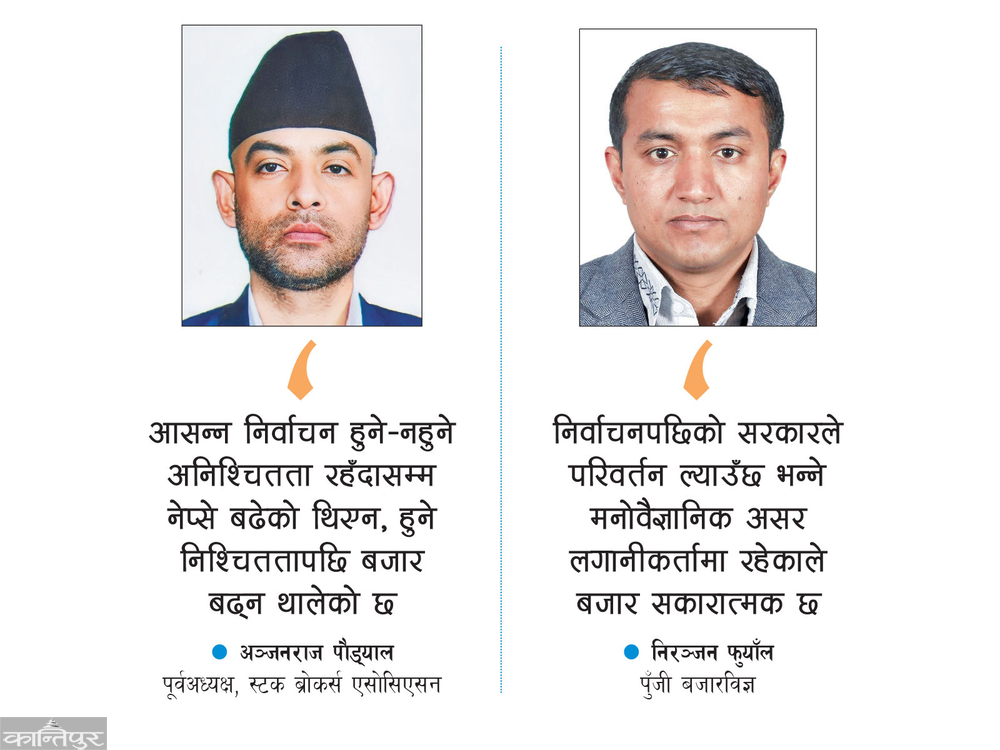
Niranjan Phuyal, a capital market expert and CEO of NRN Infrastructures and Development, says that the stock market will see positive changes in the stock market, especially since elections encourage investors to invest in the hope that a new person or political party will come to power and bring about change.
‘The psychological impact that the government after the election will bring about change remains on investors. This trend has also been seen in the stock markets of countries including India, Bangladesh, Malaysia,’ he said, ‘but there are also situations where the market has not fallen after the old party or person returns to power even after an election in a given year.’
An analysis has been made of the half-dozen previous elections to the House of Representatives and local levels in Nepal and the state of the stock market at that time. After the political changes of 2046 BS, parliamentary elections were held in Baisakh 2048, Kartik 2051, Baisakh 2056, Chaitra 2064, Mangsir 2070, Masir 2074 and Mangsir 2079.
Local body elections were held in 2049 and 2054, and local level elections in 2074 and 2079. Among them, the parliamentary and local body elections since April 2056 and the state of the stock market at that time have been analyzed here. In most parliamentary elections, the stock market has increased, while in local elections it has decreased.
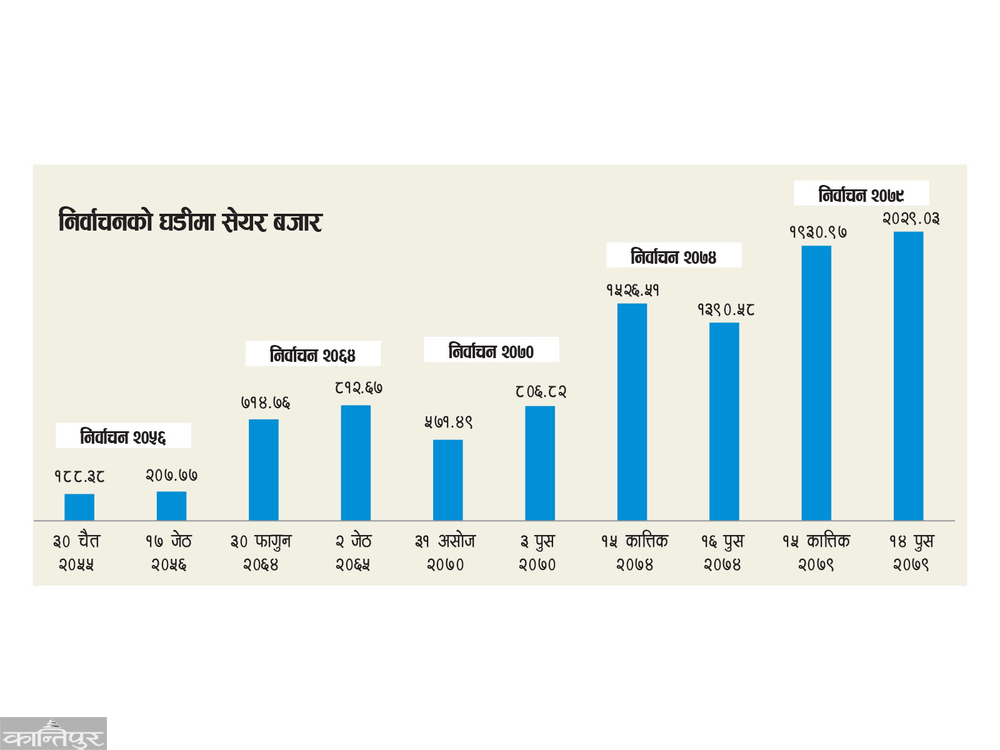
Parliamentary elections were held in two phases in April 2056. The first phase was held on April 20, 2056, and the second phase on June 3, 2056. At that time, a positive impact was seen on the stock market. The NEPSE index, which measures the stock market, increased by about 11 percent in about a month before and after the election.
The NEPSE index, which was at 188 points on April 30, 2055, reached 208 points by June 17, 2056. This has been analyzed as a positive impact of the election on the stock market. At that time, after the Nepali Congress won a majority, Krishna Prasad Bhattarai became the Prime Minister and Mahesh Acharya became the Finance Minister.
The stock market also rose by about 10 percent in the first Constituent Assembly election on April 28, 2064. This is the increase in the stock market in the 38 days before and after the election. The then Maoists became the largest party in that election.
Then, with the support of UML and others, the Maoists formed the government. At that time, Pushpa Kamal Dahal became the Prime Minister and Baburam Bhattarai became the Finance Minister. On 30 Falgun 2064, the NEPSE was at 714.76 points. On 2 Jestha 2065, the NEPSE reached 812 points.
The second Constituent Assembly election was also held on 4 Mangsir 2070. At that time, the stock market seemed to have increased by about 41 percent in a period of about a month, before and after the election. Accordingly, the NEPSE index, which was at 571 points on 31 Asoj 2070, reached 806 points by 3 Paush 2070. While by 16 Paush 2070, the NEPSE had fallen to 770. In this way,
Despite the decline, the NEPSE seems to have increased by about 35 percent in a month. In that election, the Nepali Congress became the largest party and with the support of UML, Sushil Koirala became the Prime Minister and Ram Sharan Mahat became the Finance Minister.
Another election was held in Mangsir 2074. In the first election held on 10 Mangsir and the second on 21 Mangsir, the UML and the then Maoists formed an electoral alliance to later unite. They also won a two-thirds majority. Then, with the support of the Maoists, Prime Minister KP Sharma Oli and Finance Minister Yubaraj Khatiwada became the Prime Minister.
The election at that time and the subsequent formation of the government also had a negative impact on the stock market. At that time, the NEPSE seemed to have decreased by about 9 percent in the month before and after the election. The NEPSE, which was at 1,526 points on 15 Kartik 2074, was at 1,536 points on 20 Mangsir. The NEPSE continued to decrease thereafter. On 16 Poush, the NEPSE fell to 1,390 points.
‘Elections reduce political uncertainty and the stock market seems to have responded positively after the results. But after the 2074 election, the market has decreased,’ said Phuyal, CEO of NRN Infrastructures and Development.
‘At that time, the market was on a downward journey even before the election, the NEPSE index had reached a historic high in mid-2016 and was in a ‘cosection’ phase throughout 2017,’ he said. ‘When investor morale was weak, the positive impact of the election (the election and the government formed thereafter) alone could not bring the market back.’
At that time, there was a lack of liquidity in the banking system, interest rates increased, and banks were under pressure to adjust the CCD ratio. Political stability came after the then left coalition won about a two-thirds majority, but the market fell because the market could not clearly see the direction of economic policy, according to his analysis.
The last parliamentary election was held on 4 Mangsir 2079. In which the Nepali Congress became the largest party. The third largest party formed a government under the leadership of the then Maoists, the second party UML and other parties. That government included Prime Minister Pushpa Kamal Dahal and Finance Minister Bishnu Poudel. There was no significant fluctuation in the NEPSE in the month before and after this election. On 15 Kartik 2079, NEPSE was at 1,830.97 points. On 14 Paush 2079, NEPSE reached 2,290.03 points.
‘At that time, due to weak investor morale, the market rose normally for a few months after the elections held in Manjre 2079, but started to decline after 3-4 months. In the last week of Chaitra that year, the market fell from its previous high of 3,200 to 1,832 points,’ Phuyal said. ‘Even when the country saw the desired political stability in 2074, the market failed to grow. Without a new face and a new policy, investor morale failed to increase.’
This does not mean that the market will only increase with elections, if it does not have a positive impact on investor morale, the market may also decrease, and there may be a correction in the market that has been rising for some time, says Phuyal.
Local body elections were held in 2049 and 2054 and local level elections in 2074 and 2079. The stock market has fallen significantly in both those elections.
The upcoming election is different from the previous ones because it is special, said Anjanraj Paudyal, former president of the Stock Brokers Association. ‘There was a dilemma as to whether this special election that the government formed after the Gen-G movement is going to hold will happen or not. When it was seen that the election would happen, the market has gradually set an upward path,’ he said, ‘There is also speculation that the election results will be different from the previous ones.
The people have sought change including corruption control and good governance. Investors are seeing a psychology of whether the new government will address their agenda.’ Paudyal said that in the past, when a party with an open economy and democratic ideology came to power, the stock market tended to rise, and when parties with communist ideology came to power, the stock market tended to fall.
In the past, some leaders have called the stock market a gambling house, while some prime ministers and finance ministers have been lenient towards the stock market. The fact that the stock market has declined or failed to take a clear direction while that person and party were in leadership also confirms Poudyal's statement.