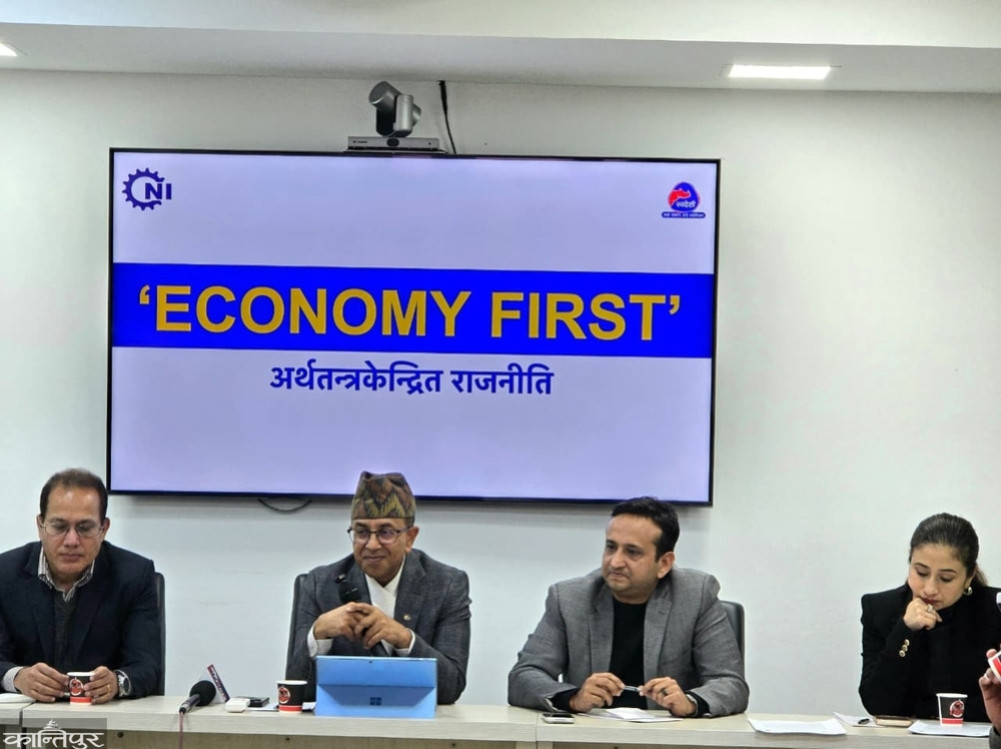
Emphasis on the need to give priority to a strong economic system, along with political stability, for the country's development
We use Google Cloud Translation Services. Google requires we provide the following disclaimer relating to use of this service:
This service may contain translations powered by Google. Google disclaims all warranties related to the translations, expressed or implied, including any warranties of accuracy, reliability, and any implied warranties of merchantability, fitness for a particular purpose, and noninfringement.
The Confederation of Nepalese Industries (CNI) has urged political parties to formulate manifestos by giving top priority to the economic agenda. The suggestions were made public by holding a press conference on Sunday to provide suggestions on the issues that parties should prioritize in their manifestos.
From 2007 BS to the Gen-G movement of 2082 BS, despite many political changes, economic changes have not gained momentum, said Birendra Raj Pandey, president of the Confederation. He said that although the parties have brought an economic agenda in their manifestos, implementation has not been given priority when they are in government.
‘The Confederation emphasizes that along with political stability, a strong economic system should be given the first priority for the development of the country. The parties should move forward with a national consensus on economic development issues and agendas for the prosperity of the entire nation, including good governance, economic development, and employment, which are sought by the general public,’ said Chairman Pandey. ‘The national consensus should clearly mention the long-term vision for the development of the country, priority areas, and time-bound action plans for projects and implementation.’
All political parties should prepare manifestos with the economy at the center and that it should make it clear to the common Nepali how the country will move forward in terms of development in the coming days, said Nirvan Chaudhary, senior vice president of the Confederation. "Considering the declining confidence of the private sector, we need to be assured of how the overall economic development will proceed," Chaudhary said.
The Confederation has urged to give high priority to the issue of effectively implementing the 'faceless, contactless, paperless' system for good governance, and to increase industry, production, and entrepreneurship. The Confederation has suggested prioritizing issues such as an integrated industrial development strategy, new lawmaking and reform, improving good governance by focusing on the use of information technology, and reforming the tax system to increase investment.
The commitments made in the manifestos of the parties and the lack of coordination in the work done by them when they were in government, and the past experience of political agendas taking priority over the economic agenda, have made comprehensive reforms inevitable in the coming days, the Confederation has stated.
It is necessary to close the huge gap in the policies and programs, budgets and implementations formulated by the government, the priorities are changing while the economic policies and plans for the country's economic development should be continued, and the country is lagging behind economically due to the lack of efforts to take ownership of the policies and programs, Pandey said.
He said that the common people are concerned that the issues of good governance are being talked about but not implemented. The Confederation emphasizes that the bodies and individuals responsible for the effective implementation of the announced economic policies and plans should be made more responsible.
The Confederation has included suggestions on the priorities that the parties should give in the areas of industrialization, export promotion and import substitution, promotion of domestic goods and market regulation, direct foreign investment, skills and employment, infrastructure development, good governance, innovation, domestic, small and medium enterprises, information technology-based industries, education and health, energy, tourism, agriculture, forestry and environment.
The Confederation has stated that a national consensus and 'thought paper' are necessary regarding economic development. The Confederation has suggested that a common vision statement regarding economic development should be prepared through political consensus, looking at the experiences and practices of neighboring countries. The Confederation has been emphasizing the need to move forward in order to make the current economy worth about $44 billion to $100 billion within the next 10 years. For this, the Confederation has said that it is conducting a comprehensive study with the participation of national and international experts. It has been stated that the study will be completed and made public within the next few months.