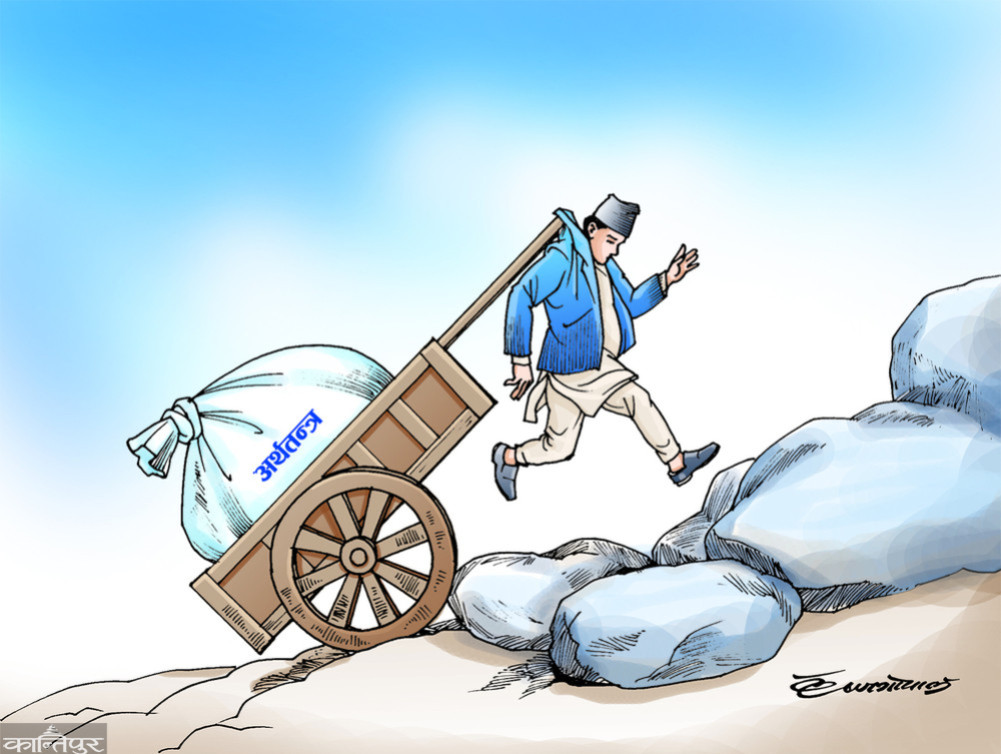
Although revenue collection increased by about 2 percent in the same period of the current fiscal year compared to the same period of the previous fiscal year, the situation of capital expenditure is disappointing.
We use Google Cloud Translation Services. Google requires we provide the following disclaimer relating to use of this service:
This service may contain translations powered by Google. Google disclaims all warranties related to the translations, expressed or implied, including any warranties of accuracy, reliability, and any implied warranties of merchantability, fitness for a particular purpose, and noninfringement.
The Gen-G movement, which demanded corruption control, good governance, and improvements in public services, saw a change in government and ministers. But the state of government finance indicators did not change.
Rameshwor Khanal, who has spent nearly three decades in government service and held important government positions including Finance Secretary, is the Finance Minister.
Khanal, who has studied the ins and outs of the economy and is aware of the reasons for the failure of economic reform, said that after taking over the responsibility of the Ministry of Finance, the expectations of the common people were high, saying that there would be reform. Khanal also made efforts for reform. However, the results of the reform have not been visible.
Although revenue collection increased by about 2 percent in the same period of the current fiscal year compared to the previous fiscal year, the situation of capital expenditure is disappointing. This also confirms that the government has changed in the country and ministers have changed, but the situation of government finances has not changed, say experts.
In the first 6 months of the current fiscal year (Shrawan-Pus), the government has spent Rs 49.4254 billion in capital expenditure. This is 12.12 percent of the annual target. The capital expenditure in the half-year (6 months) of the current fiscal year is about Rs 7.5 billion less than the same period of the previous fiscal year. The government had spent Rs 56.935 billion, or 16.16 percent of the annual target, on capital expenditure until December 2081/82.
The economy is currently in a liquidity trap. In such a situation, monetary policy ceases to work. It is fiscal policy that should be active. The economy needs a ‘big push’ now.-Keshav Acharya, economist The capital expenditure for the first six months of the current fiscal year is equal to the first six months of the fiscal year 2080/81. Up to December 2081, Rs 49.2898 billion, or 16.32 percent of the annual target, was spent on capital expenditure. In the current fiscal year, the government had allocated Rs 407.88 billion under the capital heading.
Even though Rameshwor Khanal, a person who understands the economy, is the Finance Minister, economist Keshav Acharya said that the government’s financial indicators have not improved because his expected intervention in the financial system has not been possible. ‘Personally speaking, the Finance Minister has done enough work on his part. He has also initiated reforms in many areas. But his efforts alone were not enough. He should have intervened with the Prime Minister and other mechanisms of the financial system (Development Ministry),' he said, 'The economy is currently in a liquidity trap. In such a situation, monetary policy stops working. It is fiscal policy that needs to be active. The economy needs a 'big push' now.'
He suggested that the government should invest in 2/4 large projects, even if it is by seeking loans, to solve the existing problems of the economy. Acharya said that the government should also increase capital expenditure to encourage the private sector to invest, solve the problem of excess liquidity, and make economic activities dynamic.
Acharya said that the personnel administration and other development ministries are also to blame for the lack of expected improvement in government finance indicators. 'There was a lot of hope that when the outgoing Minister for Energy, Water Resources and Irrigation, Physical Infrastructure and Transport and Urban Development Kulman Ghising initially broke the contract, it would be better now. However, the government's lack of readiness to build those projects has raised concerns that more problems will arise,' he said.
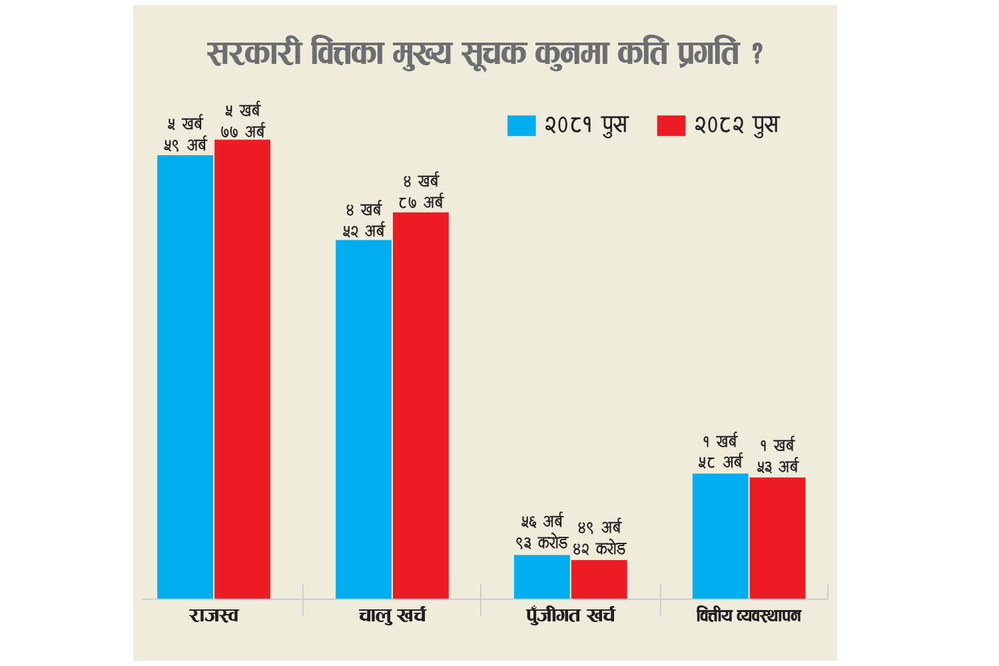
As of last December, current expenditure has been 41.25 percent of the annual target, or Rs 487 billion 1431 crore. This is more than the current expenditure of the same period of the last fiscal year. As of 2081 December, current expenditure was Rs 452 billion 23 million, or 39.63 percent of the annual target.
Economists say that the current government that came after the Gen-G movement has also not been able to increase government expenditure as expected. Now, the government has canceled projects worth about Rs 1.25 trillion. The expenditure in unnecessary areas should have been cut. However, they complain that the selection of projects for cost reduction has not been effective.
In the first six months of the current fiscal year, the government has collected Rs 577 billion 399 million in revenue. This is 39.01 percent of the annual target. The government had set a target of collecting Rs 1.48 trillion through revenue in the current fiscal year. The revenue collection of the government in the first six months was 81.40 percent of the target set for the month of Poush, according to the Ministry of Finance. The government had set a revenue target of Rs 711.21 billion by Poush. A revenue of Rs 169.16 billion has been collected in the month of Poush alone. The government had set a revenue target of Rs 190.77 billion in Poush.
Last fiscal year, the government had set a revenue target of Rs 1419.30 billion. A revenue of Rs 567.40 billion was collected by Poush that year.
Finance Ministry spokesperson Tanka Prasad Pandey admitted that capital expenditure has not increased as expected. He said that only 12 percent of capital expenditure in the first six months is a very disappointing situation. “The Ministry of Finance itself is not a capital expenditure body and it only facilitates and coordinates other development ministries. The ministry has done enough work in that regard,” he said. However, he said that the Ministry of Finance is serious about the failure to make capital expenditure as expected and will review it thoroughly and move forward.
Especially when tourism and other commercial activities were affected for about a month due to the difficult situation after the Gen-G movement on 23 Bhadra and the protests on 24 Bhadra, it is positive that revenue collection has increased by about 2 percent compared to last year,' Pandey said, 'We are also not satisfied with capital expenditure.'
In the last 6 months, the government has paid 153 billion 646.9 million rupees (40.95 percent of the annual target) on principal repayment of government loans and investment in government institutions (financial arrangements). Until Poush 2081, the government had spent 158 billion 663.9 million rupees or 43.2 percent of the target on this head. Until the last 6 months of this year, the government has received 7 billion 100 million rupees in foreign grants. This is 13.3 percent of the annual target. Until the first 6 months of the last fiscal year, the government had received 7 billion 719.2 million rupees in grants (14.75 percent of the target).
Looking at the government's income and expenditure in the first six months of this year, the government has a deficit of about Rs 1.17 billion. During that period, the government has earned Rs 588.51 billion and spent Rs 690.21 billion. 54 million. By the end of the last fiscal year, the government had a deficit of about Rs 92.42 billion. During that period, the government had earned Rs 575.19 billion and spent Rs 667.61 billion. 92 million.
The government has allocated a budget of Rs 1964.11 billion for the current fiscal year. Rs 1180.98 billion has been allocated for current, Rs 477.89 billion for capital, and Rs 375.24 billion for financial management. This year's expenditure estimate is 5.6 percent higher than the initial budget of the last fiscal year and 18.2 percent higher than the revised estimate.