Nepal Telecom has 14.412 million 576 4G subscribers, Ncell has 11.729 million 644 subscribers.
We use Google Cloud Translation Services. Google requires we provide the following disclaimer relating to use of this service:
This service may contain translations powered by Google. Google disclaims all warranties related to the translations, expressed or implied, including any warranties of accuracy, reliability, and any implied warranties of merchantability, fitness for a particular purpose, and noninfringement.
Fourth-generation mobile internet (4G) penetration in Nepal is approaching 90 percent. The Nepal Telecommunications Authority (NTA) has released data as of mid-Mangsir 2082 showing that 4G service penetration has reached 89.64 percent.
From April 2082 to November 2082 alone, the number of 4G users in Nepal has increased by 766,757. The number of 4G customers, which was 25,375,423 in April 2082, has reached 26,142,180 by the end of November 2075. During this period, Nepal Telecom's 4G customers have reached 14,412,576 and Ncell's 11,729,604.
The 4G service was launched in Nepal on December 17, 2073. The MIS report of the Nepal Telecommunications Authority shows that official details of it have started coming only from January 2074. In January 2074, the total number of 4G users in Nepal was only 1,325,440. Of these, Nepal Telecom had 536,113 customers and Ncell had 770,092 customers.
As the service expanded, this number had reached 2,314,968 by November 2075. At that time, 1.557 million 464 customers of Ncell and 680 thousand 944 customers of Nepal Telecom used 4G. The NEA's data shows that 4G has expanded rapidly in the six years since then. By Mangsir last year, the number of 4G users had reached 25 million 260 thousand 293.
With this extensive expansion of 4G, the attractiveness of the old technology 3G seems to have steadily declined. While there were more than 8.596 million 3G users in Magh 2074, this number has decreased to 81 thousand 685 in Mangsir 2082.
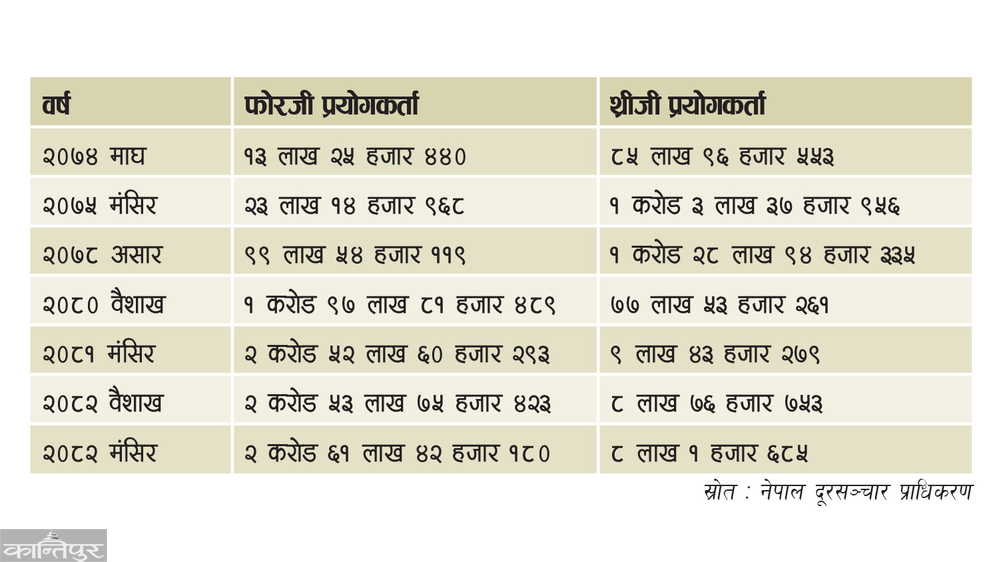
The number of 3G customers, which was 876 thousand 753 in Baisakh 2082, has decreased by nearly 75 thousand in the last 8 months. Private sector Ncell has already announced that it will completely shut down its 3G service, while Nepal Telecom has also converted it to a new technology and gradually moved towards shutdown.
The latest 62nd annual report of the Auditor General has pointed out that Nepal Telecom has been delaying the 4G project. The project, which was purchased for a total of Rs 19.68 billion, was targeted to be completed by Magh 2076, but it was not completed even after the deadline was extended to Chaitra 2078, the report states. Even when the deadline was not extended, the report raises questions about the fact that Rs 91.71 million was spent last year and the compensation amount for the delay was not determined.
On the other hand, Nepal is still lagging behind in preparing for 5G services, which have been launched commercially in many countries around the world. The Authority had decided in July 2078 to provide Nepal Telecom with 60 MHz frequency under the 2600 MHz band for 5G testing free of charge. Although the telecom said that internal testing had started in Kathmandu since Magh 2079, no report has been released on it till date, nor does it seem to be preparing to start the service.
The Auditor General's report has pointed out that Nepal Telecom has not made any progress despite spending Rs 18.438 crore for the test. 'The changes in technology, the competitive situation, and the effectiveness of 5G technical implementation should be brought,' the report suggests.
Telecom service providers, on the other hand, have not shown interest in going for this technology, citing declining income and the lack of the capacity to make the large investment required for 5G and the corresponding number of users in Nepal. On 22 Mangs, when Minister for Communications and Information Technology Jagdish Kharel visited the Ncell office in Nakkhu, Ncell CEO Michael Foley had spoken about the current challenges.
He had commented that 5G was a distant issue for Nepal in a situation where operators were unable to provide even real 4G services effectively. He admitted that although 94 percent of users in Nepal had already purchased 4G handsets, they, as service providers, were unable to provide even real 4G services, let alone 5G.