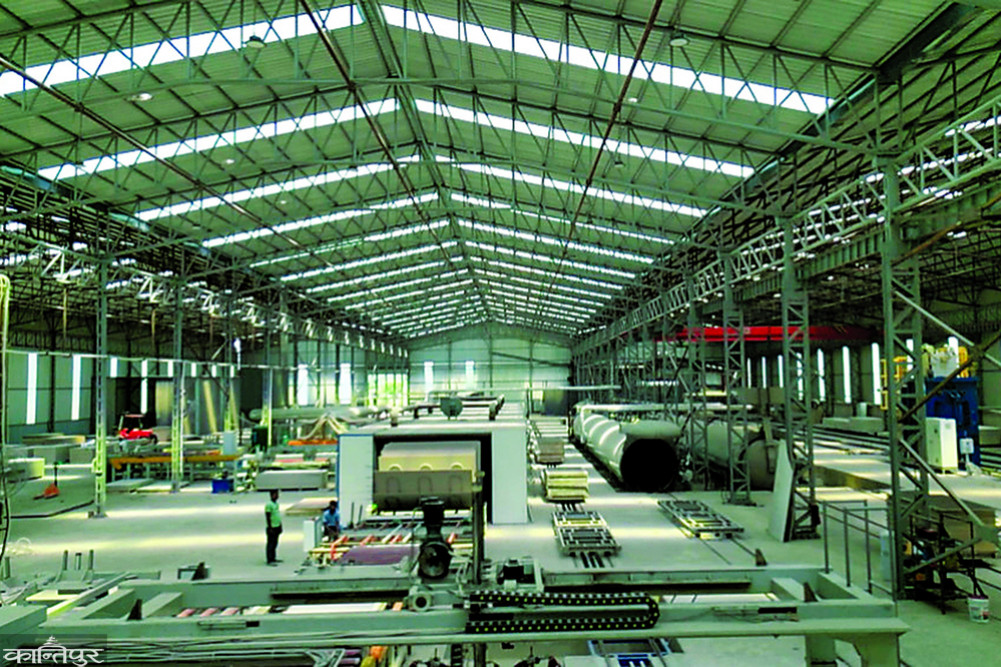
The report shows that in the last fiscal year, the tire and tube industry had the highest capacity utilization of 90.7 percent, while the vegetable ghee production industry had the lowest capacity utilization of 1.10 percent.
We use Google Cloud Translation Services. Google requires we provide the following disclaimer relating to use of this service:
This service may contain translations powered by Google. Google disclaims all warranties related to the translations, expressed or implied, including any warranties of accuracy, reliability, and any implied warranties of merchantability, fitness for a particular purpose, and noninfringement.
The Economic Activity Report of the Nepal Rastra Bank has pointed out that less than half of the industries operating in Nepal are operating at capacity utilization.
The report concludes that the average capacity utilization of industries across the country in the fiscal year 2081/82 was 44.5 percent. Compared to the previous fiscal year, the average capacity utilization of industries in the last fiscal year was 3.8 percentage points lower.
The average capacity utilization of industries in the fiscal year 2080/81 was 48.3 percent. The report considers the problems in transporting raw materials and marketing manufactured goods for industries due to lack of convenient road infrastructure, the decrease in labor due to youth migration abroad, the lack of expected capital expenditure, the decrease in market demand, and the continued problems in the industrial sector as the reasons for the decrease in capacity utilization.
Although the data in the report reflects the situation up to the last fiscal year, industrialists and businessmen say that the expected improvement in the industry situation has not been achieved in the current fiscal year. 'Demand in the economy has not been able to increase, there has been a delay in the recovery of loans in the market. Despite the signs of improvement in the capacity utilization of the industry, it has not increased as expected, said Binod Raj Pandey, President of the Confederation of Nepalese Industries (CNI). “Market demand was declining even before the Gen-G movement. The morale of industrialists has further declined after the Gen-G movement.” Pandey said that the delay in recovery has reduced the income of industries and has led to problems in expanding further investment and obtaining additional loans. “To solve this problem, the government should increase spending on large infrastructure and productive sectors,” he said. “After the market demand improves through government spending, it will also help in increasing the capacity utilization of the industry.” The report showed that the tire and tube industry had the highest capacity utilization of 90.7 percent among industries in the last fiscal year, and the capacity utilization of the vegetable ghee producing industry had the lowest capacity utilization of 1.10 percent. Accordingly, among the industries covered in the study, the capacity utilization of industries producing vegetable ghee, soybean oil, biscuits, noodles, beer, cigarettes, synthetic fabrics, other textiles, raw leather, plywood, tablet medicines, capsules, ointments, dry syrups, liquids, soaps, plastic goods, iron rods and sheets, steel products, GI pipes and transformers has increased. However, the capacity utilization of industries producing mustard oil and processed milk has decreased. The report also mentions that the capacity utilization of industries producing rice, wheat flour, animal feed, sugar, chocolate, processed tea, alcohol, soft drinks, yarn, pashmina, garments, jute goods, sawn wood, paper, rosin, paint, polythene pipes, bricks, cement, concrete, GI wire, household metal goods, aluminum products, electrical wires and cables, tires and tubes, slippers and electricity has also decreased.
The impact of the overall decrease in demand is seen in the capacity utilization of the industry, said Ram Sharan Kharel, Head of the Economic Research Department of Nepal Rastra Bank. ‘As domestic production has increased and imports have also increased, demand in the market has started to increase and the economy seems to be starting to move,’ he said, ‘Although demand has gradually improved after COVID-19, the expected improvement in demand has not yet been achieved.
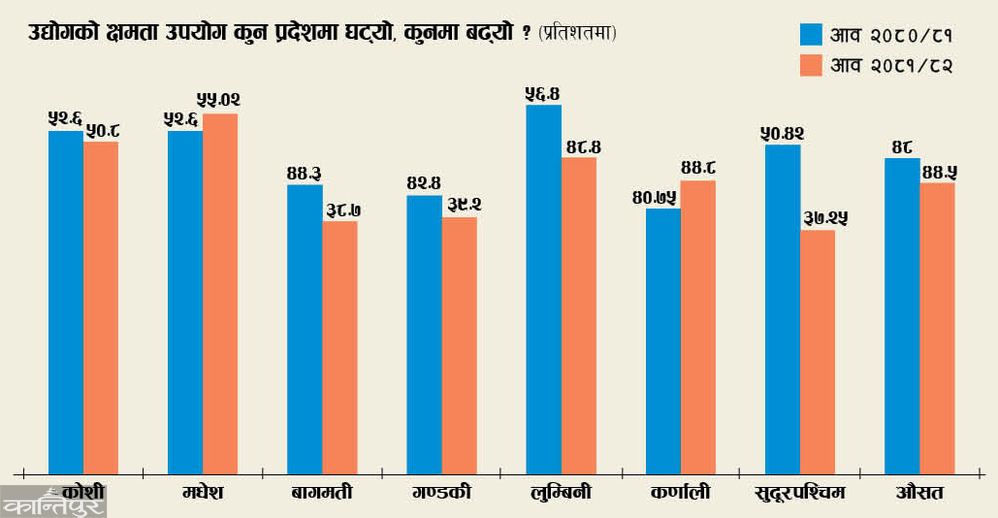
Currently, market demand has not reached the pre-COVID level. That is why the capacity utilization of industries has also decreased.' Kharel said that the problems seen in the overall economy have also affected the capacity utilization of industries. Regionally, the average capacity utilization of industries operating in Madhesh and Karnali has increased. However, the average capacity utilization of industries in Koshi, Bagmati, Gandaki, Lumbini and the Far West has decreased.
In the fiscal year 2081/82, a total of 700 industries have been registered with the Department of Industries, including 235 in the tourism sector, 110 in the service sector, 106 in the manufacturing sector, 38 in energy, 185 in information and technology, 12 in agriculture and forestry, 2 in infrastructure and 12 in mineral-based industries. Out of these, 68 are large, 54 are medium and 578 are small. The report states that a total capital of Rs. 2581.18 billion has been mobilized in these industries and 35,141 jobs have been provided.
Out of the total 700 industries registered in the fiscal year 2081/82, 543 industries are registered in Bagmati alone. This is about 77.5 percent of the total registered industries. The report says that there is a problem in the supply of goods due to the lack of necessary infrastructure such as collection centers and cold storage for some goods produced in Nepal. The report says that in the current situation and political situation of the country, industrialists are feeling the lack of peace and security, and it is a challenge to ensure and guarantee peace and security.
In the current situation where skilled manpower is fleeing, the report points out that increasing production and productivity by retaining this manpower in industries is another challenge. Despite the losses suffered by the private sector during the Gen-G movement on 23 and 24 Bhadra, the government that was formed thereafter is making policy efforts to strengthen good governance and create a business-friendly environment. In the meantime, the report estimates that the industrial sector will gradually improve due to the policy arrangements taken by the government for manufacturing industries, continuous electricity supply to industries, cash subsidies for exports of products such as shoes, mineral water, cement and foreign investment commitments, and increasing demand for some Nepali products in the international market.