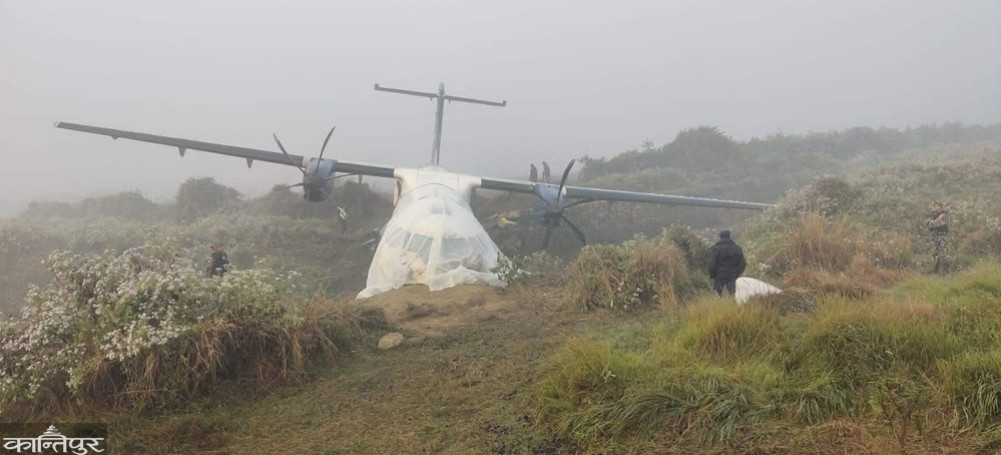
According to details received from the scene, all 72 seats inside the aircraft have been removed and placed safely in a field. Approximately 1,200 kg of fuel has also been removed and dumped safely.
We use Google Cloud Translation Services. Google requires we provide the following disclaimer relating to use of this service:
This service may contain translations powered by Google. Google disclaims all warranties related to the translations, expressed or implied, including any warranties of accuracy, reliability, and any implied warranties of merchantability, fitness for a particular purpose, and noninfringement.
Work to remove the Buddha Air ATR-72 (Mike Foxtrot) aircraft that skidded off the runway while landing at Bhadrapur Airport on Friday night is continuing on Sunday.
After the two small cranes available in Bhadrapur were unable to lift the plane till late Saturday, another large crane with a lifting capacity of 50 tons was brought from Biratnagar on Sunday.
On Saturday, Buddha Air sent a rescue team from Kathmandu to Bhadrapur via another ATR aircraft along with 18 technicians. Similarly, a team including Acting Director General of the Authority, Devchandralal Karna, reached the scene of the accident on Saturday through a relief flight from Buddha and most of the members of that team have already returned to Kathmandu on Saturday.
According to the details received from the scene, all 72 seats inside the plane have been removed and kept safe in the field. About 1,200 kg of fuel has also been removed and dumped safely.
‘Although cranes of 10 and 15 tons capacity were used to move the crashed plane to a safe place, it was not successful yesterday. "We are preparing to lift the plane by bringing a 50-ton crane from Biratnagar at 10 am on Sunday," said the rescue workers deployed at the scene. "Today, we plan to lift the plane and move it to a safe place across the bay."
He explained the reason for the immediate removal of the plane, "Since the tail of the plane is near the runway, we have to operate the flight at a risk." According to Bhadrapur Airport Chief Kishore Kumar Khatri, although the total length of the eastern runway is 1,500 meters, flights are currently being operated by reducing it by 100 meters from point number 28.
"When other planes take off, the plane reaches the final point, but during landing, they are allowed to land only after leaving 100 meters," he said. The crashed plane has crashed about 150 meters before the final point of the runway.
When this incident happened on Friday, Yeti Airlines' ATR plane was preparing to return to Kathmandu with 18 passengers. But after the runway was blocked, the plane was stopped in Bhadrapur, which returned to Kathmandu only on Sunday morning. The airport operations had to be suspended immediately after the incident.
The plane, which had completed its Kathmandu-Bhadrapur flight at 9:06 pm on Friday, skidded off the eastern runway and crashed into a ditch. In technical terms, this incident is called a runway excursion. In which the plane goes off the runway surface.
The captain of the Buddha flight, Shailesh Limbu, and co-pilot, Susanta Shrestha, returned to Kathmandu on Saturday. As per the rules, both the crew members have been grounded. According to Buddha Air officials, their health tests have been done at the Medicity Hospital. The investigation committee to be formed will now take statements from them.
Representatives of the authority have claimed that during the initial observation, the plane touched down on the runway from a slightly higher altitude than the specified height during landing. But officials have said that the real cause will be found only after studying all aspects such as weather, speed, crew condition, flight data recorder, cockpit voice recorder and communication with air traffic control.
According to Bikram Raj Gautam, acting head of the Aviation Safety and Security Regulation Directorate of the Civil Aviation Authority of Nepal, the incident will be investigated by both the authority and the Ministry of Culture, Tourism and Civil Aviation.
‘So far, there has been no formal announcement whether this is an incident or an accident.’ The first priority was rescue and the second was airport operation. Now the investigation will begin, which will suggest causes, weaknesses and improvements,’ he said.
According to a senior Buddha Air official, representatives of the aircraft insurance company will arrive in Nepal from the UK and India on Sunday. They will reach Bhadrapur and assess the condition of the aircraft. Representatives of the ATR aircraft manufacturer are also scheduled to conduct a technical inspection at the scene from France on Monday. The decision on whether or not to bring the aircraft back into service will be made after this assessment.
Nepal's first five-year aviation safety plan, which was launched in 2018, is currently being implemented. It prioritizes seven major risk areas related to flight operations. One of the challenges is runway excursion.
Analysis of aviation safety incidents identified by Nepal include controlled flight collision with terrain, loss of flight control, system/component failure - except for engine, system/component failure - powerplant, mid-air collision, ground collision without fire/smoke, and runway overrun.
This is the runway excursion (overrun) that Buddha faced in Bhadrapur. The Bhadrapur incident falls under this category. A year ago, another Budd ATR suffered a runway excursion incident in Bhairahawa, causing damage worth crores.