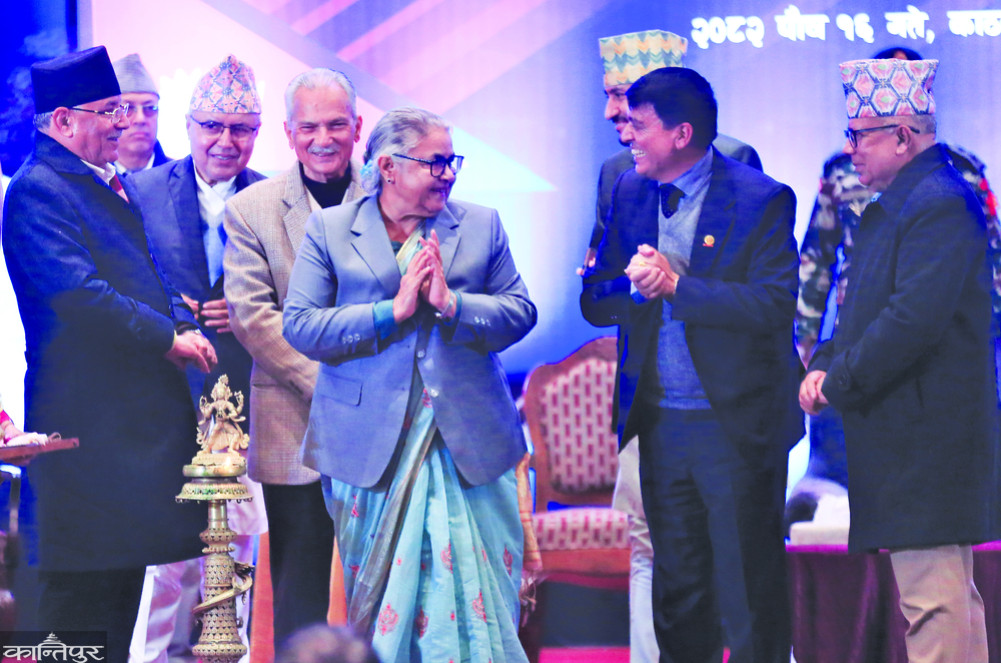
At an all-party national dialogue on 'Cooperation for Peace, Stability and Prosperity' organized by the Federation of Nepalese Chambers of Commerce and Industry in Kathmandu on Wednesday, the Prime Minister and Ministers, former Prime Ministers, politicians, industrialists and businessmen, and youth expressed the view that economic prosperity will not be achieved unless there is an environment in which the private sector can work.
We use Google Cloud Translation Services. Google requires we provide the following disclaimer relating to use of this service:
This service may contain translations powered by Google. Google disclaims all warranties related to the translations, expressed or implied, including any warranties of accuracy, reliability, and any implied warranties of merchantability, fitness for a particular purpose, and noninfringement.
Stakeholders have emphasized that since the morale of the private sector is at an all-time low, everyone should take responsibility from their respective positions to boost it. They say that since the private sector is the engine of the economy, economic development cannot be achieved unless its morale is boosted, the attention of all sectors and classes of the country should be focused on this.
At an all-party national dialogue on 'Cooperation for Peace, Stability and Prosperity' organized by the Federation of Nepalese Chambers of Commerce and Industry in Kathmandu on Wednesday, the Prime Minister and Ministers, former Prime Ministers, politicians, industrialists and businessmen and youth expressed the view that economic prosperity will not be achieved unless there is an environment in which the private sector can work.
President of the Federation of Nepalese Chambers of Commerce and Industry Chandra Dhakal said that the private sector does not have enough protection for prosperity. He said that the private sector is not able to invest with confidence and that an investment-friendly environment along with a guarantee of property security is essential for the expansion of enterprises and entrepreneurship. 'There is a concern that impunity will flourish if action is not taken against those who do wrong,' he said. He questioned how employment will be created if the government is able to provide employment to only about 3,000 to 3,500 people annually.
Dhakal said that a clear commitment from political parties is needed towards the private sector, which contributes 81 percent to the economy and 86 percent to employment. He also complained that economic activities from the private sector are not a priority for the government.
Dhakal said that the private sector was targeted during the Gen-G movement, and that at that time, physical damage worth about 40 billion rupees and losses worth about 81 billion rupees were incurred by the private sector.
He expressed his suspicion that even if the collapsed private sector structures are rebuilt, there is no guarantee that they will not be targeted again. ‘The confidence of Nepal’s private sector has reached its lowest point in history,’ said Dhakal.
Prime Minister Sushila Karki, on the other hand, said that the government is committed to creating an environment where the private sector can confidently expand investment. She claims that the government formed on the foundation of the Gen-G movement is working on a roadmap for political stability by laying the foundation of good governance.
Prime Minister Karki said that the government will keep the morale of the country’s employers, service providers, infrastructure builders, contributors to revenue collection and entrepreneurs who create wealth high, so that they can freely engage in business and show respect for the right to property. "Let us provide protection to entrepreneurs as a zone where attacks such as bandhs, strikes, vandalism, and arson are prohibited, while ensuring that they provide fast service and security," she said. "We will take necessary decisions to ensure the security of industries, factories, establishments, private residences, etc." She also clarified that the government is ready to remove investment barriers by formulating an additional action plan in collaboration with the relevant ministries and the federation. Prime Minister Karki claims that the relevant bodies are active in bringing to justice the individuals and groups involved in criminal activities such as infiltration, looting, and arson that took unfair advantage of the 24 Bhadra protests. She also urged entrepreneurs to do clean and decent business. She said that the government is committed to developing entrepreneurship by ensuring stability and uninterrupted business through elections. Former Prime Minister and NCP coordinator Pushpa Kamal Dahal said that the state's approach to the private sector is very narrow and needs to be changed. He said that although the private sector has been given priority in speech, it has not been seen in practice. He said that although the country's constitution has made the private sector one of the three pillars of the economy, in practice the private sector has not been able to get that respect. He also mentioned that the Gen-G movement has forced the political leadership to introspect.
Stating that the country is currently going through a serious crisis that is rarely seen, Dahal believed that its solution can only be possible through all-party consensus and determination. 'The Gen-G movement has motivated self-examination. It has created a situation where people can move forward with new determination and commitment, understanding the needs of the people, or they can step aside because their own justification has been exhausted. And, an environment has been created to move forward with all-party determination,' he said. Former Prime Minister and NCP Co-Convenor Madhav Kumar Nepal said that the responsibility of correcting the flaws in the state structure lies with the current government with the elections. He stressed that the government should be serious about solving the country's current problems.
He also strongly objected to the incidents of arson, looting and destruction. ‘Acts of arson, looting and destruction are objectionable and punishable,’ he said, ‘the government seemed lenient towards it, it did not seem serious, which is very sad.’
Former Prime Minister Baburam Bhattarai says that the focus should be on practical implementation rather than being limited to unnecessary formalities on issues of development and prosperity. He comments that discussions held at expensive star hotels spending lakhs of rupees have not yielded the expected results. ‘I have been hearing about what to do and how to do it for 20 years. I have also been saying,’ he said, ‘now the focus should not be on ‘what to do’, but on ‘how to do it.’
He says that Nepal is currently about a hundred years behind other countries in terms of development. ‘Countries based solely on agriculture have never progressed,’ he said, ‘point out the need for timely and correct policies and regulations to transform the agrarian economy into an industrial economy. If the state, community and private sector move forward with a clear policy covering all sectors, a big leap can be made in a few years.’
Finance Minister Rameshwor Khanal said that the profits earned by the private sector will not be consumed by them alone but will be distributed to all levels and strata of society. He said that the wealth created by the private sector also belongs to the state. Despite this, he commented that the private sector has suffered losses in every movement. He said that the private sector should also have adequate discussions with the general public to control such a situation.
Minister for Communications and Information Technology Jagdish Kharel said that it is the government’s common commitment to create a conducive environment for industry, trade and business and ensure the security of the private sector. He said that we should move forward with the slogan ‘Environment for industry, trade and business, security of the private sector – the commitment of all of us’. ‘This is the only way the country can move forward,’ he said, ‘to advance a socialist-oriented state system, the security of the private sector is indispensable.’
Former Finance Minister Prakash Sharan Mahat said that anyone who acts against the law should be brought to justice on 23 and 24 Bhadra. He suggested that the government work to raise the morale of the private sector and the general society as a whole, as the recent Gen-G movement has weakened. He said that the government should focus on this as there is no investment environment and no production and employment creation without additional investment.
Stating that peace, prosperity and stability are the common goals of the country, Deputy Chairman of the National Independent Party DP Aryal said that this goal cannot be achieved without unity between the state, private sector and civil society. He believes that the voices raised by the Gen-G generation should be understood positively. He said that there is a mutual relationship between peace and economic prosperity and that Nepal’s private sector has been making a significant contribution to job creation.
Janmat Party Chairman CK Raut commented that the mindset of viewing the rich negatively has developed in Nepali society. He said that the idea that rich people have become rich by looting the country and the private sector has come to loot the country is prevalent in society. He said, “No one has worked seriously to change this narrative,” he said.
Birendra Raj Pandey, Chairman of the Confederation of Nepalese Industries, said that there should be no attack on industry and business under this or that pretext. For this, he said, it is necessary to change the perspective of looking at the private sector from all sides. He complained about the narrative being created in society as if becoming rich and doing business is a great sin. “The country will become rich only if the people of the country become rich,” he said, “It is clear that Nepal’s private sector should invest in Nepal, increase investment and we ourselves should make the country prosperous.”
Kamlesh Kumar Agrawal, Chairman of the Nepal Chamber of Commerce, said that the economy is in a transitional stage and it is necessary to boost the morale of entrepreneurs. She says that cooperation for peace, stability and prosperity is a very important issue intertwined with the future of Nepal. She complains that during the Gen-G movement, when the economy is in a sluggish state due to the inability to efficiently manage the Covid-affected economy, there has been a huge loss to humanitarian and industrial businesses and private property.
Gen-G activist Raksha Bam said that the common ground between the private sector, government and citizens is peace, prosperity and good governance. Although corruption prevention and good governance are the common desires of everyone, she comments that the continued existence of corruption in the country is serious. ‘Everyone’s desire is that there should be no corruption. But again, the question arises as to why there is corruption in the country,’ she said, ‘Everyone should take their share of responsibility to solve the problem.’
Sudeep Sheikh of the Gen-G campaign emphasized that the hassle of registering a company should end. ‘When registering a company, it takes only a week to register the name, while young entrepreneurs get stuck in administrative hassles for months. "A youth-centric policy is needed to improve this," he said. "It shouldn't take months to register a company, so that young people don't have to leave the country."