According to him, such behavior is distracting the pilot and creating a direct risk to overall flight safety.
We use Google Cloud Translation Services. Google requires we provide the following disclaimer relating to use of this service:
This service may contain translations powered by Google. Google disclaims all warranties related to the translations, expressed or implied, including any warranties of accuracy, reliability, and any implied warranties of merchantability, fitness for a particular purpose, and noninfringement.
The Pilots Association of Nepal (PAN) has drawn the serious attention of the regulatory body, the Civil Aviation Authority of Nepal, saying that the increasing number of unmanned passengers during flights, uncontrolled drones (unmanned aerial vehicles) operating in the sky, and risks to cockpit safety are becoming major challenges for the Nepali aviation sector.
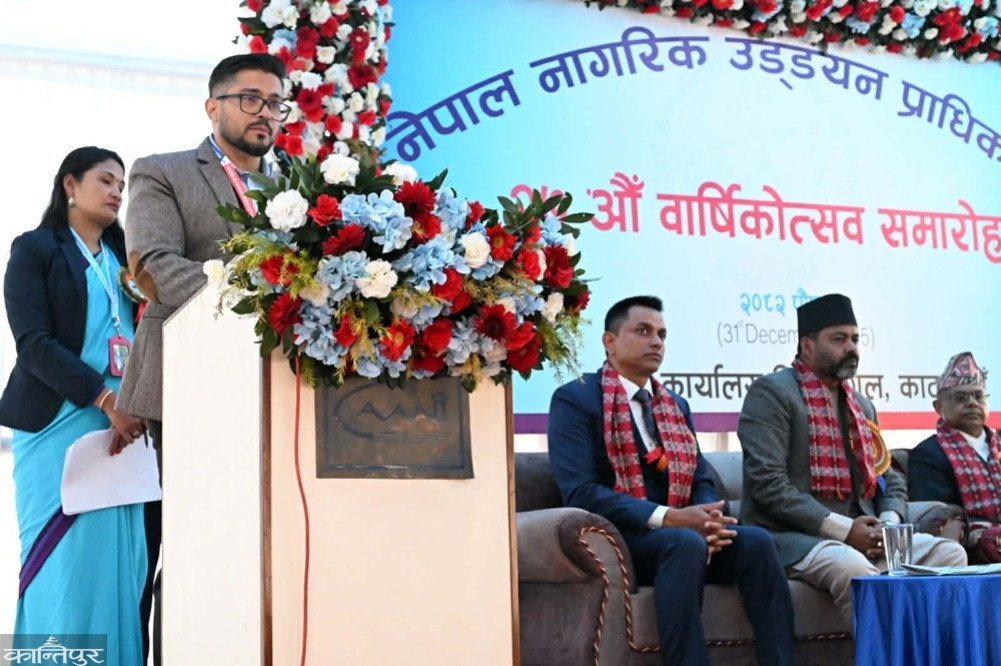
At a program organized on the occasion of the 27th foundation day of the Civil Aviation Authority of Nepal on Wednesday, Pilots Association Nepal member and senior pilot of Airbus A320, Suraj Bhandari, said that the behavior of unruly passengers has been increasing rapidly in recent years.
According to him, such behavior distracts the pilot and creates a direct risk to the entire flight safety.
‘Any kind of disorderly, rude or undisciplined behavior is not acceptable during the sensitive phase of the flight,’ Bhandari said, ‘Aviation safety cannot be complete unless the passenger is disciplined.’
At the program, he mentioned that new challenges have been added to air safety due to the rapid increase in unmanned aerial vehicles (drones) and modern aviation activities. He said that scientific, practical and coordinated regulations are necessary to minimize the risks that may arise when drones and aircraft operate in the same airspace. For this, he emphasized that the suggestions of pilots should be included at the policy-making level.
Speaking on behalf of PAN regarding cockpit safety, Bhandari said that social media, camera use and unnecessary interference are creating a situation where pilots are distracted. ‘During the most sensitive phase of the flight, the pilot’s full attention should be focused only on the flight,’ clarified Pilot Bhandari, who works at Himalaya Airlines.
Along with this, the Pilots Association Nepal has pointed out the need to institutionally strengthen the cooperation between pilots and regulatory bodies in aviation safety. Although the participation of the pilot community in the policy-making process was limited in the past, Bhandari said that the current leadership has indicated a positive change in it. ‘Providing such a platform to the Pilots Association is a clear sign of commitment to linking cockpit experience to the policy level,’ he said.
Pilot Bhandari, who has also worked at Nepal Airlines Corporation and Military Aviation before the Chinese-funded Himalaya Airlines, said that the safety culture and professional working style of the authority have improved significantly in recent years. The Pilots' Association has expressed satisfaction over the move towards implementing the concept of 'right person, right place', stating that qualitative progress has been seen in regulation, monitoring and institutional structure while studying the National Aviation Safety Plan.
Pilots have evaluated infrastructure development such as expansion of Tribhuvan International Airport, establishment of performance-based navigation routes at Chandragadhi, Janakpur and Dhangadhi airports, expansion of runways and improvement of passenger terminals as 'game-changing' steps.
The Pilots' Association has demanded that these technologies be expanded to all remote airports, stating that real-time cameras and weather forecast radars installed at airports in mountainous and remote areas have been of significant help in making decisions on whether to fly or not.
The Pilots' Association Nepal has said that the role of the human aspect in aviation safety should also be given special priority. Stating that the mental health, fatigue management and work-life balance of pilots are the basis of passenger safety, Bhandari opined that the audit related to the safety management system should not be limited to paper processes only.
In this context, he urged for timely revision of the existing legal and regulatory framework keeping in mind the career development and welfare of pilots. In particular, he pointed out the need to review the ‘Order on Control of Use and Service Safety of Aircraft Pilots and Engineers, 2070’.
Finally, Bhandari proposed the formation of a completely independent investigation body for air accident investigation and the provision of educational recognition to the experience and skills of Nepali pilots through the National Professional Qualification System.
‘If the authority is a huge tree, we pilots are its branches. Our common goal is safe and reliable Nepali skies,’ he said at the ceremony attended by the Minister of Tourism and the Secretary of Tourism.
Expressing his best wishes for the 27th anniversary of the Civil Aviation Authority of Nepal and the New Year 2026, he expressed confidence that the cooperation between the government, the authority and the pilot community will be further strengthened in the coming days.