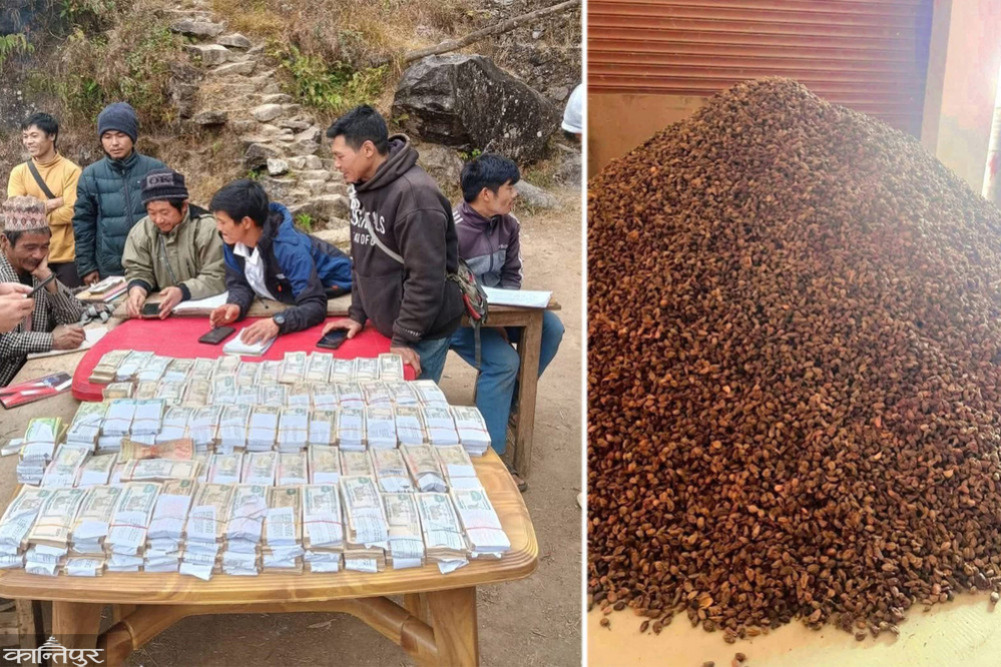
After deducting expenses, 47 farmers have shared the proceeds at the rate of Rs. 240,000.
We use Google Cloud Translation Services. Google requires we provide the following disclaimer relating to use of this service:
This service may contain translations powered by Google. Google disclaims all warranties related to the translations, expressed or implied, including any warranties of accuracy, reliability, and any implied warranties of merchantability, fitness for a particular purpose, and noninfringement.
The farmers gathered with sacks of cardamom. From the other side, the merchant came to the village with money. The cardamom was weighed and the money was counted. After receiving the lump sum, 47 farmers divided it equally.
This is the scene seen in Sisuwa Gogune village of Silichong Rural Municipality-1 in Sankhuwasabha. Farmers in the Sisuwa Gogune area have sold 115 maunds of cardamom produced collectively. Traders had come to the village to buy cardamom, also known as 'black gold'.
According to local farmer Bhupal Kulung, 47 farmers who were cultivating cardamom in small plots had cultivated collectively this year. The cardamom produced was sold at a rate of Rs 98,000 per maund (40 kg), which amounted to Rs 1.27 crore. 'This year's cardamom production was satisfactory, and we got good prices,' said Kulung.
The money received from the sale of cardamom has been distributed equally to the farmers after deducting all the expenses incurred in farming. ‘There were expenses on fertilizers, fertilizers, garden maintenance, cardamom picking, drying and transporting to the kiln,’ said Kulung. ‘When all the expenses were deducted, one farmer had 240,000 rupees in his hand.’
The profit was shared equally, regardless of who had a little or a lot of land. ‘We all became like a family, we shared the profits equally, and the sorrows equally,’ said Kulung. ‘The biggest benefit of collective farming is the sense of mutual trust, cooperation and unity that has strengthened.’
Another farmer, Suryakumbha Rai, said that when traders came to the village, they did not have to bother transporting cardamom to the market. ‘Earlier, we had to carry cardamom to the district headquarters or other markets, which was time-consuming and expensive,’ he said. ‘This time, the traders came to the village, which saved us time, labor and expense.’
According to local Sumitra Rai, the belief that good income from cardamom farming will have a positive impact on the overall development of the village has increased. ‘If you can find work in the village and earn a good income, why go abroad?’ She said, ‘It plays a big role in keeping the youth in the village.’
The farmers have also made plans to expand cardamom farming. They say that the support of the local government and stakeholders is needed for disease control, quality production and ensuring a long-term market. ‘Cardamom also faces disease problems from time to time,’ Sumitra said, ‘If technical assistance, training and a permanent market are arranged, we can produce better.’ She said that if the local level also brings a policy to encourage collective farming, production can be increased in the surrounding villages as well. Sisuwa Gogune’s collective cardamom farming has become a successful example of rural economic reform, says Bhupal Raj Mewahang, the chairman of the rural municipality. ‘The collective farming that started with a small effort has generated income worth crores,’ he says, ‘it has also shown the way to make agriculture-based lifestyles respectable and self-reliant. It has been shown that prosperity is possible in villages with unity, cooperation, and hard work.'