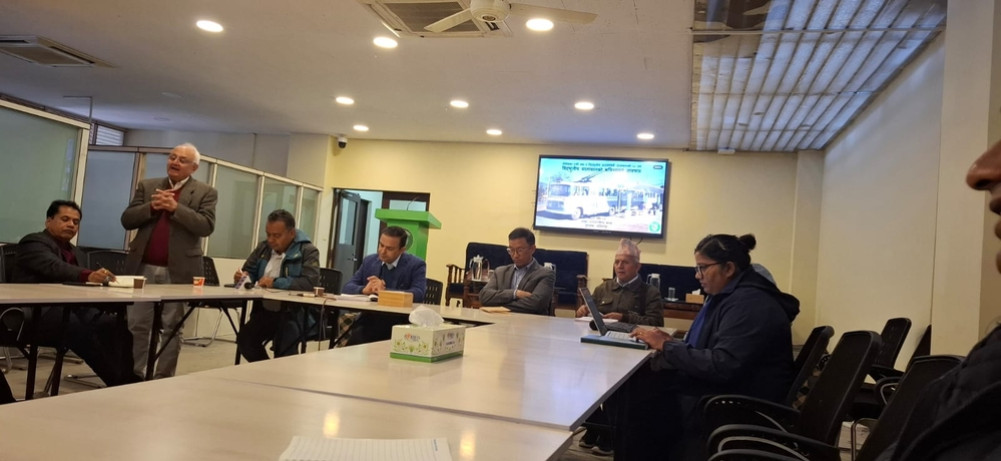
Rajiv Pokharel, Director General of the Department of Transport Management, says, ”Although the government prioritized electric vehicles through tax rates, it only worked on small private vehicles rather than public vehicles.”
We use Google Cloud Translation Services. Google requires we provide the following disclaimer relating to use of this service:
This service may contain translations powered by Google. Google disclaims all warranties related to the translations, expressed or implied, including any warranties of accuracy, reliability, and any implied warranties of merchantability, fitness for a particular purpose, and noninfringement.
Rajiv Pokharel, Director General of the Department of Transport Management, said that the transport sector has not been managed as the transport-related mechanisms have not been able to work in an integrated manner. He said this during a discussion on trolleybuses, 50 years of public electric vehicles and the future of electric transport in Nepal.
'We started electric vehicles in 2032 BS. At that time, trolley buses were running from Suryabinayak to Tripureshwor,' he said, 'Now, we are discussing how we could have brought it back to the same state 50 years later.'
Pokharel also said that there is no alternative to electric vehicles in the future. 'The future is ultimately our electric transportation in our country,' he said, 'We are also repeatedly discussing the digitalization of public vehicles with stakeholders along with further studies.'
Saying that the Department of Transport Management has been working in its own way lately, Pokharel said that the provincial government is working in its own way since all the powers have gone to the provinces. 'We have formed the Valley Authority, the authority is working in its own way,' he said, 'The Road Department is working in its own way, the Traffic Police is working in its own way, and the Sajha Yatayat is working in its own way, but the transport sector does not seem to be organized because we have not been able to work in an integrated approach.'
Stating that there are many privately owned public vehicles, Pokharel said that there are public transport and some metropolitan companies, while the rest are all private sector public buses. 'It is very difficult for us to work with an integrated approach, there is no uniformity in route permits,' he said, 'The tempo is also running, the buses are also running, how to manage it is a challenge in itself.'
He also said that a few months ago he saw a trolley bus still running on one route in Shanghai, China. 'I think we can also run trolley buses or improved trolley buses in the future,' he said, 'The government is a facilitator. I don't think the government itself will invest that much.'
Pokharel said that although the government has prioritized electric vehicles through tax rates, it has only worked on small private vehicles. 'It worked on small vehicles, but it is not working on electric public transport,' he said, 'What we want is electric public transport. An electric bus costs more than 10 million rupees. How can it be made cheaper? This is our challenge, we need to work more on this.'