The largest share of imports and exports is soybean oil. Exports have not been sustainable due to the failure to increase domestic production. As more goods are imported than exported, the trade deficit is increasing every month.
We use Google Cloud Translation Services. Google requires we provide the following disclaimer relating to use of this service:
This service may contain translations powered by Google. Google disclaims all warranties related to the translations, expressed or implied, including any warranties of accuracy, reliability, and any implied warranties of merchantability, fitness for a particular purpose, and noninfringement.
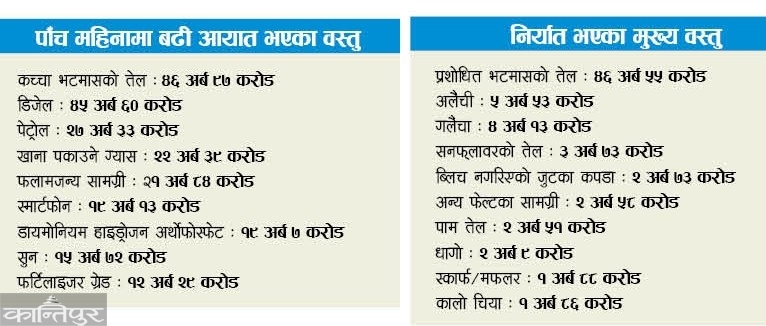
In the five months of the current fiscal year (from Shrawan to Mangsir), goods worth Rs 766.18 billion were imported, while goods worth Rs 116.5 billion were exported.
Imports increased by 15.83 percent and exports by 58.17 percent, according to the monthly report released by the Customs Department.
The department's data shows that with the increase in imports, the foreign trade deficit has also increased. The department has stated that there is a trade deficit of Rs 649.68 billion in the five months. Since Nepal imports more goods than it exports, the trade deficit is increasing every month. Nepal has imported the most goods including crude soybean oil, diesel, petrol, cooking gas, iron-based materials, smartphones, diammonium hydrogen orthophosphate, gold, etc.
The goods exported from Nepal to other countries include refined soybean oil, cardamom, carpets, sunflower oil, unbleached jute fabrics, other felt materials, palm oil, etc. The main item imported and exported is crude soybean oil. According to the department, unrefined soybean oil worth Rs 46.97 billion has been imported in the four months. During the same period, refined soybean oil worth Rs 46.55 billion has been exported.
Soybean raw materials imported from third countries are processed in Nepal and exported to India. Due to export discounts and advance payment facilities, entrepreneurs prefer to export soybean oil to India rather than selling it domestically. Former Joint Secretary Ravi Shankar Sainju says that the data shows that exports have increased since raw soybean oil is imported and processed and exported.
‘A large amount of raw soybean oil is imported and packaged and sent to India, which shows that imports and exports have only increased by a few points. By importing Rs 46 billion and exporting only Rs 46 billion, it has not been able to make a big contribution,’ he said. ‘If it does not contribute in a large amount, it will not even create jobs. It will not make exports sustainable either.’
If soybeans are imported and oil is produced and exported, a large amount of jobs will be created and even the oil cake can be sent abroad, says Sainju. The department has data on the import of diesel worth Rs 45.6 billion, petrol worth Rs 27.33 billion and cooking gas worth Rs 22.39 billion in the first four months of the current fiscal year.
Diesel, petrol and LPG gas have a major contribution to increasing the trade deficit. These items are only imported. The government has emphasized electric vehicles to replace diesel and petrol imports, while it has been emphasizing electric stoves to discourage gas imports. However, it has not been effective.
Looking at domestic production towards exports, the department has data on the export of cardamom, carpets and felt materials. Cardamom worth Rs 5.53 billion and carpets worth Rs 4.13 billion have been exported in five months. According to Sainju, domestic goods like cardamom and carpets have not been able to be produced in large quantities and for export. ‘Cardamom is produced in Nepal, but it goes to India as raw material,’ he said. ‘First, we have not been able to produce cardamom in large quantities for export. We have not been able to process and sell the products. We are dependent on India for that too.'
Since production and sale are being done traditionally, Sainju said that it is necessary to find a market commercially. According to the department, Nepal has been trading with more than 148 countries. Out of these, it has been trading profitably with 34 countries and trading at a loss with 114 countries. It has been trading profitably with countries including Denmark, Romania, Sweden, Niger, Iraq, Samoa, Iceland, Seychelles, New Caledonia, Fiji, Lebanon, Norway, Colombia.
While importing goods worth 69.7 million 35 thousand rupees from Denmark, Nepal has exported 45.3 million 33 million 4 thousand rupees. It has been trading profitably with Romania for 63.4 million 69 thousand rupees. While importing goods worth 17.8 million 30 thousand rupees from Romania, Nepal has exported goods worth 81.2 million 99 thousand rupees. It is trading in deficit with countries including India, China, Argentina, UAE, Indonesia, Thailand, Brazil, Malaysia, Australia, Qatar, Canada, and Japan. According to the department, Nepal has exported goods worth Rs 95.42 billion while importing goods worth Rs 434 billion from India. Nepal has exported goods worth Rs 466.8 million while importing goods worth Rs 163.73 billion from China. The department does not publish the data of countries with trade of less than Rs 100,000 separately. Former president of Nepal Freight Forward Association Rajan Sharma says that Nepal has not been able to identify and sell markets according to its domestic products.
‘We have not been able to find markets according to our products, we have been selling them in the traditional way, we have not been looking for new markets,’ he said. He said that despite differences in demand according to place and time, there has been no difference in Nepal’s production. ‘Carpets used to go to America yesterday. They go there even today, but the goods we send are the same. "Innovation has not been achieved," Sharma said. "Only goods produced by the seller are being exported, rather than according to the buyer's preferences."