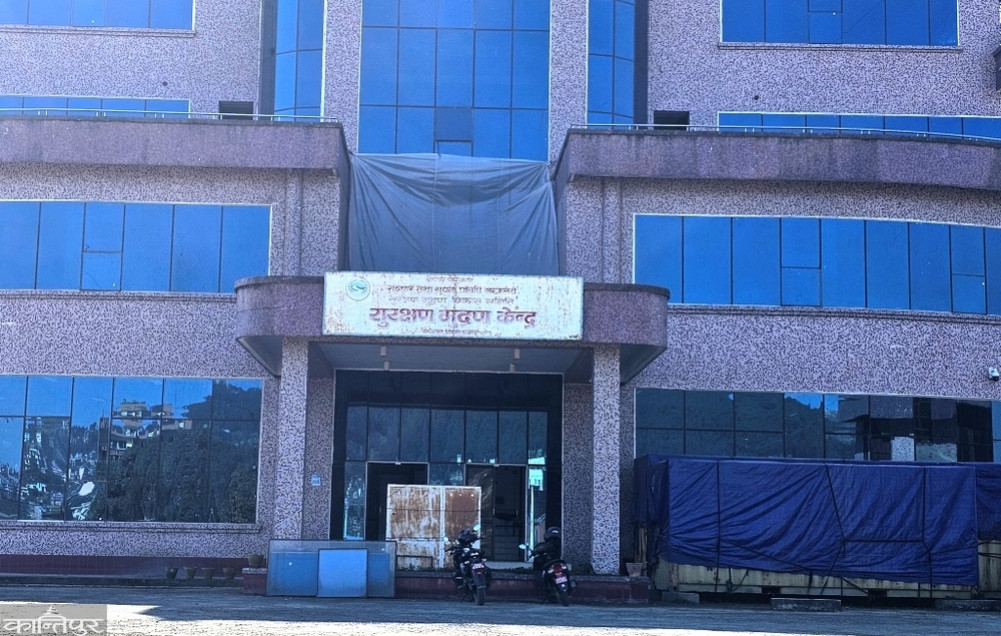
While inaugurating the license printing facility at the Security Printing Center on November 21, Minister of Communications and Information Technology Jagdish Kharel promised to print 500 licenses daily, but the number has not been achieved.
We use Google Cloud Translation Services. Google requires we provide the following disclaimer relating to use of this service:
This service may contain translations powered by Google. Google disclaims all warranties related to the translations, expressed or implied, including any warranties of accuracy, reliability, and any implied warranties of merchantability, fitness for a particular purpose, and noninfringement.
There are delays in printing smart driving licenses at the secure printing center inaugurated at the IT Park in the district last October.
The printing process has been delayed due to the failure to receive the necessary 'data' from the Department of Transport Management in the secure printing center that has been put into operation for printing licenses, said Devraj Dhungana, executive director of the center.
According to him, the department's main 'software' and 'middleware' systems have not been fully operational, so the necessary details for printing licenses have to be collected 'manually'. He said that due to the lack of 'bulk data' facilities, thousands of licenses could not be printed at once and only three to four hundred 'data' could be pulled daily.
On November 21, Minister for Communications and Information Technology Jagdish Kharel had informally inaugurated the license printing at the secure printing center. Although it was said at the time of inauguration that the center would print 500 licenses daily, the work on that number has not been done. ‘Although there was a plan to print 500 licenses daily in the beginning, the department is currently providing data only twice a week,’ he said. ‘Sometimes five or seven hundred or even 1,000 data comes at a time and it has to be printed and distributed based on the data received.’
Since the inauguration, the center has received ‘data’ for about 7,000 licenses so far, of which about 6,000 have been printed and distributed. According to him, preparations are underway to print and distribute the remaining ‘data’ within two days.
The printing company stated that they are only a service provider and that the Department of Transport Management is solely responsible for providing ‘data’, operating the system and maintaining the details of service recipients. He said that the printing process is expected to accelerate once the software system is fully operational from the department.
An agreement was reached between the center and the department to print 1.2 million ‘licenses’, including essential ones, in the first phase. He said that the printing system is fully implemented within the next six months, once the current technical problems are resolved.
Keshav Khatiwada, senior computer engineer at the Department of Transport, said that the department has so far sent about 8,000 'data' to the center and 6,500 licenses have been printed from the center. According to him, before the Gen-G movement, an average of 1,800 to 500 applications for 'licenses' were received daily. But now, 200 to 250 emergency application forms are received daily. He informed that 800 to 1,200 'data' are currently being sent to the center per week. 'Right now, we are printing licenses for emergency purposes. We will have to send block data to print 1.2 million licenses. For that, the department is developing a 'middleware personalization software' system.'
In this system, an agreement was made to print 1.2 million licenses after the center entered 'data in blocks'. He said that work is underway as per the agreement to print 1.2 million licenses within the next 4 months.