The interest rate on one-year personal term deposits, which was 5.045 percent in Mangsir, decreased to 4.839 percent in Poush.
We use Google Cloud Translation Services. Google requires we provide the following disclaimer relating to use of this service:
This service may contain translations powered by Google. Google disclaims all warranties related to the translations, expressed or implied, including any warranties of accuracy, reliability, and any implied warranties of merchantability, fitness for a particular purpose, and noninfringement.
Banks and financial institutions have reduced deposit interest rates for the month of Poush. Compared to Mangsir, the average deposit interest rate of commercial banks has decreased by 0.206 percentage points in Poush. Accordingly, the interest rate on one-year individual term deposits, which was 5.045 percent in Mangsir, has decreased to 4.839 percent in Poush.
The average interest rate on one-year fixed deposits by commercial banks for Poush is 3.445 percent. This is also lower than in Mangsir. Banks have stated that since the base rate of banks and financial institutions has decreased after the deposit interest rate has decreased, the interest rate on loans has also decreased automatically.
Remittances are continuously increasing and due to lack of demand for loans, banks and financial institutions have accumulated about 1.11 trillion rupees of loanable amount (excess liquidity). Due to this, banks and financial institutions are reluctant to take institutional fixed deposits. And, every month, banks and financial institutions are reducing the interest rate on deposits even at low rates.
 The National Bank has also put forward a strategy to reduce interest rates through monetary policy. Through the first quarterly review of monetary policy issued on 15 Mangsir, the National Bank has reduced the standing liquidity facility rate, which is the upper limit of the interest rate corridor, from 6 percent to 5.75 percent and the policy rate from 4.50 to 4.25 percent. The permanent liquidity facility rate (upper limit) and the policy rate have been reduced with the aim of gradually reducing the distance between the lower and upper limits of the interest rate corridor and keeping the policy rate in the middle of the corridor (symmetric), said Ram Sharan Kharel, Head of the Research Department of the National Bank. He said that such a system will reduce the interest rate that banks have to pay when taking loans from banks and financial institutions, which will reduce their costs.
The weighted average interest rate paid by the general public when taking loans from banks and financial institutions was 7.38 percent in Kartik last year. This is the lowest in the last 13 years. The National Bank has started calculating the weighted average interest rate of deposits and loans since 2069 (2012). The average interest rate on loans in Ashar last year was the lowest since then.
Experts claim that the interest rate in Ashar last year was the lowest ever. According to officials of the National Bank, there was no such low interest rate before 2069. In Ashar 2069, the weighted average interest rate on loans was 12.40 percent. In the fiscal year 2077/78 Ashar, the average interest rate on loans in banks and financial institutions was 8.43 percent. Since then, the interest rate on loans has been rising. In the fiscal year 2079/80 Falgun, the average interest rate on loans had reached 13.03 percent. Since then, the interest rate has started to decrease again. The interest rate that started to decrease from that point was 9.93 percent in Ashar, 2081. In last Ashar, the average interest rate on loans has fallen to 7.85 percent.
‘The National Bank has started calculating the weighted average interest rate since 2012, and since then, the average interest rate on loans has been at its lowest point in last Ashar,’ said a senior official of the National Bank. ‘Since interest rates were even more expensive before 2012, the average interest rate in last Ashar can be said to be the lowest so far.’ Although the National Bank was established in 2013 BS, the credit policy was started to be formulated through monetary policy only in 2023 BS.
Accordingly, from 2023 to 2046 BS, the National Bank itself used to set the interest rates on loans and deposits. Banks and financial institutions used to collect deposits and provide loans on the basis of the same interest rate. But after 2046, the Rastra Bank stopped directly setting interest rates. The responsibility of setting interest rates in a sectoral sense has been left to the banks. However, although not directly, it has not stopped controlling the interest rates of deposits and loans through tools such as spread, base rate, interest rate of ordinary and fixed deposits.
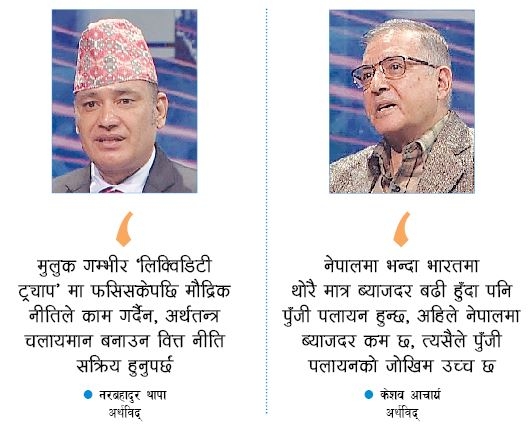
Economist Keshav Acharya says that interest rates on loans have fallen significantly and low interest rates reduce the income of depositors and there is a possibility of investment going into unproductive sectors. Although the interest rate decrease is good for the borrower, it has not had a positive impact on the overall economy. ‘However, since the inflation rate is low, the real interest rate is still positive. However, since interest rates have reached a very low point, the possibility of capital flight to India is high,’ he said. ‘Even when interest rates in India are slightly higher than in Nepal, capital tends to flee through traders in the border areas. Interest rates are now even lower in Nepal. That is why capital flight is not a new thing.’
Even though the financial sector is strong from all aspects due to low interest rates and sufficient liquidity, it has not been able to contribute to the economy, Acharya said. ‘The financial sector has become like a separate island in the economy. That sector is strong from all aspects, but the economy has not been able to benefit from it,’ he added. ‘In such a situation, there is a risk of investing in areas where investment returns are low, so the economic growth rate is not high. Capital flight, hundi transactions and other transactions flourish. It helps those who do uneconomic transactions.’
The fact that there is excess liquidity in the market for two and a half years confirms that the economy is in a ‘liquidity trap’, according to economist Nar Bahadur Thapa. ‘Liquidity trap means that there is excess liquidity in the economy, interest rates are very low and there is no possibility of reducing interest rates or there is no situation where the economy can be accelerated by reducing interest rates,’ he said. ‘Monetary policy does not work once the country is trapped in a serious liquidity trap. Fiscal policy must be active to keep the economy moving here.’
According to the National Bank, in the last Kartik, the average base rate of commercial banks was 5.44 percent, development banks 7.74 percent and finance companies 8.39 percent. All these interest rates have decreased compared to Kartik 2081. In Kartik 2082, the weighted average interest rate of commercial banks’ deposits was 3.74 percent, development banks 4.32 percent and finance companies 5.47 percent. In Kartik 2081, the weighted average interest rate of commercial banks’ deposits was 5.01 percent, development banks 5.83 percent and finance companies 7.18 percent.
In Kartik 2082, the weighted average interest rate of commercial banks' loans was 7.38 percent, development banks' loans were 8.66 percent, and finance companies' loans were 10.05 percent. In Kartik 2081, the weighted average interest rate of commercial banks' loans was 9.07 percent, development banks' loans were 10.43 percent, and finance companies' loans were 11.70 percent, according to the monthly report of the Nepal Rastra Bank.
Experts say that since interest rates are probably at their lowest level so far, the government and the private sector have a good opportunity to increase investment. In a situation where interest rates are very low, depositors may be discouraged, capital may flee, and the real interest rate may become negative. They say that this should be paid attention to. At such a time, they suggest that the government should also increase investment in the development and construction sectors, including infrastructure. Instead of giving it to public institutions, they can raise money from the market by issuing bonds themselves. Thus, the government will not be burdened with debt, and there will be no procedural hassles like in the government, they said.
The Rastra Bank is withdrawing money through various monetary instruments to manage the accumulation of loanable funds (excess liquidity) in the financial system. The Rastra Bank last sent money to the market through repo on 23 Chaitra 2079. Since then, it has been withdrawing money from the market every Sunday and Wednesday as needed.

