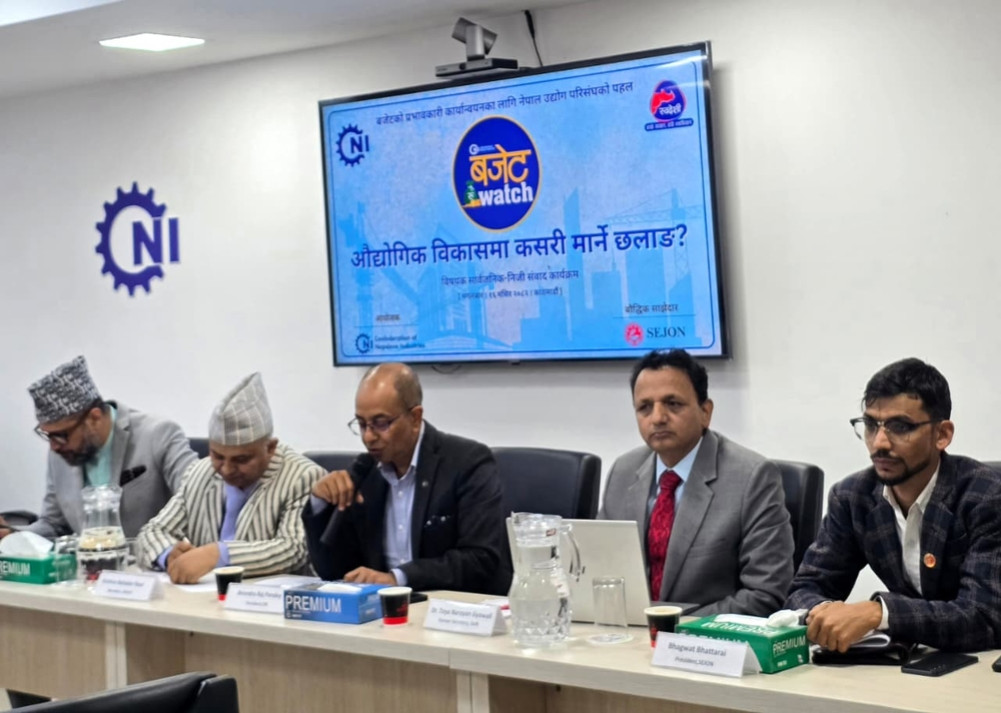
The public report, presented at the 'Budget Watch' program, a public-private sector dialogue organized by the Confederation of Nepalese Industries in collaboration with the Society of Economic Journalists of Nepal (SEJON), showed that overall progress was weak in the first quarter.
We use Google Cloud Translation Services. Google requires we provide the following disclaimer relating to use of this service:
This service may contain translations powered by Google. Google disclaims all warranties related to the translations, expressed or implied, including any warranties of accuracy, reliability, and any implied warranties of merchantability, fitness for a particular purpose, and noninfringement.
It has been found that only 2.4 percent of the 74 points related to the private sector in the budget for the fiscal year 2082/83 have been fully implemented.
The public report, organized by the Confederation of Nepalese Industries in collaboration with the Society of Economic Journalists of Nepal (SEJN) as a public-private sector dialogue, 'Budget Watch' program, showed that overall progress was weak until the first quarter.
The report pointed out that out of the 74 points related to the private sector and economy mentioned in the budget statement, 51 percent had zero progress, 46 percent had partial progress, and only 2.4 percent had full progress. By the first quarter of last year, 4.8 percent had been fully implemented, 38 percent had partial progress, and 57 percent had zero progress.
The budget for the current fiscal year included 74 points, including 27 in the industry sector, 14 in energy, infrastructure, and urban development, 9 in tourism, 8 in investment and financial sectors, 7 in agriculture and herbal medicine, 6 in information technology and innovation, and 3 in education and employment.
According to the report, out of the 74 points in the industry sector, 17 have made zero progress, 9 have made partial progress, and only 1 has made full progress. The report mentions that only two out of 14 points, namely energy, infrastructure and urban development, have been fully implemented.
The Confederation of Nepalese Industries, the leading organization of the country's manufacturing and service-oriented industries, has been playing a constructive role in the successful implementation of the government's plans and programs.
The government's fiscal policy is the most important for the development of the overall economy. Fiscal policy, that is, other policies should be supportive to achieve the goals specified in the budget, said Birendra Raj Pandey, President of the Confederation of Nepalese Industries.
'Successful implementation of the budget will increase capital expenditure, achieve the goals specified in the budget, and develop and expand the overall economy through policy reforms. Therefore, successful and effective implementation of the budget is very important,' he said, 'We have been giving policy suggestions from the private sector in the budget. Our policy suggestions are also included in the budget. That gives us encouragement. But when the implementation stage comes, the budget implementation is very weak, which disappoints us.'
He said that industrial development is indispensable for overall economic development. 'Effective implementation of the issues mentioned in the budget regarding industrial development is necessary. We should focus on industrial development and move forward by making policy reforms accordingly,' he said, 'That will help increase domestic production and replace imports. If domestic production cannot be increased, we cannot build a self-reliant economy.'
At a time when the world is competing in trade, our goal also needs to be clear. Only a self-reliant economy can achieve sustainable economic prosperity. Therefore, along with the effective implementation of the current fiscal year's budget, the goal of the upcoming budget also needs to be focused in the same direction, he said.
Countries with economies like ours have advanced much further than us today. It is important for our policymakers and regulatory bodies to understand why and how those countries were able to achieve progress. Chairman Pandey says that if the policy is stable, productive industries are protected, and industries are encouraged to be established, we can also move forward in a short time through industrialization.