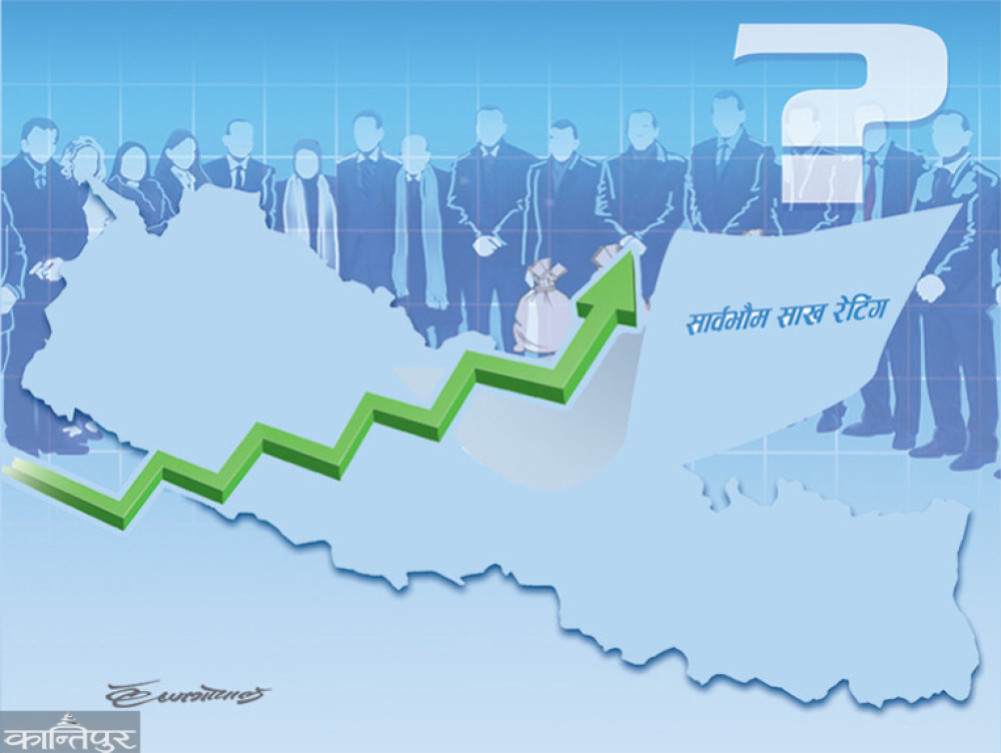
Although Nepal received the same rating as last year, Fitch has pointed out that reforms are urgently needed as government finances are very weak. It has been said that reforms in the economic structure are necessary due to low revenue collection and capital expenditure, and increasing political instability.
We use Google Cloud Translation Services. Google requires we provide the following disclaimer relating to use of this service:
This service may contain translations powered by Google. Google disclaims all warranties related to the translations, expressed or implied, including any warranties of accuracy, reliability, and any implied warranties of merchantability, fitness for a particular purpose, and noninfringement.
Nepal has received a 'BB minus' rating in the sovereign credit rating this year as well. This is the same as last year. It received a 'BB minus' rating for the first time on 7 Mangsir 2081. Receiving the same 'rating' for the second year also shows that the investment situation in the country is the same as last year.
Fitch, an international agency known worldwide for sovereign credit ratings, is rating Nepal. The Nepalese government had already selected the company for a two-year rating and technical assistance in the third year. The company has been rated for the second year under the same.
Although Nepal received the same rating as last year, Fitch has pointed out that reforms are urgently needed as government finances are very weak. It is said that reforms in the economic structure are necessary due to low revenue collection and capital expenditure, and increasing political instability. Fitch has stated that although Nepal's credit is stable, there are sufficient economic risk indicators that cannot be ignored.
Experts say that despite the increasing political instability in the country in recent months, lack of credit expansion, and accumulation of loanable funds in banks, getting the same rating as last year confirms that Nepal's investment environment among investors has not deteriorated further.
The Ministry of Finance claims that the maintenance of the same rating as last year, despite the socio-political challenges seen in recent months, rain-related natural disasters and global economic slowdown, has internationally reaffirmed Nepal's ability to meet its long-term obligations and confirms that macroeconomic stability is stable and strong.
'Despite the possibility of increasing election-focused spending and uncertainty, the government's fiscal discipline, reform in revenue management, appropriate spending priorities, commitment to holding elections on time and the policy of continuing strategic projects without interruption have strengthened the international community's confidence in Nepal,' said Tanka Prasad Pandey, spokesperson for the Ministry of Finance. 'This rating received by Nepal has given a clear indication that a stable and positive economic foundation is being prepared within the country.'
The 'rating' will help increase foreign investment in the country, expand cooperation with international development partners and maintain the necessary stable credit profile when Nepal issues its sovereign debt (sovereign debt-bonds) in the international financial market in the future, the ministry has stated. The ministry has stated that the stability of the ‘rating’ is a very important indicator for attracting long-term investment, especially in energy, infrastructure, tourism, agriculture and the digital economy.
Nepal has succeeded in achieving ‘BB minus’ this year as well due to the very strong external indicators of the economy and sufficient liquidity in the financial system, said Prakash Kumar Shrestha, former member of the National Planning Commission. ‘In broad terms, the external indicators of the economy (macro economy) are very strong. Liquidity has accumulated in the financial system due to continuously increasing remittances,’ he said, ‘That is why Nepal has achieved the same rating this year as last year. Although there is political instability in the country, there is a lack of good governance. But overall, the economy looks good.’
Former banker and chartered accountant Analraj Bhattarai said that it is very good for Nepal to get the ‘BB minus rating’ for the second year. "If it were not for the political instability, the Gen-G movement and the uncomfortable situation created by it in Nepal this year, the country would have received a higher rating than last year," he said. "Despite so many developments, it should be considered very good to get the same result as last year." He said that Nepal has not done anything that would deteriorate the economy and give a bad impression to the external sector, so this year too, the result has been the same as last year.
A statement issued by Fitch regarding the 'rating' result received by Nepal states that Nepal's debt repayment capacity is good. Nepal's internal and external debt burden is low, it is getting loans at concessional interest rates, and overall growth is improving from the hydropower sector, the statement said.
Fitch has pointed out that political uncertainty is increasing in Nepal and that instability will increase further if the current interim government fails to hold elections on 21 Falgun. The statement states that political uncertainty persists even though a new government was formed soon after the Gen-G movement on 23 and 24 Bhadra. Fitch emphasizes that Nepal's economy should be sensitive to external shocks, including natural disasters.
Fitch also stated that Nepal's external sector is in good shape due to the effective implementation of the Extended Credit Facility (ECF) program provided by the International Monetary Fund (IMF) to improve the balance of payments situation during the COVID-19 pandemic. However, Fitch also pointed to the risk of the economy slipping into further crisis due to increasing political instability. Fitch claims that the impact of aggressive credit expansion by banks and financial institutions in 2021 is still being seen in the financial sector.
Last week (18, 19 and 20 Kartik), a Fitch team came to Nepal for an on-site study for the sovereign credit assessment. The team interacted with representatives of the Ministry of Finance, Rastra Bank, Securities and Exchange Board of Nepal, Insurance Committee, private sector umbrella organizations, the World Bank, Asian Development Bank and IMF on the economy.
During the on-site assessment, discussions were also held with some private companies including Unilever, Nepal Infrastructure Development Bank, Standard Chartered Bank. The team's main concern was political instability. Nepali officials say they have repeatedly questioned where the country's situation will go if the election is not held on the scheduled date of 21 Falgun.
The Gen-G movement is demanding good governance, transparency, corruption prevention, and job creation, so the team expects the election to be held on time and the economy to move forward on the right path. Nepal has been praised by the international community for its ability to successfully manage crises such as the post-earthquake reconstruction and the COVID pandemic. Nepal has benefited from that this time as well.