Remittances have increased by 35.4 percent in the first three months of the current fiscal year compared to the same period of the previous fiscal year.
We use Google Cloud Translation Services. Google requires we provide the following disclaimer relating to use of this service:
This service may contain translations powered by Google. Google disclaims all warranties related to the translations, expressed or implied, including any warranties of accuracy, reliability, and any implied warranties of merchantability, fitness for a particular purpose, and noninfringement.
Remittances sent by Nepalis living abroad have set a record. In Asoj alone, remittances of Rs 21.22 billion have been received. This is the highest monthly amount ever. Previously, in Asajar 2082 alone, remittances of Rs 189.11 billion had been received.
According to the monthly report released by Nepal Rastra Bank on Sunday, remittances have increased by 35.4 percent in the first three months of the current fiscal year compared to the same period of the previous fiscal year.
Between Shrawan and Asoj, Rs 553.31 billion has been received through remittances. The inflow of remittances in the same period of the current fiscal year is 35.4 percent more than in the previous fiscal year. In the same period of the previous fiscal year, Rs 47.31 billion was received.
According to the Rastra Bank, remittance inflow in US dollars has increased by 29.2 percent to reach Rs 3.94 billion in the first three months. The inflow had increased by 10.6 percent in the previous year. In Shrawan of the current fiscal year, Rs 177.41 billion and Rs 174.67 billion were received in Bhadra. The positive impact on remittances has been seen due to the significant increase in the number of people going for foreign employment during the review period.
In the first three months of the current fiscal year, the number of Nepalis who received final labor permits (institutional and individual-new) for foreign employment was 123,459 and the number of those who received re-labor permits was 77,257. In the same period last year, such numbers were 110,654 and 59,939, respectively.
Dr. Prakash Kumar Shrestha, former member of the National Planning Commission, said that there has been a flood of liquidity in the country due to increasing remittance inflows, low domestic demand, and low consumption. ‘There is a flood of liquidity in the country, on the other hand, government expenditure has not been able to increase, while the private sector has not been able to invest,’ he said. ‘Even imports have not been able to be made according to foreign exchange reserves. The confidence of the private sector has decreased after the Gen-G movement.’
Shrestha said that remittances are increasing as the number of people going abroad for foreign employment is increasing. ‘More people have gone abroad. More remittances have come in. Consumption has decreased after more people left. Demand has decreased after consumption has decreased. "There is no need to invest more when demand is low," Shrestha said, "Why produce when there is no demand? Employment is not created. The number of people going for foreign employment has increased because of the lack of employment. A kind of cycle has been formed. This does not create a situation for the economy, domestic production and employment. The country's economy is in a 'downward cycle.'
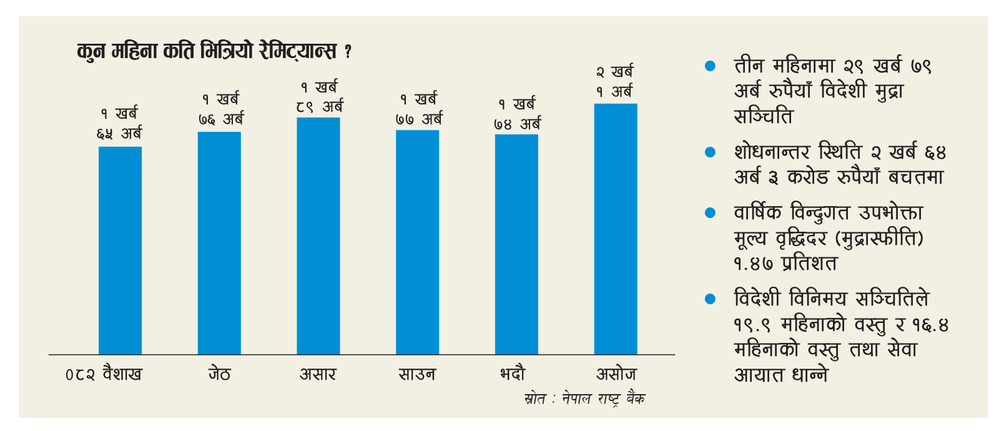
In the first three months of the current fiscal year, the balance of payments position has been seen in surplus by Rs 264.3 billion. While in the first three months of the last fiscal year, the balance of payments position was in surplus by Rs 184.99 billion. The balance of payments position indicates the difference between the amount leaving and entering the country. When the amount entering the country is more than leaving the country, the balance of payments goes into surplus. The Rastra Bank has stated that the balance of payments position in US dollars is in surplus by Rs 1.88 billion.
When the balance of payments position goes into surplus, it also has a positive effect on foreign exchange reserves. As exports have also increased along with remittances, the country has sufficient foreign exchange reserves. Foreign exchange reserves have been setting records for almost three years due to increasing remittances, high growth in exports despite increasing imports, and gradual improvement in tourism and other sectors. The National Bank has stated that foreign exchange reserves are worth 2979 billion rupees as of mid-July-August of the current fiscal year.
He said that various types of movements and political instability are further promoting this, saying that there is no chance of improvement soon. ‘There is one aspect of whether there will be an election or not, and how the political environment will progress. The private sector will probably remain in a wait-and-see situation,’ said Shrestha. ‘If there is an environment that can be predicted for four to five years, the private sector will have the capacity to invest. Interest rates are expected to be very low and there are also resources. While there is speculation about whether political stability will occur, unfortunately, we have reached a situation where we cannot expect or predict what will happen next. This does not seem to be a situation where investment will improve.’
Shrestha said that the economy is under pressure from liquidity. ‘Political changes, government changes, and movements were common, they did not affect the private sector much. But recent developments have ‘hit’ the private sector,’ he said, ‘Political instability is starting to affect the government’s capital expenditure. The current revolution has also further affected the private sector. That has created a difficult situation.’
Such reserves have increased by 11.3 percent in three months from Rs 2677 billion as of mid-Ashad. The country’s reserves in US dollars have increased by 8.7 percent compared to mid-Ashad to Rs 21.21 billion as of mid-Shrawan-Asoj. Of the total foreign exchange reserves, the reserves held by the Rastra Bank are worth Rs 2414 billion, while those held by banks and financial institutions (excluding Nepal Rastra Bank) are worth Rs 312.1 billion. The Rastra Bank has stated that the current foreign exchange reserves will be sufficient to cover 19.9 months of goods and 16.4 months of goods and services imports based on current imports.
Since the interim government came with an election 'mandate', the main issue is who will take responsibility even if the private sector invests, says Shrestha. 'The contract process for development and construction needs to be radically reformed. Can it be done or not? How much capital expenditure can the interim government make,' he said, 'The government and the private sector will use the liquidity that is available now. The government is interim.' He said that the private sector, which is under pressure from liquidity contraction after Covid, is being further affected while it is adjusting its 'balance sheet'.
'There are few immediate measures for reform. For this, all bodies should sit down and discuss and agree and start increasing the confidence of the private sector. We should be able to make commitments like on 24 Bhadra that there will be no impact on business.' Shrestha said that since there is a suitable situation for the private sector, we should be careful about liquidity flowing elsewhere again.
The annual point consumer price increase (inflation) rate in the last month of Asoj was 1.47 percent. In the same month of the previous year, such inflation was 4.82 percent. According to the monthly report of the National Bank, the inflation of the food and beverage group in Asoj was negative by 2.54 percent, while the inflation of the non-food and service group was 3.80 percent. In the same period of the previous year, the inflation of these groups was 7.20 percent and 3.49 percent, respectively, according to the National Bank.
The average inflation in the first quarter of the fiscal year 2082/83 is 1.67 percent. The average inflation in the same period of the previous year was 4.26 percent. During the review month, the annual point consumer price index of the ghee and oil sub-group under the food and beverage group increased by 7.75 percent, non-alcoholic beverages by 3.71 percent, and fish and meat by 3.15 percent. The annual point consumer price index of the vegetable sub-group decreased by 15.63, spices by 7.82, and pulses and legumes by 4.41 percent.

