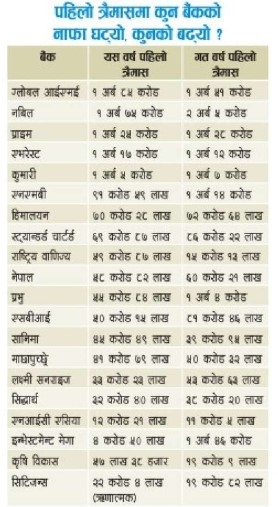
Four reasons for the decline in bank profits are political instability, floods and landslides, the fact that the quarter falls between Dashain and Tihar, and uncertainty about whether there will be more protests.
We use Google Cloud Translation Services. Google requires we provide the following disclaimer relating to use of this service:
This service may contain translations powered by Google. Google disclaims all warranties related to the translations, expressed or implied, including any warranties of accuracy, reliability, and any implied warranties of merchantability, fitness for a particular purpose, and noninfringement.
The direct impact of the difficult situation created by the Gen-G movement on 23 Bhadra and the protests on 24, and the loss of life and property caused by the incessant rains that have been falling for a few days since 18 Asoj, has been seen in the first quarter financial statements of banks and financial institutions.
Despite the increase in interest income of banks, net profit has decreased by 18 percent due to declining loan recovery and increased provision for bad loans, while bad loans have increased. Bankers say that some borrowers have not been able to make regular principal and interest payments due to the fact that the first quarter falls between the big festivals of Dashain and Tihar along with the protests and floods.
In the first quarter of the current fiscal year, 20 commercial banks have earned a total net profit of Rs 13.14 billion and 9.8 million. This is about 19.77 percent less than in the first quarter of the last fiscal year. In the first quarter of the last fiscal year, 20 commercial banks had earned a net profit of Rs 16.18 billion and 9.4 million.
According to Santosh Koirala, the president of the Nepal Bankers Association, bank profits have decreased significantly due to four main reasons. According to him, the loss of life and property in the first Gen-G movement and the political instability that followed, the second, the incessant rains and landslides that occurred for a few days from 18 Ashoja, the third, the mid-quarter movement between Dashain and Tihar, and the fourth, the expression that there will be another movement in Mangsir, the lack of interest rates, declining profits, and the increase in bad loans are the main reasons for the lack of interest, decline in profits, and the increase in bad loans.
Koirala informed that the demand for loans in banks has not increased since last Ashoja. ‘Borrowers have started paying principal and interest. But the demand for loans has stagnated,’ he said, ‘The uncertainty created in the country has prevented the demand for loans from increasing.’
In the first quarter, the profits of 14 commercial banks have decreased by 2 to 96 percent. One commercial bank has gone into loss. This means that the expenses of that bank in the first quarter were more than the income it earned. The bank that is making a loss in the first quarter is Citizens. Even in the current difficult situation, five banks - Everest, Global IME, NIC Asia, Rastriya Banijya and Sanima Bank - have increased their profits in the first quarter of this year compared to last year. The profits of Krishi Bikas Bank and Nepal Investment Bank have decreased by 96 percent. As the non-performing loans of banks have increased at a high rate, the profits have decreased significantly even though the provisions made for this have increased.
‘Profits have decreased as many borrowers have not been able to pay the principal and interest on loans for various reasons,’ said Siddhartha Bank CEO Sundar Prasad Kandel. ‘Due to the economic situation, borrowers had difficulty paying the interest for Ashar due to the situation in the economy. There were signs of general improvement in the principal and interest payments in Shrawan and Bhadau. However, the improvement could not continue due to the impact of the Gen-G movement in the last week of Bhadau and the floods in the second week of Asoj.’ He said that this is the reason for the decline in the profits of the banks.
The current fiscal year was expected to see an improvement in the economy at the beginning of the fiscal year due to the provisions made in the budget and monetary policy, the possibility of implementing the report of the High-Level Suggestion Commission for Economic Reforms under the chairmanship of Rameshwor Khanal, and other factors. If that had happened, it would have been expected that the credit flow of banks and financial institutions would increase and that the recovery of principal and interest would improve, but the expected improvement has not materialized, Kandel says. The profit has declined at a high rate as the provision amount that banks have to keep for non-performing loans has increased due to the failure to recover loans.
Net interest income, which is considered the main source of income of banks, has also increased by 7.51 percent in the first quarter. Earlier, such income of banks that had a net interest income of Rs 45.54 billion has reached Rs 49.17 billion. Of the 20 commercial banks in operation, the net interest income of Nabil, Standard Chartered, Nepal SBI, Machhapuchhre, NIC Asia and Nepal Investment Bank has decreased.
Although the profits of many banks declined in the first quarter, most commercial banks are in a position to distribute dividends this year from the earnings of the last fiscal year. On average, the dividend rate of banks this year is about 20 percent. But banks are not in a position to distribute dividends only from the profits of the first quarter of this year.
The average bad debt of banks has reached 4.86 percent in the first quarter. The bad debt of the same period of this year is higher compared to the first quarter of the last fiscal year. The average bad debt of banks in the first quarter of the last fiscal year was 4.04 percent. Looking at the bad debt by bank, Himalayan Bank has the highest 7.39 percent and Everest Bank has the lowest 0.74 percent. In the same period, the bad debt of 5 banks is more than 6 percent and the bad debt of 8 banks is more than 5 percent.
In the first quarter, the average deposit collection of banks has increased by 3 percent while the loan flow has increased by 6.39 percent. Due to problems in loan recovery, the National Bank had made arrangements for banks and financial institutions to include interest accrued up to 15 Kartik in their first quarter financial statements.
Due to the situation created after the Gen-G movement, many borrowers have not paid the principal and interest due by mid-Asoj. For this reason, the umbrella organizations of banks and financial institutions had demanded an extension of the time for interest recovery and publication of financial statements.
As per their request, the National Bank has made arrangements for interest accrued up to 15 Kartik to be included in the financial statements of the first quarter. Banks and financial institutions had been given an additional 7 days to publish their first quarter financial statements. Under normal circumstances, banks were required to publish their first quarter financial statements by 15 Kartik.