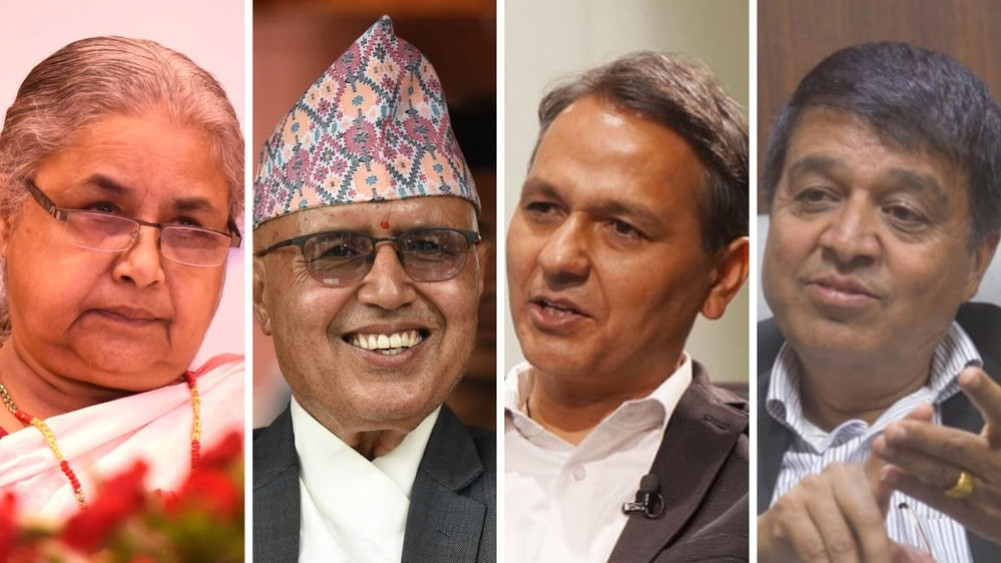
Stakeholders emphasized the need to chart a blueprint for Nepal and Nepali people respected in the world, based on equality, inclusion, and prosperity, through effective collaboration between the government and the private sector.
We use Google Cloud Translation Services. Google requires we provide the following disclaimer relating to use of this service:
This service may contain translations powered by Google. Google disclaims all warranties related to the translations, expressed or implied, including any warranties of accuracy, reliability, and any implied warranties of merchantability, fitness for a particular purpose, and noninfringement.
Stakeholders have said that the country's prosperity is possible only through effective collaboration between the government and the private sector. They say that effective collaboration between the government and the private sector is the only path to prosperity, as it is envisioned by the Constitution of Nepal and is also demanded by the current crisis.
In an interaction organized by the ‘National Economic Debate 2.0’ organized by the Federation of Nepalese Chambers of Commerce and Industry, they expressed the view that a blueprint for Nepal and Nepal that is respected in the world based on equality, inclusiveness and prosperity should be drawn through effective collaboration between the government and the private sector.
Prime Minister Sushila Karki said that economic prosperity, building a respected and civilized country is possible only through strong collaboration with the private sector. Prime Minister Karki said that since industrialists and businessmen are the giant stones of the foundation of economic prosperity, the tower of prosperity of the entire country rests on them.
‘Our statistics have repeatedly proven how significant and strong the contribution of the private sector to the development of the country is. "Whether it is in GDP, exports, job creation or as a taxpayer, the contribution of the private sector is always at the forefront," she said. "Various studies have shown that despite the strong foundation of our economy (remittances, natural resources, tourism), we are not getting the fruits of our hard work due to structural weaknesses and capital flight." Prime Minister Karki said that the government has accepted the reality that youth have been forced to leave the country due to lack of work, investment in industry has not increased, and the problem of banks not raising loans has created a kind of disappointment in the overall market. "We are busy preparing for the election of the House of Representatives on 21 Falgun. We are trying to create a suitable environment for that, raising hope that we can move the country forward in a sustainable democratic process through elections and that this is where it can be done," Karki said. "The private sector also has an important role to play in making the elections successful and fair." Prime Minister Karki also called on entrepreneurs, farmers and youth to move forward with confidence. "Various studies have indicated that our economic growth rate will increase and inflation will decrease, which shows that our efforts are in the right direction. We will unite to build a better tomorrow than yesterday," she said. "If we don't build our country, no one will come and build it for us."
She said that the movement of 23 and 24 Bhadra has given Nepal a new mandate. Now, she said, the general youth, the general Nepali have no choice but to take the country forward. Prime Minister Karki said that good governance is a prerequisite for social justice and economic growth in any country. She also said that she is aware of the looting of private and state property under political cover and the suspicious and exploitative distressing system imposed on the private sector.
She said that the government will leave no stone unturned to establish the rule of law. She said that the government is working with all its might to guarantee security. “Industrialists and businessmen not only pay taxes to the state, they also shoulder a huge responsibility of the state by providing employment and social security to a large number of people,” said Prime Minister Karki. “Therefore, a country cannot be built without industry and business. The economy cannot rise until the morale of industrialists is raised. Any business is irrigated with the dreams of entrepreneurs, investment from the financial sector, the skills of professionals and the sweat of workers, in which the role of society and the government is focused on creating a proper environment.”
Chandra Prasad Dhakal, President of the Federation of Nepalese Chambers of Commerce and Industry, said that it is necessary to break the negative narrative that nothing happens in the country. Investment can be made in Nepal. He also said that there are many investment opportunities, and that Nepal Development Public Limited (NDP) Company was established at the initiative of the federation with the involvement of members of the Confederation of Nepalese Industries, Chamber of Commerce and Non-Resident Nepali Association and other businessmen.
‘It will collect domestic capital scattered across the country and invest in large infrastructure projects,’ he said. ‘This will increase investor confidence and send a message that large projects can be undertaken through the mobilization of domestic capital.’
Chairman Dhakal also said that the country is standing at a crossroads of hope and doubt. He said that the government is trying to reduce corruption in the country and maintain good governance in line with the movement and demands of the young generation. He clarified that the private sector is also trying to revive itself by shaking off the ashes. ‘It is known that the private sector is attacked in every movement or demonstration. But the private sector has been hurt more this time than in previous movements. Entrepreneurs have invested by taking loans and making small changes,’ said Chairman Dhakal. ‘It has contributed to revenue. It has created employment opportunities. However, even the bedrooms of entrepreneurs have been looted. Business is on fire.'
Finance Minister Rameshwor Khanal said that the current government has started working from the first day to restore the private sector to its former state from the damage and impact of vandalism and arson. 'The government is holding discussions with the private sector,' he said.
Informing that tax administration services have been decentralized, he said that the government is committed to instilling confidence in the business community. 'The government is ready to provide services without causing any inconvenience to the business community,' said Finance Minister Khanal.
Home Minister Omprakash Aryal also said that the current government, which is working as the guardian of the common citizen, will address the concerns of the private sector. 'The country is now moving forward as a state of law, the government acts as a government of a state of law,' he said, 'The foundation of the economy should be strengthened, its organs should be protected, this is what the government is doing.'
Stating that the responsibility of saving the economy lies with the private sector, the Home Minister said that the government and the private sector should join hands in the prosperity of the country. ‘There was infiltration in the Gen-G movement, criminal elements caused damage, but the state has addressed it,’ he said, ‘380 people have been arrested, 150 people have been prosecuted, the government is providing full security to industrialists and businessmen.’
Minister for Industry, Commerce and Supplies Anil Kumar Sinha said that the current government is ready for policy-level facilitation. He said that the government has prioritized the work of removing legal obstacles necessary to facilitate industries. Nepal Rastra Bank Governor Bishwanath Poudel urged industrialists and businessmen to work with high morale. He said that the private sector should take the situation arising after the Gen-G movement as an opportunity and work with high morale.
Chief Secretary to the Government of Nepal Ek Narayan Chief Secretary Ek Narayan Aryal has emphasized the need to adopt a youth-centric economic strategy with development as the main mantra. Birendra Raj Pandey, president of the Confederation of Nepalese Industries, said that it will be difficult to create an investment environment unless peace and security are guaranteed, so the government should be sensitive to this. Surendra Shrestha, vice president of the Nepal Chamber of Commerce, said that the morale of industrialists and businessmen has been weakened due to the situation after the movement.