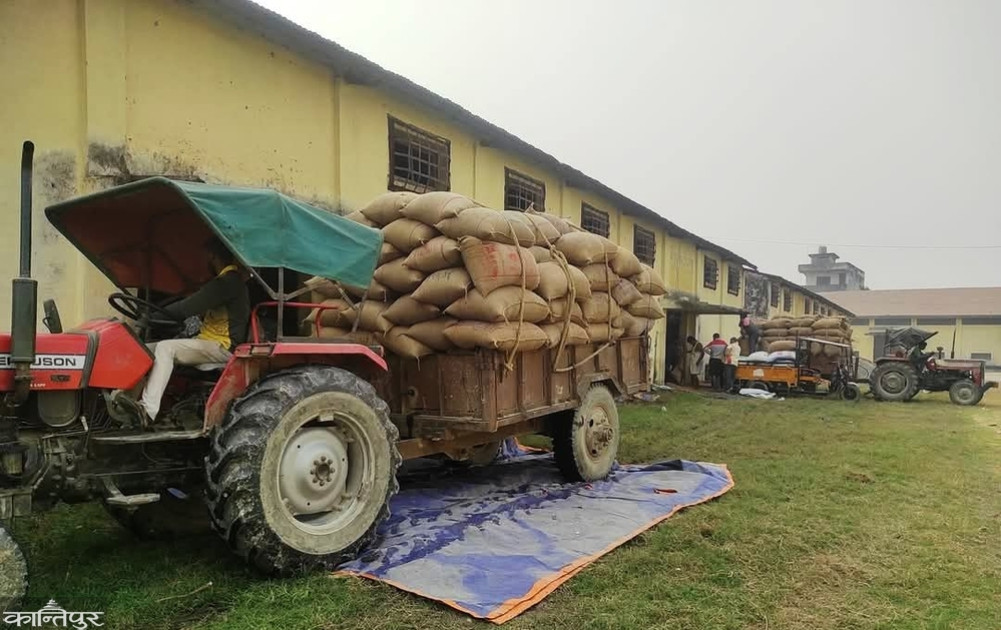
The Food Management and Trading Company Limited has stated that paddy procurement will begin only from the first week of Mangesh as some farmers have not been able to import their crops.
We use Google Cloud Translation Services. Google requires we provide the following disclaimer relating to use of this service:
This service may contain translations powered by Google. Google disclaims all warranties related to the translations, expressed or implied, including any warranties of accuracy, reliability, and any implied warranties of merchantability, fitness for a particular purpose, and noninfringement.
The Birgunj branch of the Food Management and Trading Company Limited is planning to purchase 10,000 quintals of rice in Birgunj this year.
According to the branch's information officer, Munilal Kushwaha, the branch has been given a quota to purchase 10,000 quintals of rice.
'In the first phase, a quota of 10,000 quintals of rice has been obtained,' he said, 'if more rice comes, the purchase quota may be increased.' He said that since it has been raining recently and some farmers have not been able to bring in their crops, there is a possibility that rice procurement will start only from the first week of Mangsir.
Kushwaha says that this year too, the branch plans to purchase Sona Mansuli and Jeera Masino rice. Since the support price of Sona Mansuli rice has been fixed by the federal government at Rs 3,628.33 per quintal, the branch will also purchase at the same price.
The purchase price of Jeera Masino rice will be determined by the local primary procurement committee headed by the Chief District Officer.
Last year, the branch had a quota of 42,000 quintals of rice. But after getting a good price from the private sector, the branch did not come to sell the targeted quantity of rice. Last year, the branch had a target of purchasing 32,000 quintals of Sona Mansuli and 10,000 quintals of Jeera Mañino paddy.
Usually, the private sector starts purchasing paddy in this region before the food department starts purchasing paddy. When the private sector pays a price higher than the government's support price, farmers prefer to sell paddy to the private sector rather than the food department.