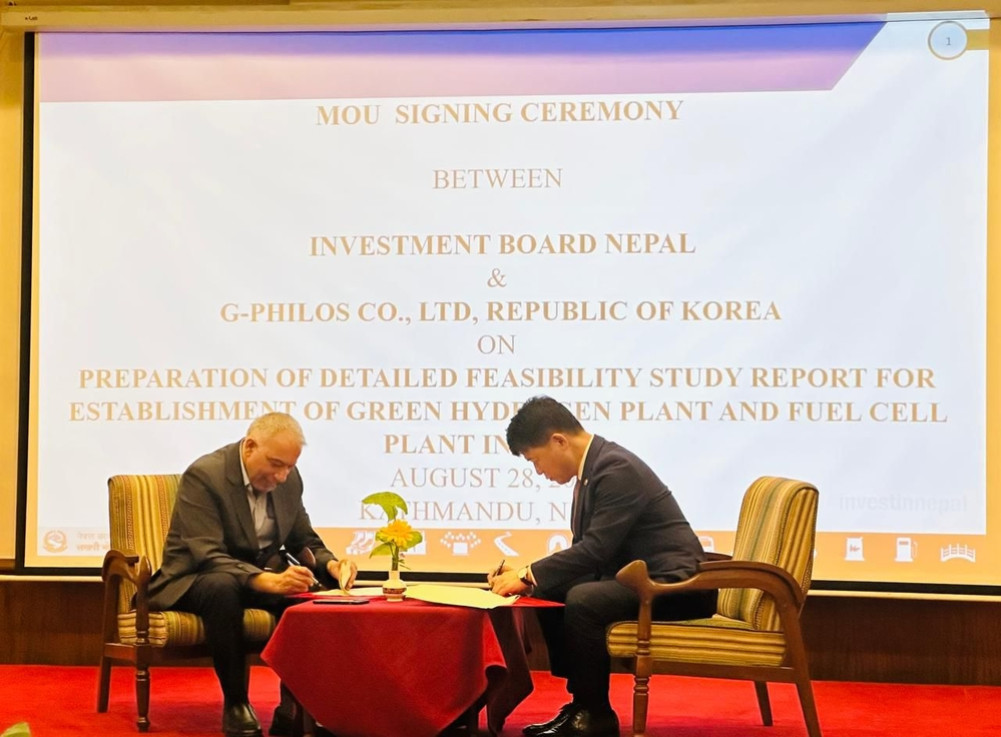
According to the agreement, G-Philos Company will prepare a detailed feasibility study report after receiving the survey permit from the Board of Investment and submit it to the office of the Board of Investment within 10 months.
We use Google Cloud Translation Services. Google requires we provide the following disclaimer relating to use of this service:
This service may contain translations powered by Google. Google disclaims all warranties related to the translations, expressed or implied, including any warranties of accuracy, reliability, and any implied warranties of merchantability, fitness for a particular purpose, and noninfringement.
An agreement has been reached between the Investment Board Office and the South Korean company G-Philos Company Limited regarding the preparation of a detailed feasibility study report for the establishment of a green hydrogen plant and fuel cell in Nepal. The MoU was signed by Chief Executive Officer Sushil Gyawali on behalf of the Board of Investment and Chief Executive Officer Gavu Park on behalf of the proponent company G-Philos Company Limited.
According to the agreement, after the proposal company G-Philos Company received the survey permit from the Board of Investment A detailed feasibility study report will be prepared and submitted to the Investment Board office within about 10 months.
According to the investment board, an estimated investment of 7 billion rupees will be required for the establishment of the project.
The company is proposed to produce 20 megawatts of green hydrogen in the initial phase. At the
event, Park Tae-yong, Ambassador of South Korea to Nepal, pointed out that there is a lot of potential for this kind of renewable clean energy in Nepal and said that such projects will prove to be a milestone in the achievement of the sustainable development goals that Nepal has reflected. He emphasized on adding a new dimension to the bilateral relations between Nepal and South Korea.
President of Electricity Regulatory Commission Ram Prasad Dhital said that some projects can be started in Nepal based on the study of G-Philos Company. "Green hydrogen production is expensive, this study also shows how much it costs," he said. Dhital said that the government has adopted a policy of energy mix and said that it will be easy and will help wherever it is needed.
Director General of Electricity Development Department Jeevach Mandal, Joint Secretary of Ministry of Energy, Water Resources and Irrigation Chiranjeevi Chatout, Executive Director of Nepal Electricity Authority Hitendradev Shakya were present.
Viraj Singh Thapa, a researcher at Kathmandu University, gave information about the current policy and legal system regarding green hydrogen in Nepal, its multifaceted benefits and the use of this type of energy in the future. Gyawali, chief executive officer of
board, said that the academic sector will also play an important role in the green hydrogen project and said that it will play an important role in the exchange of capital and technology in a country like Nepal. Saying that the proposing company will submit a quality report at the specified time, Gyawali promised to establish a green hydrogen plant in Nepal as soon as possible after the study.
G-Philos Company Limited submitted a proposal to the Investment Board office on 15 May 2082 for the establishment, development and operation of a green hydrogen and fuel cell plant in a public-private partnership framework in Nepal. The 63rd board meeting of the Board of Investment decided to agree with the proposed company and grant survey permission.