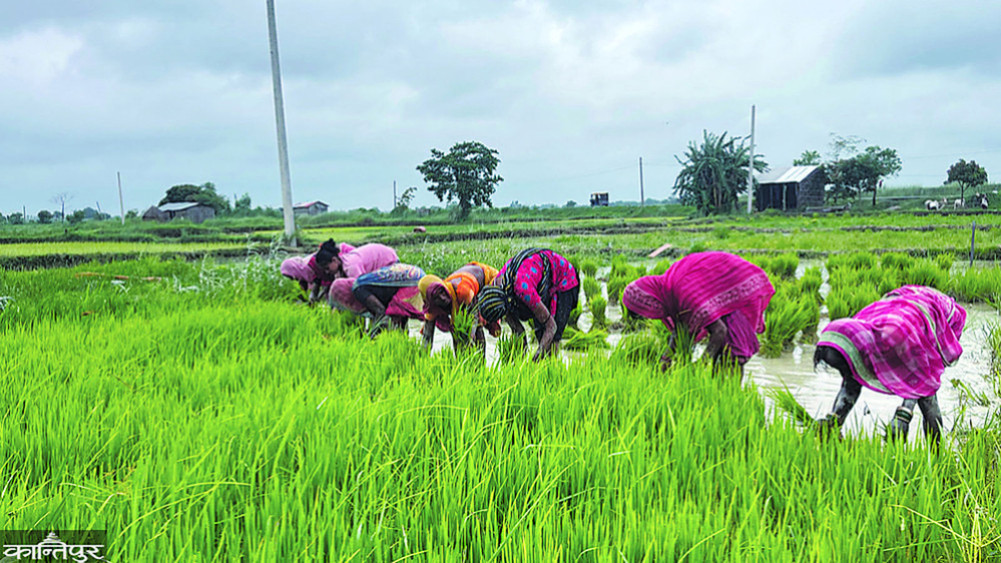
This year, because the monsoon was not active in all the districts, planting could not be done in 70 thousand 173 hectares of cultivable land. Last year till August 7, 98.54 percent planting was done.
We use Google Cloud Translation Services. Google requires we provide the following disclaimer relating to use of this service:
This service may contain translations powered by Google. Google disclaims all warranties related to the translations, expressed or implied, including any warranties of accuracy, reliability, and any implied warranties of merchantability, fitness for a particular purpose, and noninfringement.
As the monsoon is not active in all areas, only 94.9 percent planting has been done this year. Barkhe paddy is planted in 13 lakh 76 thousand 466 hectares across the country. According to the Center for Crop Development and Agricultural Biodiversity Conservation, only 1.3 lakh 6 thousand 293 hectares have been planted till August 8. Last year till August 7, 98.54 percent planting was done.
Keshav Devkota, head of the center, said that since the monsoon was not active in all districts this year, 70 thousand 173 hectares of cultivable land could not be planted. "Rice planting has been completed all over the country, compared to last year, the planting is less," he said, "The reason for less rice planting is the lack of irrigation." Planting has decreased this year due to lack of water.'
When planting in less hectares, the production decreases, even after the planting is done, the production seems to decrease due to the problem of drought: Sushil Subedi, rice scientist, Nepal Agricultural Research Council Sushil Subedi, rice scientist of Nepal Agricultural Research Council (NARC), said that rice production will decrease by at least 800,000 tons this year. In terms of productivity of 3.79 tons per hectare, about 265,000 tons will decrease due to lack of planting in 70,000 hectares. In most places the scattered seeds have been sown late. Drought caused problems even after planting," he said. "What kind of seeds have the farmers planted, local seeds or hybrids? It seemed to depend on that too. The condition of the stool also determines it. Even if it rains and floods again, it will affect the production. Looking at all this, the production will decrease by about 8 lakh tons this year.'
The officials of the Ministry of Agriculture also say that the production will decrease. But they say that it is not possible to say how much production will decrease immediately. Due to the drought, there was not enough planting. It was not even known what kind of seeds the farmer had planted. The situation of stool is also the same, they are not easily found. It will definitely affect the production' said a joint secretary of the ministry, 'most of the farmers have planted late, the production will decrease a lot. But it is difficult to confirm that it will decrease by that much.' According to the
center, the problem has been seen most in Madhesh province. Madhesh is also known as the capital of rice production. 370 thousand 145 hectares are planted in Madhesh. But this year only 86.35 percent planting has been done here.
Last year, 97 percent planting was done in Madhesh. Planting could not be done in Madhesh due to drought. After the recent rains, the farmers planted the seeds that had been covered. However, 100 percent planting did not happen.
According to the center, planting has also decreased in Koshi region. 276 thousand 386 hectares are planted in Koshi. This year only 97.24 percent planting has been done. By August 7, 2081, 100 percent planting was done in Koshi. The center is of the opinion that there is not 100% planting due to lack of water in Koshi as well. Similarly, 97.27 percent planting has been done in Bagmati province. Paddy is planted in 1 lakh 15 thousand 621 hectares in Bagmati. Of which only 1 lakh 12 thousand 459 hectares have been planted. Last year, 99 percent planting was done in Bagmati.
96.63 percent planting has been done in Gandaki. Barkhe paddy is planted in 94 thousand 182 hectares in Gandaki province. Last year, 98 percent planting was done in Gandaki. In Lumbini, 98.37 percent i.e. 298 thousand 11 hectares have been planted. Last year, 98 percent planting was done in Lumbini. In Karnali, planting has been done like 100 percent. According to the center, 41 thousand 42 hectares are planted in Karnali province. Till August 8, 99.34 percent planting has been done. Last year, 99 percent planting was done in Karnali.
Similarly, 99.72 percent i.e. 1 lakh 75 thousand 652 hectares have been planted in Far West. Last year, 100 percent planting was done in South West. Barkhe paddy is planted in 1 lakh 76 thousand 151 hectares in far. Experts say that when there is less planting in arable land, the production will decrease and the import of paddy/rice will increase.
In the last fiscal year 2081/82, 59 lakh 55 thousand 476 tons of rice was produced. Although this amount is 231 thousand 242 tons more than in the financial year 2080/81, 500,000 tons of rice (including seeds) worth 20.35 billion was imported in the last financial year. 241 thousand tons of rice (including rice) worth 18.66 billion was imported.