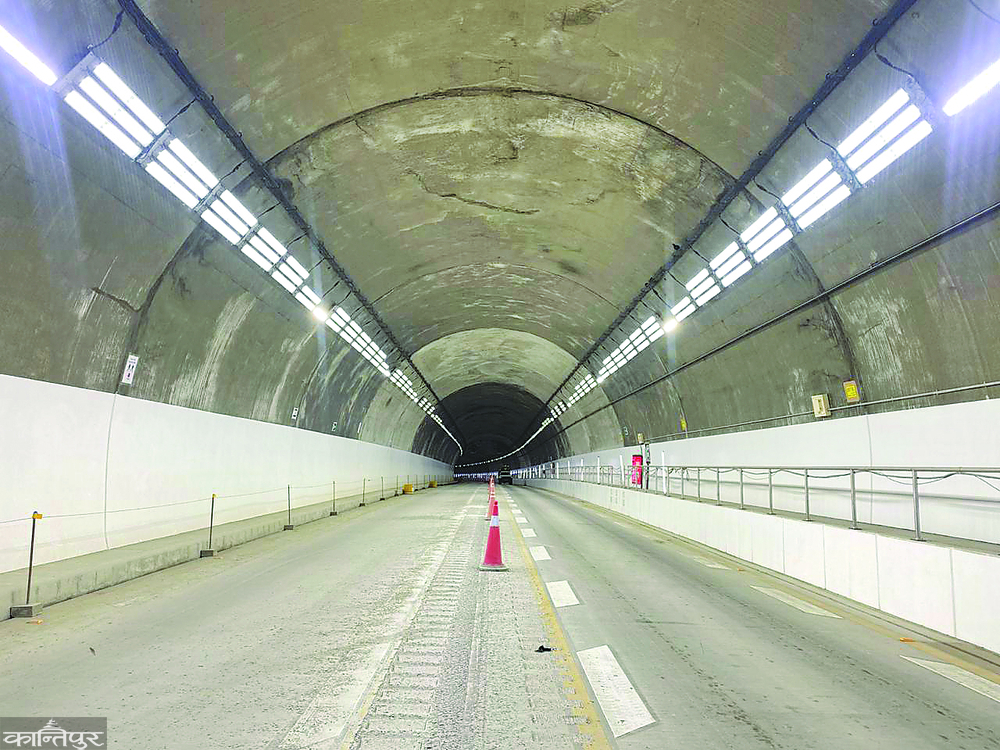
At present, the final stage of testing of equipment such as jet fans, CC cameras, lights, etc., are being carried out inside the tunnel.
We use Google Cloud Translation Services. Google requires we provide the following disclaimer relating to use of this service:
This service may contain translations powered by Google. Google disclaims all warranties related to the translations, expressed or implied, including any warranties of accuracy, reliability, and any implied warranties of merchantability, fitness for a particular purpose, and noninfringement.
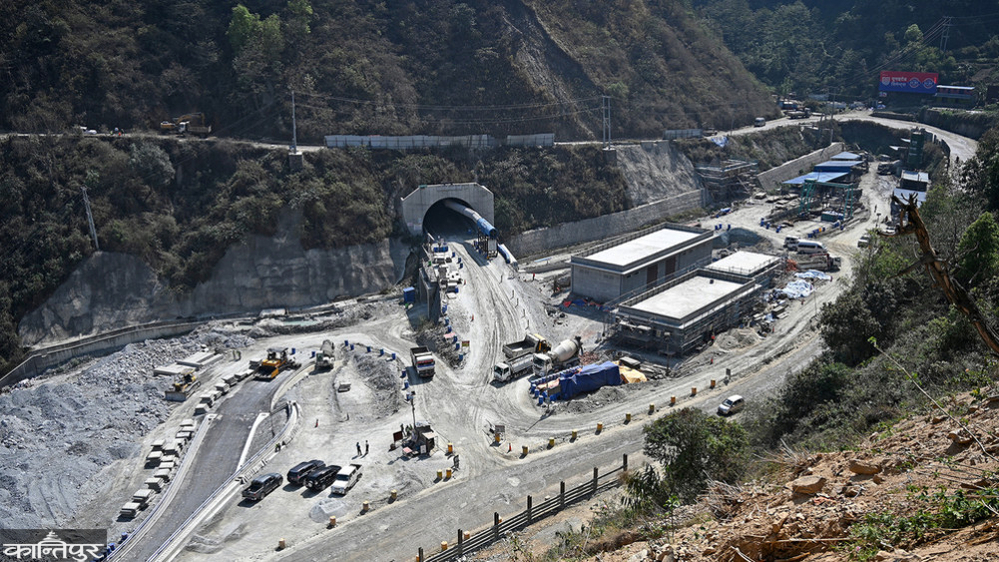
Nagadhunga-Sisne river tunnel will be operational from English New Year 2026. The construction work has reached the final stage, only the hill improvement work is left near the mouth of the tunnel towards Sisne river.
According to the head of Nagadhunga tunnel construction project, courtesy of Nepal, the guidelines for conducting traffic through the tunnel have been issued by the Department of Transport Management.
"There are preparations so far to put the tunnel into operation from the English New Year," Nepal said, "Before that, we will test the equipment connected inside the tunnel and drive vehicles on the physical structure built there." Nepal says that during that period, the manpower and the operating agency will be selected. "We are preparing to select the entity that will operate the tunnel," he said, "we will call for bids within 15 days."
Currently, the test work is being done in the final stage of equipment such as jet fans, CC cameras, lights, etc. connected inside the tunnel. "First, only parts were tested," said Nepal, "now all are being tested at once." He said that the landslide prevention work towards Dhading was stopped due to rain and will be started from the end of August. "The flyover construction work has also been completed on the Kathmandu side at Kisipdi," he said, "Now the road marking work is underway."
Tunnel tolls approved
The fee for vehicles using the tunnel has been approved by the Cabinet. It was approved by the cabinet meeting held on July 26 on the proposal of Road Board Nepal. Ganesh Bahadur KC, the executive director of Road Board Nepal, said that the fixed fee will not be changed for two years. According to the
proposal, cars and vans are charged Rs 65 when entering Kathmandu and Rs 60 when leaving. It is estimated that such vehicles will enter in the number of 859 and leave in the number of 646. Similarly, mini bus-trucks, tippers are charged Rs 150 when entering Kathmandu and Rs 80 when leaving. According to the project, these vehicles will enter the valley in the number of 540 and leave in the number of 406.
Buses, trucks will have to pay a toll of 260 rupees when entering Kathmandu through the tunnel and 200 rupees when exiting through this route. The project office estimates that 794 such vehicles will enter and 597 will exit. Big trucks and heavy vehicles (lorries) will have to pay a toll fee of 600 rupees when entering the valley through the tunnel and 250 rupees when exiting the valley. The project estimates that these vehicles will enter 596 and exit 448.
According to Vijay Jaisi, Director General of the Road Department, after the fee was initially submitted to the Council of Ministers, it was further reduced after discussions between the concerned agencies. He said that data has been extracted with an estimate that 60 percent of the vehicles passing through the main highway will use the tunnel. The head of the Nagadhunga tunnel construction project Nepal said that the fee will be applied only after the tunnel is operational.
Nagadhunga-Sisne River Tunnel Traffic Operation Guide, 2081 has already been released on March 25. According to the guidelines, pedestrians, two-wheelers, three-wheelers and non-motorized vehicles will not be allowed to enter the tunnel after the tunnel is operational. Vehicles carrying diesel, petrol, gas and other highly flammable substances and explosives will also be prohibited in the tunnel.
It is mentioned in the guidelines that vehicles larger than 18 meters in length or 2.5 meters in width cannot be driven inside the tunnel. Vehicles with loads exceeding the capacity specified by the Cargo Vehicle Load Regulation Guideline, 2074 and the Load Guideline issued by the Road Department and Transport Management Department are prohibited in the tunnel.
94.5 percent of the tunnel work has been completed
The construction of the tunnel project, which was started on November 4, 2076, has not been completed even after 69 months. So far, 94.5 percent of the construction progress of the overall project has been completed. Now only 5 and a half percent work is left.
The project claims that the completion of the project was delayed initially due to Covid and later due to local obstacles. According to the project, it will take 33 minutes to reach Balumbu from Sisne river via Nagadhunga road and 23 minutes from exit. But after the tunnel is operational, the project has said that the KCPD will reach Balambu from Sisne river within 7 minutes. The 2.307 km road from Balambu's Kisipdi to the entrance of the tunnel to Tutipakha has been constructed in two lanes.
The main tunnel is 2,688 meters long and the emergency tunnel is 2,557 meters long. The total contract amount of the project is 22 billion rupees. In which Japan has a concessional loan of 16 billion rupees and the government of Nepal has invested 6 billion rupees. The contract for the construction of the tunnel was taken by the Japanese company Hazma Endo Corporation. According to the road department, the daily traffic jams in Nagadhunga uphill will be reduced after the tunnel is operational.

